


You typed a word, paused, and asked yourself: should I write nonresponsive vs unresponsive? Both look correct. Both sound familiar. But which one actually fits your sentence? This guide answers that question once and for all.
Whether you are writing a medical report, a customer follow-up email, or a tech troubleshooting note, knowing the right word keeps your writing sharp, professional, and clear.
Quick Answer: Nonresponsive vs Unresponsive Explained Fast
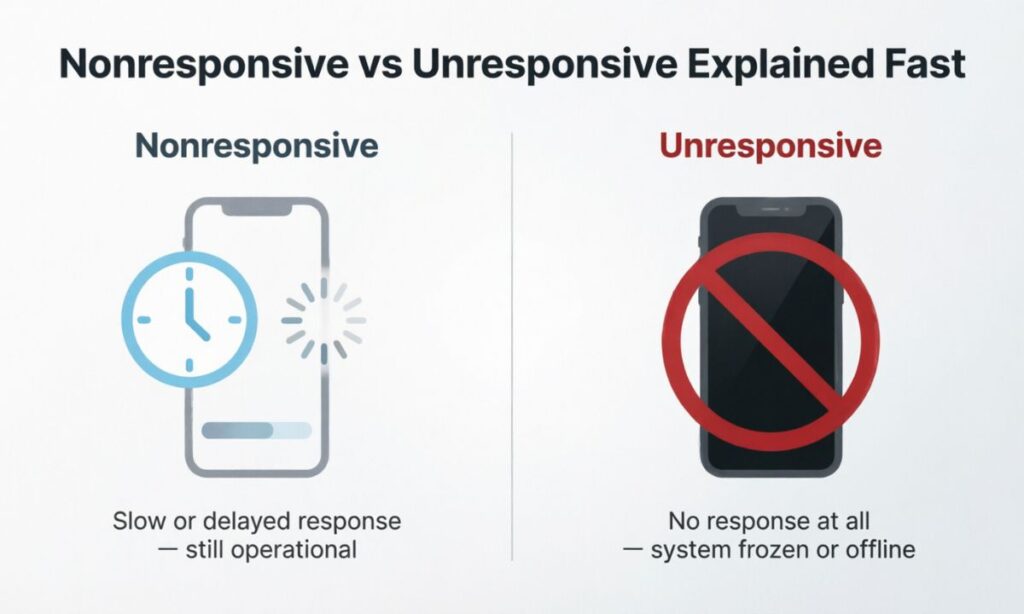
Both nonresponsive vs unresponsive are real, valid English words. They both describe a lack of reaction or reply. However, they are not always interchangeable. Unresponsive is the more common, natural word used in everyday speech, medical emergencies, and technology. Nonresponsive is more formal and typically appears in clinical documentation, research studies, and professional business communication.
Key Takeaway
Use unresponsive for general, medical, and emotional situations. Use nonresponsive in formal, technical, or procedural writing where a specific response was expected but not received.
Side-by-Side Comparison: Nonresponsive vs Unresponsive Meaning
| Feature | Unresponsive | Nonresponsive |
| Prefix | un (not, opposite of) | non (not, lacking) |
| Tone | Natural, conversational | Formal, technical |
| Medical Use | Emergency settings, patient care | Clinical trials, treatment response |
| Tech Use | Frozen devices, apps | System documentation |
| Business Use | Casual follow-ups | Formal reports, surveys |
| Frequency | Very common | Less common |
| Interchangeable? | Often yes | Sometimes, with care |
Read This: Giddy vs Gitty: Understanding Differences, Meanings, And Proper Usage
What Does “Unresponsive” Mean?
Core Meaning
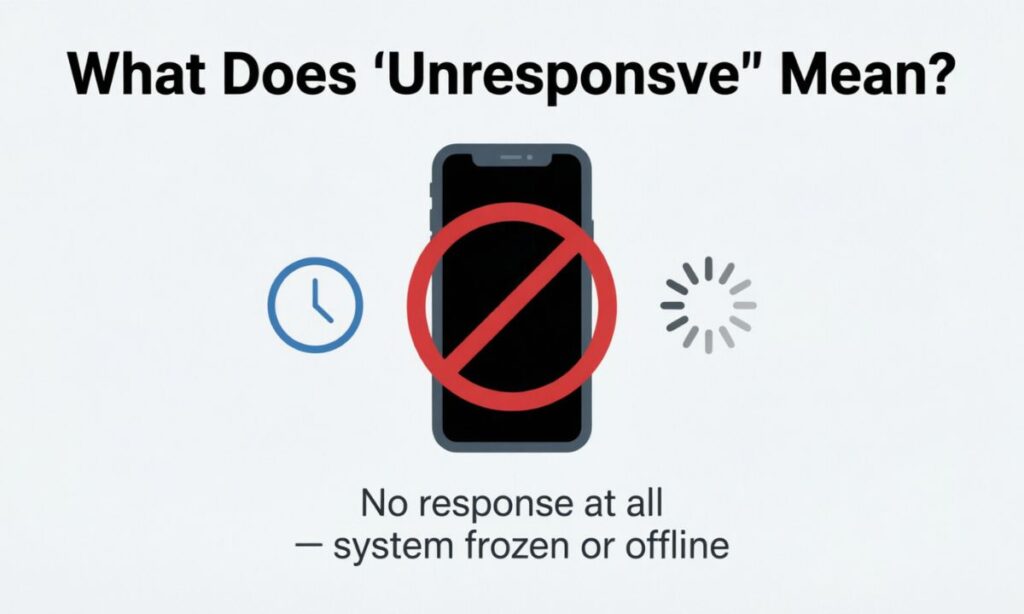
Unresponsive means not reacting or not replying to a stimulus, question, command, or interaction. It combines the prefix “un” (meaning not or opposite of) with the base word “responsive,” which traces back to the Latin responsivus, recorded around 1375 to 1425. The result is a word that signals a complete absence of reaction, whether physical, emotional, or digital.
When someone or something is unresponsive, it means they either cannot respond or they are choosing not to react to what is happening around them.
Common Uses of “Unresponsive”
Human Behavior
In everyday life, unresponsive describes a person who fails to react to communication or emotional cues. This can apply to someone who ignores messages, shows emotional detachment, or simply does not acknowledge what is being said.
Examples:
- “He remained unresponsive throughout the entire meeting.”
- “She was unresponsive to all feedback from the team.”
Medical Context
In medicine, calling a patient unresponsive carries serious weight. It means the person shows no reaction to external stimuli such as sound, touch, or pain. This term is used in emergency care settings and signals an urgent condition.
Example: “The paramedics reported the patient was unresponsive upon arrival.”
Technology
In the world of devices and software, unresponsive describes a screen, app, or system that has frozen and will not react to user input.
Example: “The app became unresponsive after the latest update.”
Why “Unresponsive” Dominates Everyday English
The prefix “un” is far more versatile in English than “non.” It attaches to adjectives, verbs, and nouns, making it feel more natural across different contexts. This is why nonresponsive vs unresponsive almost always tips in favor of unresponsive for general audiences. It flows better, feels less clinical, and is instantly understood by all readers.
What Does “Nonresponsive” Mean?
Core Meaning
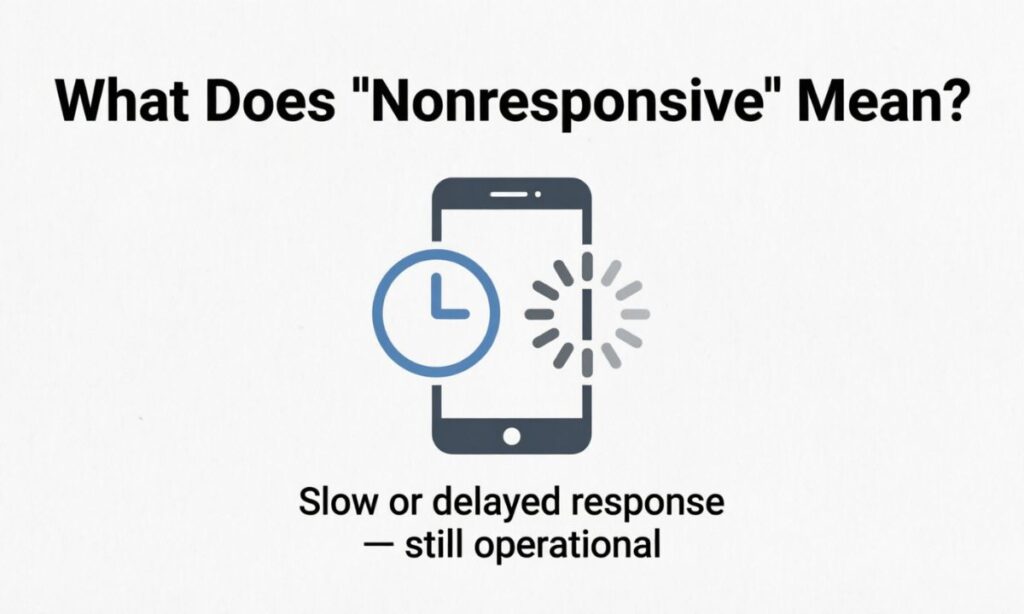
Nonresponsive means not giving a response, particularly in a situation where a response was expected. It combines the prefix “non” (meaning not or lacking) with “responsive.” The word signals that a specific type of reply or reaction was due, but it did not happen. This makes nonresponsive feel conditional and structured, which is why formal writing gravitates toward it.
Where “Nonresponsive” Is Commonly Used
Medical Documentation
In formal clinical settings, nonresponsive describes a patient who does not respond to a specific treatment or intervention. It is used in written records, not typically in verbal emergency communication.
Example: “The tumor remained nonresponsive to chemotherapy after two cycles.”
Research and Studies
In academic and scientific writing, nonresponsive is used to categorize data. Survey responses that do not answer the question, or study participants who do not react to a stimulus, are labeled nonresponsive for analytical accuracy.
Example: “Nonresponsive survey entries were excluded from the final dataset.”
Business and Surveys
In professional communication, nonresponsive describes clients, leads, or contacts who have not replied despite multiple outreach attempts. It adds a formal tone to a follow-up record.
Example: “Accounts marked as nonresponsive will be escalated to the senior team.”
Subtle Difference in Tone
The key tonal difference in nonresponsive vs unresponsive is this: unresponsive implies an inability to react, while nonresponsive implies a failure to reply under expected conditions. One is about capability; the other is about a missed expectation.
Nonresponsive vs Unresponsive: Key Differences That Matter
Tone and Natural Usage
Unresponsive sounds natural in nearly every sentence. Nonresponsive can sound stiff or overly technical in casual writing. If you are writing a text to a friend, an email to a client, or a social media caption, unresponsive is always the better pick.
Context-Based Difference
The difference in nonresponsive vs unresponsive sharpens when you look at context:
- In a medical emergency: “The patient is unresponsive.” (Verbal, urgent)
- In a clinical report: “The patient was nonresponsive to the administered treatment.” (Written, formal)
- In tech support chat: “Your screen appears unresponsive.” (User-friendly)
- In a technical incident report: “The system was nonresponsive to repeated API requests.” (Documentation)
Practical Rule
Think of it this way:
- Unresponsive = no reaction at all (broad use)
- Nonresponsive = no expected response given (formal use)
Nonresponsive vs Unresponsive in Different Contexts
Medical Context (Critical Distinction)
This is where nonresponsive vs unresponsive matters most. In emergency medicine, the two words are used in different ways, and mixing them can cause confusion.
Common Usage
| Situation | Correct Word | Example |
| Patient unconscious at scene | Unresponsive | “Patient is unresponsive to verbal stimuli.” |
| Patient not improving with treatment | Nonresponsive | “Patient is nonresponsive to antibiotics.” |
| ER verbal report | Unresponsive | “She was unresponsive when we arrived.” |
| Clinical trial documentation | Nonresponsive | “30% of subjects were nonresponsive to the drug.” |
Example Comparison
- “The child was unresponsive after the fall.” (Emergency, physical)
- “The child was nonresponsive to the pain management protocol.” (Clinical, treatment-based)
Why This Matters
Using unresponsive in an emergency is instantly clear to everyone. Using nonresponsive in a clinical report adds the specific meaning that a targeted intervention did not work. Getting this right in medical writing protects both the reader’s understanding and the accuracy of the record.
Technology and Devices
When it comes to devices, both words appear but unresponsive is far more common in user-facing content.
- “Your device is unresponsive. Please restart.” (User notification)
- “The server remained nonresponsive to all ping requests.” (Technical log)
Why?
Tech companies use unresponsive because it is clear and friendly for general users. Engineers writing internal documentation may prefer nonresponsive for its precision when describing a failure to meet an expected system response.
Communication and Everyday Writing
For emails, blog posts, articles, and social communication, unresponsive is the safe and natural default. Saying “the client has been unresponsive” sounds normal. Saying “the client has been nonresponsive” is not wrong, but it can feel overly stiff in informal writing.
Are Nonresponsive and Unresponsive Interchangeable?
When They Can Be Interchanged
Yes, in many contexts nonresponsive vs unresponsive are synonyms and either word works. If you are writing general content and simply want to say someone did not reply, both words carry the same meaning.
- “The team member was unresponsive to requests.” ✓
- “The team member was nonresponsive to requests.” ✓
When They Should NOT Be Swapped
Avoid swapping them when precision matters:
- In emergency medical reports: stick to unresponsive
- In clinical trial results: stick to nonresponsive
- In casual or everyday writing: always prefer unresponsive
- In formal technical documentation: nonresponsive is more appropriate
Example
Wrong in context: “The patient is nonresponsive” (shouted by paramedics in an emergency). Right: “The patient is unresponsive” (clear, urgent, instantly understood).
Wrong in context: “The drug was unresponsive in trials.” Right: “Patients were nonresponsive to the drug in trials.”
Nonresponsive vs Unresponsive vs Responsive
Quick Comparison Table
| Word | Prefix Meaning | Usage | Tone |
| Responsive | (none) | Reacts quickly and positively | Positive |
| Unresponsive | un (not) | Fails to react, broad use | Neutral/Urgent |
| Nonresponsive | non (lacking) | Fails to reply formally | Formal |
Insight
Responsive is the root word. Both unresponsive and nonresponsive are its opposites, just applied in different ways. When someone asks about nonresponsive vs unresponsive, the answer almost always connects back to which type of “not responding” you mean: inability or expectation failure.
Common Mistakes and How to Avoid Them
Mistake: Using “Nonresponsive” in Casual Writing
Many writers use nonresponsive thinking it sounds smarter or more professional. In casual writing, it actually sounds awkward. A simple rule: if you would say it out loud in a conversation, use unresponsive.
Mistake: Ignoring Context
The biggest error in nonresponsive vs unresponsive confusion is ignoring the context. A word that works in a research paper may not work in a patient care handoff. Always match the word to the setting.
Quick Fix Checklist
Before you choose between nonresponsive vs unresponsive, ask yourself:
- Is this a verbal or written communication?
- Is the situation urgent or formal?
- Am I describing an inability to react, or a failure to meet a response expectation?
- Is my audience a general reader or a technical/clinical professional?
- Does the sentence sound natural when I read it out loud?
Pronunciation and Spelling Guide
| Word | Pronunciation | Syllables |
| Unresponsive | un-reh-SPON-siv | 4 |
| Nonresponsive | non-reh-SPON-siv | 4 |
Both words follow the same stress pattern and share the same spelling rules in both American and British English. There is no regional difference in spelling between the two.
Tip
Neither word uses a hyphen. “Non-responsive” with a hyphen occasionally appears in older texts, but modern style guides recommend writing it as one word: nonresponsive.
Memory Tricks to Choose the Right Word
Easy Associations
- Think of U in Unresponsive as Universal use. It works almost everywhere.
- Think of N in Nonresponsive as Niche use. It belongs in specific, formal settings.
Quick Rule
UNresponsive = UNiversal (use it most of the time) NONresponsive = NON-standard setting (use it in formal/technical writing)
Real-World Examples That Make It Clear
Example 1: Medical Emergency
“When the firefighters entered the building, they found a man who was unresponsive on the floor. He showed no reaction to verbal commands or physical touch.”
Here, unresponsive is correct because the situation is urgent, physical, and immediate. No one in an emergency says “nonresponsive.”
2: Business Communication
“We have contacted the vendor three times over the past two weeks. The account has been marked nonresponsive and will be referred to our legal department.”
Here, nonresponsive fits perfectly. This is a formal record of a missed expected reply in a professional process.
3: Research Context
“Out of 200 participants, 48 were nonresponsive to the new treatment protocol and were moved to the control group for further observation.”
Nonresponsive signals a measured, documented failure to meet a study-defined response threshold.
Case Study: Tech Support Scenario
Situation
A software company is updating its user help documentation after receiving complaints that users found certain phrases confusing.
Issue
The original text read: “If the interface is nonresponsive, please close the application.”
Users reported the word “nonresponsive” felt unusual and confusing.
Improved Version
“If the interface is unresponsive, please close the application and reopen it.”
Result
After the change, user satisfaction scores with the help documentation improved. The word unresponsive felt natural, clear, and easy to understand for non-technical users. This real scenario shows how the nonresponsive vs unresponsive decision has direct impact on user experience and content quality.
Read This: Unaccessible or Inaccessible: Which Word Is Correct? Explained Clearly
Is “Nonresponsive” a Correct Word?
Yes. Nonresponsive is a fully correct, recognized English word. It appears in medical literature, academic journals, legal documents, and formal business writing. However, correctness does not always mean it is the right choice.
A word can be grammatically valid and still feel wrong in context. Nonresponsive is correct, but in most everyday situations, unresponsive is both correct and more appropriate.
Key Insight
Correctness is about grammar. Appropriateness is about context. In the nonresponsive vs unresponsive debate, both words pass the grammar test. The winner in any given sentence depends on your setting, audience, and purpose.
Reference Cambridge Dictionary Definitions
The Cambridge Dictionary defines unresponsive as: “not reacting in a quick or positive way to something” and “not reacting or moving.” This definition captures both its emotional and physical applications. The dictionary lists it as a C1 level word, meaning it is used at an upper-intermediate to advanced level of English.
Nonresponsive does not have its own standalone entry in Cambridge, but it is widely recognized across medical dictionaries, legal references, and academic databases. This reinforces the idea that unresponsive is the mainstream standard, while nonresponsive belongs to specialized domains.
Final Thoughts
The nonresponsive vs unresponsive question has a clear answer: both words are correct, but they serve different purposes. Unresponsive is your everyday go-to word for people, patients, emotions, and devices that fail to react. It is natural, widely understood, and appropriate for nearly every audience.
Nonresponsive is the specialist’s choice. It belongs in clinical reports, research papers, formal business documentation, and technical logs where a specific expected response did not occur.
When you compare nonresponsive vs unresponsive side by side, think about your context first. Who is your reader? How formal is your writing? Is the situation urgent or procedural? Answer those questions, and the right word will always become obvious.
As a final tip: when in doubt, use unresponsive. It is the safer, clearer, and more universally accepted choice in modern English.