
Do you ever stop mid-sentence wondering whether to write “emersion” or “immersion”? You are not alone. These two words look almost identical, sound nearly the same, yet carry completely opposite meanings. Getting them mixed up is one of the most common grammar mistakes in academic writing, language education, and scientific content.
This guide breaks down emersion vs immersion in simple, clear terms so you never confuse them again. Whether you are a student, a writer, or simply someone who wants to use precise language, understanding emersion vs immersion properly will sharpen your communication skills for good. By the time you finish reading, you will know exactly which word to use, when to use it, and why it matters.
Quick Answer: Emersion vs Immersion in One Simple Explanation
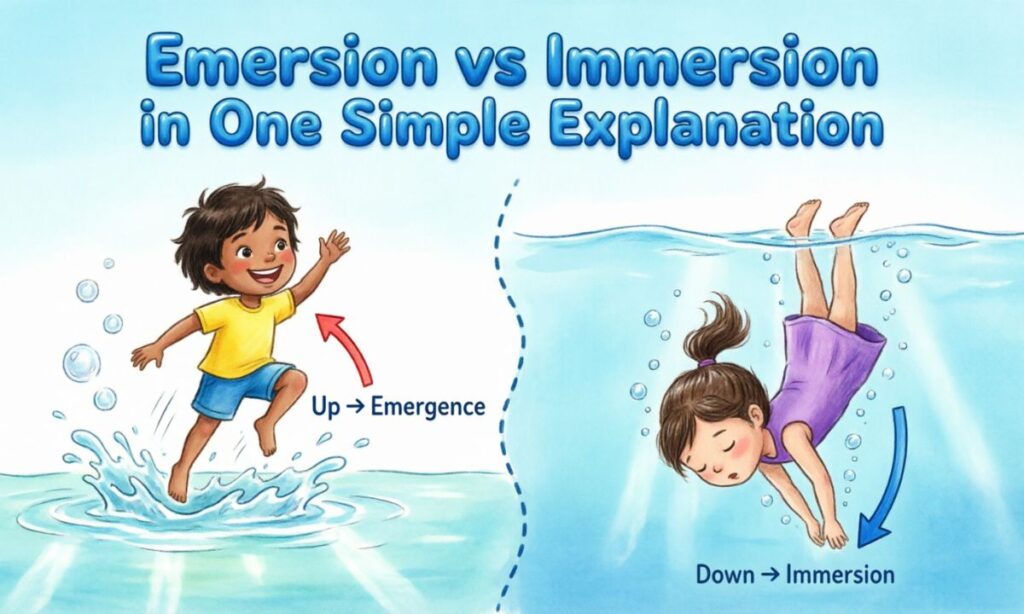
Emersion vs immersion comes down to direction. Immersion means going into something deeply. Emersion means coming out of something. One word goes in. The other comes out. That is the entire difference in a single sentence.
Simple Analogy
Picture a scuba diver. The moment the diver plunges beneath the ocean surface, that is immersion. The moment the diver resurfaces and breaks through the water back into the open air, that is emersion. Same diver, same ocean, two completely opposite actions.
Definitions: What Do Emersion and Immersion Mean?
Read This: Wise vs Wize: When To Use Each One? What To Consider
What Is Emersion?
Emersion is a noun that refers to the act of emerging or rising out of something. It describes the process of coming out from a submerged, hidden, or obscured state into visibility. The word comes from the Latin root “emersio,” meaning to bring out or rise up.
In everyday use, emersion can describe physical emergence from water or a metaphorical rise from difficulty, obscurity, or a deep state of focus. In astronomy, emersion has a very specific technical meaning: it describes the moment a celestial body reappears after being hidden during an eclipse or occultation.
Emersion is far less common in everyday speech than immersion. You will mostly encounter it in scientific, astronomical, or academic writing.
Example
The emersion of the moon from Earth’s shadow marked the end of the lunar eclipse.
What Is Immersion?
Immersion is a noun that refers to the state of being fully submerged in a liquid or deeply absorbed in an experience, environment, or activity. It comes from the Latin “immersionem,” meaning to plunge into.
Immersion is used in a wide range of contexts including language learning, technology, religion, education, and physical therapy. It carries both a literal meaning (placing something completely in water) and a metaphorical meaning (being totally focused or involved in something).
Example
Her complete immersion in the project meant she lost track of time for hours.
Emersion vs Immersion: Key Differences at a Glance
| Feature | Emersion | Immersion |
| Core Meaning | Coming out of something | Going into something |
| Direction | Outward / upward | Inward / downward |
| Latin Root | Emersio (to rise out) | Immersionem (to plunge in) |
| Frequency | Rare, mostly technical | Very common, everyday use |
| Common Contexts | Astronomy, biology, personal growth | Language learning, education, baptism, gaming |
| Antonym | Immersion | Emersion |
| Grammar Role | Noun | Noun |
The Core Concept: Direction Matters (In vs Out)
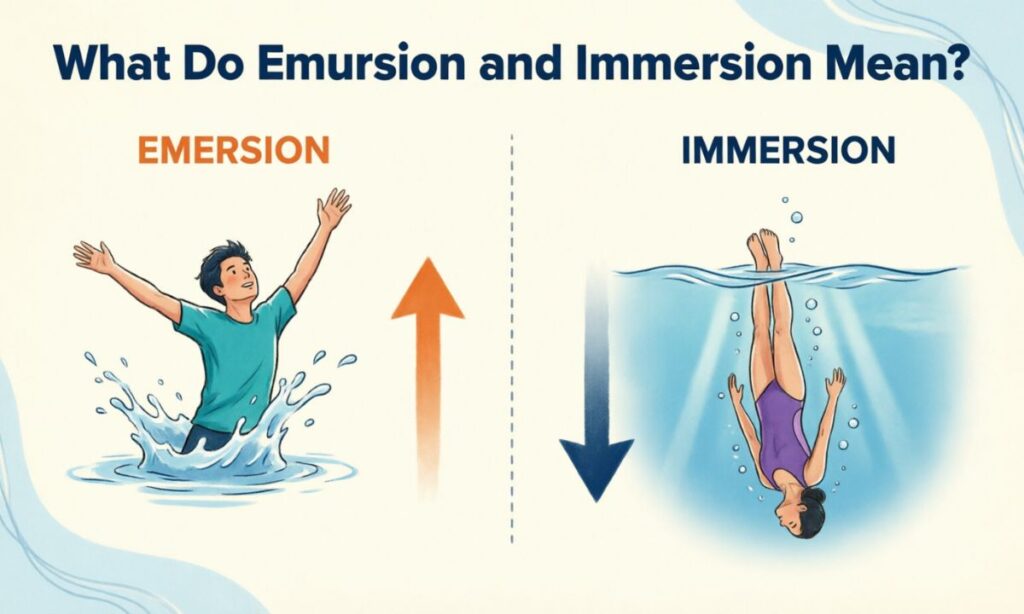
The single most important thing to remember about emersion vs immersion is that direction defines everything. These two words are true antonyms. They describe movements that go in completely opposite ways.
Immersion = going in Emersion = coming out
Once you internalize this one rule, the entire confusion disappears.
Visual Explanation
[ Surface ]
↓ IMMERSION (going under, diving in, submerging)
[ Beneath the Surface ]
↑ EMERSION (rising up, coming out, emerging)
[ Surface ]
Think of immersion as the entry point and emersion as the exit. You cannot have emersion without immersion first because you cannot come out of something you never went into.
Real-Life Examples That Make It Crystal Clear
Everyday Examples
Here are some simple real-life situations to help you picture each word:
Immersion examples:
- Placing a tea bag completely into hot water
- Getting so absorbed in a novel that you forget to eat
- Fully participating in a foreign culture while traveling abroad
- Wearing a virtual reality headset and entering a simulated world
Emersion examples:
- A whale breaking through the ocean surface
- A person stepping out of a meditation retreat after weeks of silence
- The sun appearing from behind dense cloud cover
- A student finishing an intensive study program and re-entering daily life
Science and Academic Examples
In science, emersion vs immersion appears with very precise technical definitions. Both terms are used in biology, environmental science, and astronomy. The distinction in emersion vs immersion science contexts is particularly important because using the wrong term can change the meaning of an observation entirely.
Example
In marine biology, intertidal organisms experience cycles of both states. During high tide, these organisms undergo immersion as they are covered by water. During low tide, they experience emersion as they become exposed to open air. Both phases matter for their survival.
Language Learning Context
One of the most popular modern uses of emersion vs immersion is in education, particularly language acquisition.
Immersion Learning
Language immersion refers to a teaching method where students are surrounded by the target language at all times. Instead of studying a language as a separate subject, learners use it as the medium of instruction for all subjects. French immersion schools in Canada are a well-known example of this approach.
Example
Students in a Spanish immersion program study math, science, and history entirely in Spanish, which accelerates fluency dramatically compared to traditional classroom methods.
How to Use Emersion and Immersion in Sentences?
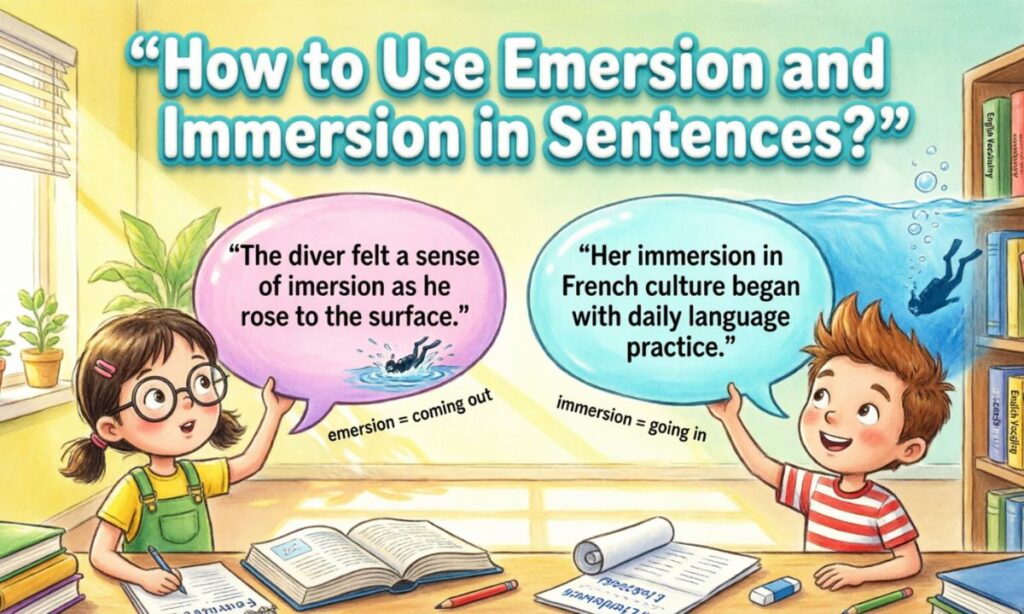
Using “Emersion” Correctly
Emersion is the correct word when you want to describe something rising out, reappearing, or coming back into view. It is a noun of action, so it often appears after verbs like “marked,” “signaled,” or “described.”
Examples
- The astronomer recorded the exact time of the star’s emersion from behind the moon.
- After years of financial hardship, her emersion from debt felt like breathing fresh air again.
- The emersion of the submarine above the waterline surprised nearby sailors.
- Scientists tracked the frog’s emersion from the pond as spring temperatures rose.
Using “Immersion” Correctly
Immersion is the right word when describing deep involvement, submersion, or total engagement in something. It works in both literal (physical) and figurative (mental or cultural) contexts.
Examples
- Total immersion in a new culture is the fastest way to learn its customs.
- Baptism by immersion requires the person to be fully placed under water.
- The immersion of the heating element in the water brings it to a boil quickly.
- His immersion in the research left no room for distractions.
Pronunciation and Spelling Differences
Pronunciation
Even though emersion vs immersion look similar on paper, they are distinct words with slightly different sounds:
- Immersion: ih-MUR-zhun (three syllables)
- Emersion: ih-MUR-zhun (three syllables, very similar sound)
Because they sound nearly identical in casual speech, context is what separates them when spoken aloud.
Common Mistakes
People frequently write “emmersion” which is not a real word. Others write “emersion” when they actually mean “immersion” simply because one letter difference is easy to miss.
Another mistake is using “immersion” to describe something coming out of water. That job belongs to “emersion.”
Quick Tip
Tie “imm” in immersion to the word “in.” Both start with the letter I and point inward. Tie “em” in emersion to “emerge.” Both begin with “em” and point outward.
Etymology and Word Origins (Why They Mean Opposites)
Latin Origins
Both emersion vs immersion share Latin ancestry, which is exactly why they look so similar. Latin was the dominant language of science and scholarship for centuries, and many English vocabulary words come directly from it.
- Immersion traces back to the 15th century Latin word “immersionem,” formed from “immergere,” which means to plunge or dip into.
- Emersion first appeared in English in the 1630s, derived from the Latin “emergere,” meaning to rise out or come forth.
Prefixes Matter
The prefixes are the key to understanding the entire difference:
- “Im” (or “in”) = into, within, inward
- “E” (or “ex”) = out of, from, outward
So immersion = “into” + “merge” = going into a merged state And emersion = “out” + “merge” = coming out of a merged state
This simple prefix logic applies to dozens of English word pairs, making it a powerful grammar rule to remember.
Common Mistakes and Misconceptions
Why People Confuse These Words
The confusion around emersion vs immersion is completely understandable for three main reasons:
- Both words look nearly identical with only one letter difference
- Both words sound almost the same when spoken quickly
- Both words relate to the concept of water or deep involvement
- The word “emersion” is so rarely used that many people have never seen it
Incorrect vs Correct Usage
| Incorrect | Correct |
| The diver’s immersion from the pool was graceful. | The diver’s emersion from the pool was graceful. |
| Emersion in a new language speeds up fluency. | Immersion in a new language speeds up fluency. |
| Cultural emersion helps travelers adapt quickly. | Cultural immersion helps travelers adapt quickly. |
| The moon’s immersion after the eclipse was beautiful. | The moon’s emersion after the eclipse was beautiful. |
Related Terms You Should Know
Understanding emersion vs immersion becomes even clearer when you know the related vocabulary that surrounds both words. Each term in the emersion vs immersion debate connects to a broader family of words:
- Submersion: Being completely covered by water, similar to immersion but often more physical
- Emergence: The process of coming into view or existence, closely related to emersion
- Immersive: An adjective describing something that creates deep engagement (an immersive experience)
- Submerge: The verb form of placing something under a liquid
- Emerge: The verb form of coming out of something, the action that leads to emersion
- Occultation: An astronomical event where one celestial body hides another, triggering both immersion and emersion phases
- Immersion heater: A device that heats liquid by being placed directly inside it
When Should You Use Each Word?
Use Immersion when:
- Describing someone diving into water or being submerged in liquid
- Talking about deep cultural or social engagement during travel
- Discussing language learning programs where students use only the target language
- Referring to baptism by full submersion in water
- Describing total mental absorption in a task, game, book, or project
- Writing about virtual reality or technology that creates fully engaging environments
- Using hydrotherapy or physical therapy involving water submersion
Use Emersion when:
- Describing a celestial body reappearing after an eclipse or occultation in astronomy
- Referring to a physical object or organism rising out of water
- Writing about someone emerging from a difficult period of life
- Discussing scientific contexts involving tidal zones and exposed organisms
- Describing the moment a submarine, creature, or person breaks the water surface
Emersion vs Immersion in Language Learning
What Is Immersion Learning?
In the world of education, immersion is one of the most researched and celebrated learning strategies. A language immersion program places students in an environment where the target language is the only means of communication. This approach removes the safety net of the native language and forces the brain to adapt quickly.
Why It Works
The human brain is wired to learn language through context, repetition, and necessity. When a learner is surrounded by a language at all times, the brain creates stronger neural connections to vocabulary and grammar patterns. Studies consistently show that immersion learners achieve higher fluency rates than students in traditional classroom settings.
Emersion, by contrast, represents the reflective phase after immersion ends. When a student finishes a language immersion program and re-enters their home environment, that transition back to the everyday world is a form of emersion.
Case Study
A Canadian student spends six months in Paris studying at a French-only university. Every lecture, every conversation, every grocery run happens in French. That experience is full immersion. When the student returns to Toronto and switches back to English daily life, the transition out of that intensive learning environment represents emersion. Both phases are important for language development.
Read This: Nonresponsive vs Unresponsive: Which One Is Correct?
Reference Cambridge Dictionary Definitions
For authoritative clarity on emersion vs immersion, the Cambridge Dictionary provides the following definitions. These definitions confirm that emersion vs immersion is a recognized and established distinction in formal English:
Immersion: “the act of putting something or someone into a liquid so it is completely covered, or the state of being put into a liquid in this way; the situation of being completely involved in something.”
Emersion: “the fact of something coming out of water or appearing after being hidden” and specifically in astronomy: “the reappearance of a star or other celestial body after being hidden by the moon or another planet.”
These definitions confirm that emersion vs immersion are clearly established as distinct terms in formal English, each with specific and opposite meanings.
Final Thoughts
Understanding emersion vs immersion is simpler than it seems once you focus on direction. Immersion goes in. Emersion comes out. Immersion means deep engagement, submersion, and full involvement. Emersion means rising out, reappearing, and emerging from a hidden or submerged state. Both words are valid, both words are useful, and now you know exactly when to use each one. Whenever the emersion vs immersion question pops into your head, return to this simple rule: in vs out.
The next time you write about language learning, scientific phenomena, or even personal growth, you will reach for the right word with complete confidence. Emersion vs immersion is no longer a source of confusion. It is a distinction you now own.