
Have you ever typed “ingage” and wondered if it was right? Or seen “ingage” somewhere online and thought it might be a new, accepted spelling? You are not alone. The confusion between ingage vs engage shows up constantly — in blog posts, social media captions, business emails, and even school papers.
Here is the short answer: engage is the correct word. Ingage is not a recognized word in standard English dictionaries. But the story does not end there. Understanding why this confusion happens, when “ingage” might appear legitimately, and how to always use “engage” correctly will make you a stronger, more confident writer.
This article breaks down everything you need to know about ingage vs engage — from definitions and sentence examples to common mistakes and practice exercises. Let’s get into it.
Ingage vs Engage: When To Use Each One? What To Consider
Before diving into definitions, it helps to know the bottom line upfront.
| Feature | Ingage | Engage |
| Standard dictionary word | ❌ No | ✅ Yes |
| Correct spelling | ❌ No | ✅ Yes |
| Accepted in formal writing | ❌ No | ✅ Yes |
| Used as a brand name | ✅ Sometimes | ✅ Yes |
| Historical/obsolete usage | ✅ Yes (archaic) | ✅ Yes |
| Appears in SEO/marketing | ✅ Occasionally | ✅ Yes |
When you are choosing between ingage vs engage, the decision is almost always simple — use “engage.” The only exceptions are brand names, rare archaic references, or very specific technical jargon used inside a niche field.
Define Ingage
Ingage is not a standard English word. It does not appear in major dictionaries like Merriam-Webster, Oxford, or Collins as a valid, modern term.
However, ingage does have two notable histories worth knowing:
1. Ingage as an Archaic Spelling
In Old and Middle English, “ingage” was occasionally used as an alternate spelling of “engage.” You can even find it in a 1705 text by Lady Damaris Masham and referenced in early dictionary works. The Oxford English Dictionary lists “ingage” as an obsolete variant — meaning it was once real, but no longer accepted today. Even John Milton used the spelling “ingaging” in Paradise Lost (1667). So if you see “ingage” in old literature, it is not a mistake — it is just a historical artifact.
2. Ingage in Modern Marketing and Branding
Some companies and content creators use “ingage” today as a way to describe a deeper level of involvement — a connection that goes beyond surface-level attention. In this informal marketing context, “ingaging” an audience suggests that customers are not just watching; they are actively participating and emotionally connected.
Some marketers also use “ingage” as a brand name — there are actual companies and software platforms called “Ingage.” In those cases, the word is a proper noun, not a spelling of “engage.”
Summary: Unless you are quoting old literature, using a specific brand name, or writing in a very niche creative/marketing context, never write “ingage” when you mean “engage.”
Define Engage
Engage is a real, fully accepted English verb with a rich history and a wide range of meanings. Here is what you need to know.
Etymology of Engage
The word “engage” comes from the Old French word engagier, which meant “to pledge” or “to bind by promise.” That French root itself comes from en- (in) + gage (a pledge or deposit). English speakers adopted the word in the 1520s, and over time its meaning expanded far beyond a simple pledge.
According to the Oxford Learner’s Dictionary, “engage” was formerly also spelled as “ingage” in Middle English — which is exactly how the archaic confusion was born.
Modern Meanings of Engage
The word “engage” carries many meanings in current English:
- To attract and hold attention: “The documentary engaged everyone in the room.”
- To participate or get involved: “She engages in community service every weekend.”
- To hire or employ: “They engaged a lawyer to handle the case.”
- To promise or commit: “He was engaged to marry her by summer.”
- To interact mechanically: “Engage the clutch before shifting gears.”
- To enter into conflict: “The troops engaged the enemy at dawn.”
This versatility makes “engage” one of the most useful verbs in the English language. It ranks among the 2,000 most commonly used words in modern written English, according to the Oxford English Dictionary.
How To Properly Use The Words In A Sentence?

Read This: Bachelor vs Batchelor: When to Opt for One Term Over Another
How To Use “Ingage” In A Sentence
Because ingage is not a standard word, your use of it should be extremely limited. Here are the only three situations where “ingage” might appear appropriately:
- Quoting historical text: “The original manuscript used the spelling ‘ingage’ to describe loyalty to the crown.”
- Referring to a brand name: “I use Ingage software to build interactive presentations.”
- In experimental creative writing: “The poet chose ‘ingage’ deliberately to evoke an archaic tone.”
In any other scenario, replace “ingage” with “engage” immediately.
How To Use “Engage” In A Sentence
“Engage” works across virtually every writing context — formal, casual, academic, business, and creative. It pairs naturally with prepositions like in, with, and by.
- “Please engage with the material before the exam.”
- “We need to engage in meaningful dialogue.”
- “She was engaged by the complexity of the puzzle.”
Common verb forms of engage:
- Present: engage / engages
- Past: engaged
- Present participle: engaging
- Past participle: engaged
More Examples Of Ingage & Engage Used In Sentences
Examples Of Using Ingage In A Sentence
These examples show “ingage” only in its historically or contextually appropriate settings:
- “Besides these two motives, could I need any other to ingage me in the defence of virtue?” (Lady Damaris Masham, 1705 — archaic usage)
- “The brand name Ingage helps sales teams create interactive content.”
- “In her experimental novel, the author deliberately used ‘ingage‘ to signal an 18th-century voice.”
Examples Of Using Engage In A Sentence
Here are natural, everyday examples showing how “engage” works in different tones and contexts:
- “The professor found a creative way to engage students during the online lecture.”
- “Our goal is to engage customers through personalized emails and targeted offers.”
- “She decided to engage a financial advisor before making any investment decisions.”
- “The charity campaign successfully managed to engage thousands of volunteers across the country.”
- “Always engage the parking brake on a steep hill.”
- “He engaged the audience from the moment he stepped on stage.”
- “The two nations agreed to engage in peaceful negotiations.”
- “The startup is working hard to engage younger users on social media platforms.”
- “The mechanic asked me to engage the clutch while he adjusted the gears.”
- “Teachers who engage students in hands-on activities often see better test results.”
Common Mistakes To Avoid: Engage vs Ingage
Understanding ingage vs engage also means knowing the mistakes writers fall into. Here are the three most common ones — and how to avoid each.
Mistake #1: Using “Ingage” Instead Of “Engage”
This is the most frequent error. Writers hear the word “engage” spoken aloud, notice the first vowel sounds like a short “i,” and guess the spelling from sound alone. The result is “ingage” — a phonetically logical but factually incorrect spelling.
Why this happens: English spelling follows history and etymology, not pure phonetic logic. Words like “energy,” “enough,” and “encourage” all begin with “en-” — and so does “engage.”
Memory trick: Think of the word “engine.” Both “engine” and “engage” begin with “en-.” If you can remember that, you will never write “ingage” again.
✅ Correct: “We need to engage the community.” ❌ Incorrect: “We need to ingage the community.”
Mistake #2: Using “Engage” In The Wrong Context
Even though “engage” is always the correct spelling, it can still be used in the wrong way. This usually happens when writers use “engage” when they actually mean “involve,” “participate,” or “interact.”
Example of misuse: ❌ “She engaged the door handle and walked inside.” ✅ “She turned the door handle and walked inside.”
The word “engage” works best when describing meaningful interaction, attention, involvement, or mechanical operation. Outside those contexts, a more precise synonym usually works better.
Mistake #3: Overusing “Engage”
Because “engage” is so flexible, writers sometimes lean on it too heavily. When every sentence says “engage your audience” or “engage with content,” the writing becomes flat and repetitive.
Better alternatives to mix in:
- Involve
- Connect
- Interact
- Participate
- Captivate
- Draw in
- Attract
- Collaborate
Using these synonyms alongside “engage” keeps your writing varied, natural, and more readable.
Context Matters: Ingage vs Engage Across Different Situations
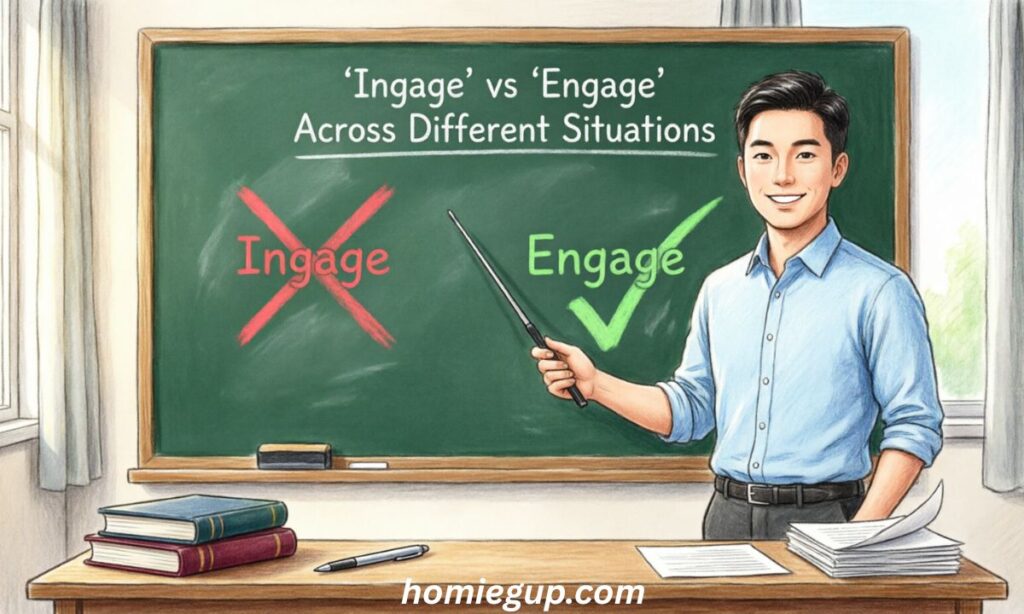
When discussing ingage vs engage, context plays a significant role. The right word — and how you use it — shifts depending on where your writing appears.
Examples Of Different Contexts
Marketing
In marketing, engage describes the process of capturing a potential customer’s attention and prompting action — a click, a sign-up, a purchase. It is the go-to word for social media strategy, content marketing, and digital advertising.
Example: “Our email campaign was designed to engage cold leads and move them down the funnel.”
Some marketers loosely use “ingage” to describe long-term relationship building — keeping existing customers emotionally connected to a brand. However, this is a niche, informal usage. In all professional copy and marketing materials, stick with engage.
Example of the nuance: A content plan might focus on engaging new visitors through SEO-driven blog posts, while simultaneously deepening loyalty among existing customers through personalized outreach.
Education
Teachers and educators use engage regularly to describe making lessons interactive, interesting, and student-driven.
Example: “The new curriculum was built to engage students through project-based learning.”
The deeper version — where a student becomes fully absorbed and intrinsically motivated — is sometimes described as “ingaged” in informal educational discussions. But in formal academic writing, papers, lesson plans, and reports, always use engage.
Business
In business settings, engage covers a lot of ground — from hiring professionals (“We engaged a consultant”) to motivating staff (“Employee engagement initiatives reduced turnover by 20%”) to entering into negotiations (“The two companies engaged in talks over the merger”).
The word “engage” is practically indispensable in corporate communication. Writers who substitute “ingage” in a business document will immediately signal carelessness or a lack of language proficiency.
Exceptions To The Rules
While engage is almost always the right choice in any ingage vs engage situation, there are a small number of exceptions worth noting.
Technical Terminology
In certain software development, engineering, or system design environments, “ingage” might appear as a proprietary term, function name, or platform-specific command. If a technical manual, API documentation, or company-specific guide uses “ingage” in a defined technical sense, it should be used exactly as documented — even if it differs from standard spelling.
Regional Differences
Unlike words such as “colour” vs. “color” or “organise” vs. “organize,” engage does not vary between British English and American English. Both regions use “engage” identically. The confusion around ingage vs engage is not a dialect issue — it is purely a phonetic spelling error.
Creative Writing
Literary fiction, poetry, and experimental prose sometimes bend grammar and spelling deliberately to create a specific effect, voice, or historical authenticity. A historical novelist writing in the voice of an 18th-century narrator might legitimately use “ingage” to deepen the period feel. This is a conscious, intentional choice — not a mistake.
Brand Names
Several companies use “Ingage” as a proper brand name — including presentation software platforms and customer experience tools. When referring to these brands, “Ingage” should be capitalized and treated as a proper noun, not as an alternate spelling of the verb “engage.”
Read This: Sponser or Sponsor: Which Spelling Is Actually Correct?
Practice Exercises
Put your knowledge of ingage vs engage to the test with these exercises.
Exercise 1: Fill In The Blank
Choose “ingage” or “engage” to complete each sentence correctly.
- The school hired a specialist to ________ students with learning disabilities.
- The author wrote “to ________ me in the defense of virtue” in her 1705 essay.
- We must find better ways to ________ remote workers during virtual meetings.
- The software platform called ________ helps sales teams deliver interactive presentations.
- It is essential to ________ with your audience before pitching your product.
- She wants to ________ in volunteer work this coming summer.
- Historians noted that Milton used the word “in-” spelled as “________ ing” in Paradise Lost.
- The clutch failed to ________ properly, causing the vehicle to stall.
Answers:
- engage | 2. ingage (archaic quote) | 3. engage | 4. Ingage (brand name) | 5. engage | 6. engage | 7. ingage (historical) | 8. engage
Exercise 2: Sentence Rewrites
Each sentence below contains an error related to ingage vs engage. Rewrite each one correctly.
- ❌ “The campaign manager decided to ingage voters through door-to-door outreach.” ✅ “The campaign manager decided to engage voters through door-to-door outreach.”
- ❌ “It is hard to ingage teenagers in meaningful conversation these days.” ✅ “It is hard to engage teenagers in meaningful conversation these days.”
- ❌ “The soldiers were ordered to ingage the opposing forces at sunrise.” ✅ “The soldiers were ordered to engage the opposing forces at sunrise.”
- ❌ “Our brand needs to ingage more actively on Instagram and TikTok.” ✅ “Our brand needs to engage more actively on Instagram and TikTok.”
- ❌ “She was ingage’d to be married before she turned twenty-five.” ✅ “She was engaged to be married before she turned twenty-five.”
Frequently Asked Questions
Is “ingage” a real word?
No. “Ingage” is not recognized in modern dictionaries. It is either a misspelling of “engage” or an obsolete archaic spelling from centuries ago.
Which spelling is correct — ingage or engage?
“Engage” is always the correct spelling in standard modern English.
Why do so many people spell it “ingage”?
Because the first vowel in “engage” sounds like a short “i” when spoken quickly, leading writers to spell it phonetically.
Can “ingage” and “engage” ever be used interchangeably?
No. Only “engage” is valid in standard writing. “Ingage” only appears appropriately in historical quotes or brand name contexts.
Is there a difference between British and American English for this word?
No. Both use “engage” identically. There is no regional variation.
What are good synonyms for “engage”?
Involve, interact, connect, attract, participate, captivate, employ, absorb, and collaborate.
Does “ingage” appear in any famous literature?
Yes — in archaic form. John Milton used “ingaging” in Paradise Lost (1667), and Lady Damaris Masham used “ingage” in 1705.
Is “Ingage” a company name?
Yes. Several companies use “Ingage” as a brand name for software products, particularly in the sales enablement and presentation technology space.
Final Thoughts
The debate around ingage vs engage comes down to one clear verdict: use “engage” every single time — unless you are quoting historical text, referencing a brand name, or working in a creative writing context that deliberately calls for the archaic spelling.
“Engage” is one of the most versatile, widely used, and clearly defined verbs in the English language. It covers everything from hiring a professional and operating machinery to building a relationship and entering into battle. Its etymology stretches back to Old French, and its usage spans every domain of modern writing.
“Ingage,” on the other hand, is either a spelling mistake or a ghost from centuries past. Knowing the difference makes your writing cleaner, more professional, and more trustworthy.
The next time your fingers start to type “i-n-g-a-g-e,” pause, remember the word “engine,” and write “engage” instead. Your readers — and your spellchecker — will thank you.