
One small thumb position can be the difference between a powerful, safe punch and a fractured hand. If you have ever stood in front of a heavy bag, squared up in a sparring session, or simply wondered how to form a proper fist, the question of thumb in or thumb out probably crossed your mind. It seems minor.
It is not. Every boxing coach, MMA trainer, martial arts instructor, and sports medicine expert agrees on this point with zero ambiguity. Getting thumb in or thumb out wrong does not just ruin your technique. It puts one of the most important structures in your hand directly in the path of impact force. This guide covers everything you need to know, with real examples, anatomy, expert consensus, and practical steps you can use today.
Thumb In or Thumb Out — Why Thumb Placement Really Matters
Most beginners focus on stance, footwork, and power when learning to punch. Thumb placement gets ignored until something snaps. The thumb is the most independently mobile finger on the human hand. It has its own dedicated set of muscles, tendons, and ligaments.
When you place it in the wrong position and then apply impact force, those structures absorb stress they were never designed to handle. The question of thumb in or thumb out directly determines whether that stress is distributed safely or concentrated dangerously on the thumb’s smallest bones and joints.
The metacarpophalangeal joint at the base of the thumb, commonly called the MCP joint, is especially vulnerable. The ulnar collateral ligament that stabilizes this joint can suffer partial or full tears when the thumb is caught in a bad position under impact. These injuries are so common in boxing that they have their own clinical names: Boxer’s Thumb, Skier’s Thumb, and Gamekeeper’s Thumb. All three refer to damage caused, at least in part, by improper thumb alignment during a strike. Understanding thumb in or thumb out is not optional knowledge. It is foundational safety.
Quick Answer: Thumb In or Thumb Out?
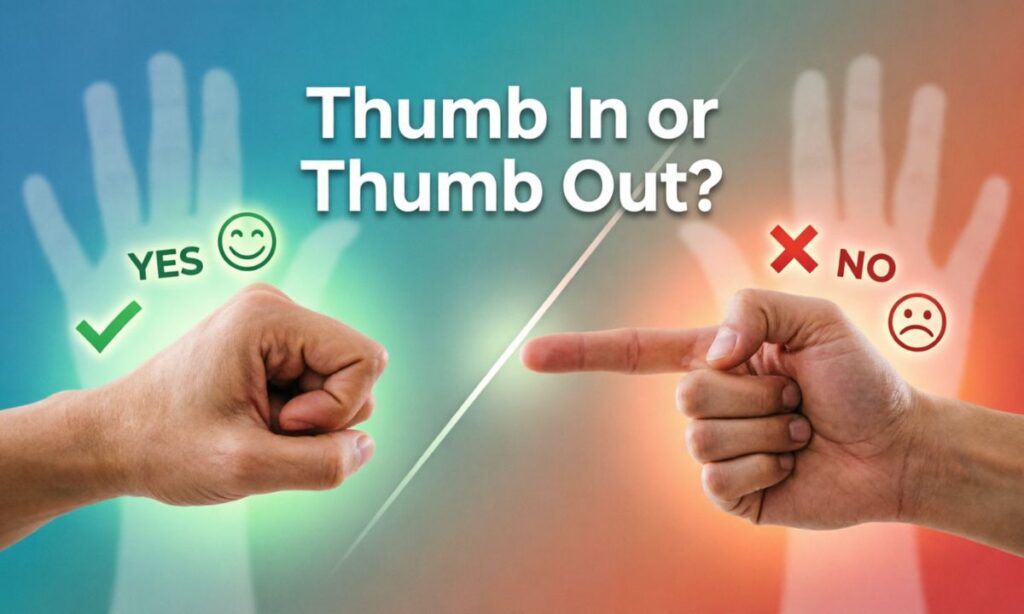
For punching, striking, and any impact-based hand motion, always keep your thumb out. This means your thumb rests alongside and over your curled fingers, positioned safely on the outside of the fist. Never tuck your thumb inside your curled fingers before or during a punch.
The answer to thumb in or thumb out is this: thumb out, every time, in every combat or striking context. This consensus comes from every credible martial arts discipline, sports medicine practice, and combat sports training system on the planet.
Understanding What “Thumb In” Actually Means
Read This: Complaint or Complain: What’s the Real Difference? (2026)
“Thumb in” describes the position where the thumb is tucked or hidden inside the closed fist, under the curled fingers. Some beginners do this instinctively because it feels tight and secure. In reality, it traps the thumb in the most dangerous possible location. When the fist makes contact with a target, the force travels through the knuckles and into the hand. If the thumb is inside the fingers, it becomes a compression point between your own fingers and the target. The smallest bones in your hand get crushed between two hard surfaces with nowhere to go.
Doctors who treat hand injuries report seeing this pattern repeatedly after street altercations, beginner boxing sessions, and emotional outbursts where someone punches a wall or door. The question of thumb in or thumb out ends badly for everyone who chooses thumb in without understanding the consequences.
Understanding What “Thumb Out” Actually Means
“Thumb out” means the thumb is placed alongside the outside of the fist, resting on top of or against the index and middle fingers without being tucked underneath them. It sits in a natural, supported position. The thumb acts as a stabilizer rather than a passenger.
When a properly formed fist lands on a target, force passes through the index and middle knuckles along the aligned bones of the hand and forearm. The thumb stays out of that force path entirely. It contributes to grip stability without absorbing the strike’s energy.
This is the position every coach teaches from day one. The answer to thumb in or thumb out is embedded in the first lesson of every boxing gym, dojo, and self-defense class in the world.
Thumb In or Thumb Out When Making a Fist?
Forming a safe fist requires a specific sequence:
- Start with a relaxed, open hand.
- Curl your four fingers tightly toward your palm, starting from the fingertips.
- Press your fingertips firmly against the upper palm.
- Place your thumb on the outside, pressing it down across the front of your index and middle fingers.
- Squeeze the fist firmly but not to the point of cramping.
At no point does the thumb go under or inside the curl of the fingers. When the fist is complete, the thumb should be visible on the outside, held firmly against the finger joints. This is the definitive answer to thumb in or thumb out when making a fist.
Most Common Thumb Mistakes People Make
Several errors repeat themselves across beginners and even intermediate athletes:
- Tucking the thumb fully under all four fingers before punching
- Allowing the thumb to stick straight out to the side, fully extended, which exposes it to sideways impact
- Gripping the fist too loosely so the thumb shifts on impact
- Placing the thumb only over the index finger instead of across both index and middle fingers
- Forgetting to recheck thumb position after fatigue sets in during a long round
Each of these mistakes changes the answer to thumb in or thumb out from a safety choice into an injury waiting to happen.
Thumb In vs Thumb Out Safety Comparison
| Feature | Thumb In | Thumb Out |
| Dictionary-level safety | Dangerous | Safe |
| Risk of thumb fracture | Very High | Very Low |
| Risk of UCL ligament tear | High | Low |
| Fist stability on impact | Poor | Strong |
| Recommended by coaches | Never | Always |
| Used in professional combat sports | Never | Always |
| Force distribution across knuckles | Disrupted | Aligned |
| Wrist alignment support | Weak | Strong |
| Recovery time if injury occurs | 4 to 24 weeks | No injury risk |
The table above makes the thumb in or thumb out choice completely clear.
Thumb In or Thumb Out in Boxing, MMA, and Martial Arts
Every major combat discipline resolves the thumb in or thumb out debate the same way. In boxing, coaches watch new fighters’ hands constantly and correct thumb-in habits immediately. In Muay Thai, fighters deal with bare-knuckle training scenarios where thumb placement becomes even more critical. In MMA, fighters using open-fingered gloves must maintain proper thumb discipline during ground-and-pound and clinch strikes. In Karate and Taekwondo, the makiwara (striking board) training reveals incorrect thumb placement quickly through pain and swelling.
The International Boxing Association, national martial arts federations, and sports medicine boards that govern combat sports all support the thumb-out position as the only safe option.
What the Experts Say
Sports medicine professionals who treat hand injuries in athletes confirm that the most preventable boxing hand injuries involve thumb position. Research on glove design shows that standard boxing gloves increase natural joint angles by more than 20 degrees compared to a bare fist, which means even with padding, poor thumb placement amplifies stress at the MCP joint.
Boxing equipment engineers who design premium gloves build curved thumb pockets specifically to guide the thumb into the safe outside position. The engineering investment in proper thumb positioning tells you everything about how seriously the industry takes thumb in or thumb out.
Why Thumb Inside Leads to Injuries?
The anatomy of this injury pattern is straightforward. The thumb contains two primary bones called phalanges and connects to the hand through the first metacarpal bone. These bones are smaller and more isolated than the other four fingers. When the thumb is tucked inside a fist and the fist strikes a target, three things can happen simultaneously:
- The impact force drives the target surface back into the hand
- The curled fingers press inward from above
- The thumb bone, sandwiched between both forces, buckles
The result is a fracture, a sprain, or a full tear of the ulnar collateral ligament. Grade 3 UCL tears, which involve complete ligament rupture, sometimes require surgery because a piece of tissue called the adductor pollicis aponeurosis folds into the gap and physically prevents the ligament from healing without intervention. This entire cascade of damage begins with one choice: thumb in or thumb out. Choosing inside starts it all.
Proper Thumb Placement for Safe Punching
Step by step, safe thumb placement works like this:
- Curl all four fingers tightly to the palm.
- Lock them down firmly, pressing the second row of knuckles up.
- Position the thumb horizontally across the front of the index and middle fingers.
- The tip of the thumb should rest between the first and second knuckle of the index finger.
- Apply firm pressure with the thumb to brace the fist without locking the wrist.
- On impact, the force should pass directly through the index and middle knuckles into the aligned wrist and forearm.
Practicing this sequence slowly, hundreds of times, builds the muscle memory that keeps the thumb safe automatically, even when adrenaline is running and the decision-making brain temporarily steps back.
Case Studies: Real Situations Where Thumb Placement Changes Everything
Case Study 1 — Beginner Boxer Injury
A new student joins a boxing fitness class and starts hitting the heavy bag in the first session. Nobody checks their fist formation. They punch enthusiastically with the thumb tucked inside. After 20 minutes, sharp pain radiates through the hand. At the emergency clinic, an X-ray confirms a fracture of the first metacarpal bone. The student misses six weeks of training. The injury was entirely preventable. The answer to thumb in or thumb out was never taught.
Case Study 2 — Street Fight Mistake
A person instinctively throws a punch in a threatening situation. Adrenaline is surging. The fist forms incorrectly with the thumb inside the fingers. The punch lands. The thumb bends sideways under impact. The attacker is deterred, but the person who threw the punch spends the next eight weeks in a splint with a Grade 2 UCL sprain. Winning a confrontation while losing hand function for two months illustrates exactly why thumb in or thumb out matters beyond the gym.
Case Study 3 — Professional Fighter
A professional MMA fighter competing in a regional organization spars thousands of rounds over a career. Their coach enforces thumb-out fist formation from the first session. Over a decade of competition, they suffer no thumb fractures despite the brutal demands of their sport. Discipline around thumb in or thumb out becomes automatic. The investment in correct form pays back in longevity and continued performance.
Body Mechanics: Why Thumb Out Makes Sense Physically
The human hand evolved for gripping, carrying, and tool use. It was not designed for striking hard surfaces at speed. Given that limitation, the safest possible striking position is one where the strongest bones bear the load and the most vulnerable structures stay protected.
The index and middle finger knuckles, backed by the metacarpals and aligned with the radius and ulna of the forearm, form the most structurally sound impact surface the hand can offer. The thumb, with its unique saddle joint and independent range of motion, is safest when braced on the outside of this structure, contributing grip stability without being in the direct impact path.
Biomechanics always favors strength through alignment. Keeping the thumb outside places every bone in its optimal position to transfer force efficiently. This is precisely why thumb in or thumb out resolves so clearly in favor of out.
Thumb In or Thumb Out During Workouts and Weightlifting
The thumb in or thumb out question extends into the weight room as well. When gripping a barbell, dumbbell, or pull-up bar, coaches recommend wrapping the thumb around the bar for a full, secure grip. This is called a closed grip and it distributes pressure evenly across the palm and fingers. Some advanced lifters experiment with a thumbless grip, sometimes called a suicide grip, where the thumb rests on the same side as the fingers without wrapping. This is not recommended for beginners because it increases the risk of the bar rolling out of the hand.
In Olympic weightlifting, athletes use a technique called the hook grip, where the thumb wraps around the bar first and the fingers wrap over it. This creates exceptional security for heavy pulls but requires conditioning the thumb tissues over months of practice. In all of these contexts, the thumb has a specific, intentional role in hand mechanics and safety.
Thumb Placement in Self-Defense Situations
Self-defense instructors consistently teach that adrenaline degrades fine motor control. Under real threat, the body prioritizes gross movement over precision. This makes pre-trained muscle memory critical. If you have practiced the correct answer to thumb in or thumb out for months or years, your hands form correctly even when your conscious mind is occupied with survival instincts.
Self-defense courses at beginner level almost always dedicate time to fist formation for exactly this reason. The habit must be automatic. A correctly formed fist in a genuine emergency not only protects the thumb but also reinforces wrist alignment, which reduces the risk of a collapsed wrist on impact, another common injury during untrained striking.
Thumb Position in Daily Life
Outside combat and fitness, the thumb position question influences comfort during everyday hand use. Typing, writing, gripping tools, opening jars, and carrying bags all involve the thumb in various positions. Keeping the thumb naturally aligned, neither hyperextended nor tucked unnaturally, reduces cumulative strain on the MCP joint and the surrounding tendons.
People who experience repetitive strain injuries in the thumb, such as De Quervain’s tenosynovitis, often benefit from conscious attention to how they position the thumb during daily tasks. The principle behind thumb in or thumb out applies here too: natural alignment reduces stress, and forced positions over time create damage.
Myths vs Reality About Thumb Position
| Myth | Reality |
| Thumb inside makes the fist stronger | It only makes the fist more dangerous |
| Real fighters tuck their thumbs | No professional combat system teaches this |
| Movies show thumb-in fists so it must be right | Films are not safety guides |
| Punch technique alone negates thumb position | Technique and thumb placement work together |
| You only need to worry with bare fists | Gloves reduce but do not eliminate the risk |
| The thumb naturally goes inside when you squeeze hard | With training, squeezing hard positions the thumb outside automatically |
Every myth in the thumb in or thumb out debate comes from untrained intuition, media representation, or a misunderstanding of hand mechanics. Every reality comes from anatomy, biomechanics, and decades of combat sports training data.
Are There Any Times Thumb In Is Acceptable?
For striking, punching, and any forceful hand contact: no. There is no situation in combat, self-defense, or sport where tucking the thumb inside the fist is the correct choice.
In non-impact contexts, the thumb naturally enters what might be called an “inside” position during certain grips, such as a power grip around a thick tool handle. This is different from tucking it under curled fingers before a strike. In those everyday gripping scenarios, the thumb is not endangered because no sudden impact force is traveling through the hand. The thumb in or thumb out rule is specifically about strike preparation and execution.
Read This: Atleast or At Least: Which One Is Correct? (2026)
Practical Safety Tips for Thumb Placement
Apply these points immediately to protect your hands:
- Practice slowly first. Form the correct fist slowly, check thumb placement visually, then gradually build speed.
- Shadow box in front of a mirror. Watching your hands while you move catches bad habits before they become automatic.
- Wrap your hands before bag work. Wrapping does not fix a thumb-in position, but it adds support around the thumb joint for an extra margin of safety.
- Ask your coach to watch your fist formation. Even experienced fighters benefit from a second pair of eyes.
- Condition gradually. Do not start hitting heavy bags with full power before your hands have adapted to the stress of impact.
- Rest if thumb pain appears. Pain is the early warning system. Ignoring it turns a Grade 1 ligament stretch into a Grade 3 tear requiring surgery.
- Use properly designed gloves. Boxing gloves with curved thumb pockets guide the thumb into the correct outside position and reduce accidental tucking during training.
Conclusion
The thumb in or thumb out question gets answered the same way by every boxing trainer, MMA coach, self-defense instructor, sports medicine doctor, and martial arts master who has ever addressed it: thumb out is always correct, and thumb in is always dangerous in a striking context. The anatomy of the hand makes this non-negotiable.
The thumb’s bones, joints, and ligaments are not built to absorb compression between curled fingers and a hard target. Keeping the thumb on the outside of the fist removes it from harm, stabilizes the striking surface, aligns the wrist, and distributes impact force through the hand’s strongest structures.
Whether you train in a gym, attend a self-defense workshop, work out with weights, or simply want to know how to protect yourself in an emergency, understanding thumb in or thumb out is one of the most practical physical safety lessons available. It takes thirty seconds to learn, a few weeks to make automatic, and a lifetime to benefit from. Keep the thumb out. Keep your hand intact.