
Spelling errors are costly. They chip away at your credibility the moment a reader spots one. One of the most searched spelling confusions in the English language right now is naive vs nieve. Both look plausible at a glance, both sound similar when spoken aloud, and yet only one belongs in the English language.
If you have ever paused mid-sentence wondering which to write, this guide gives you the complete answer. You will learn the correct spelling, the real meaning, the French origin behind the word, why the mistake keeps happening, and how to use the word with confidence in professional, academic, and everyday writing. The answer to naive vs nieve is definitive, and by the time you finish this article, you will never second-guess it again.
Naive vs Nieve: The Quick Answer
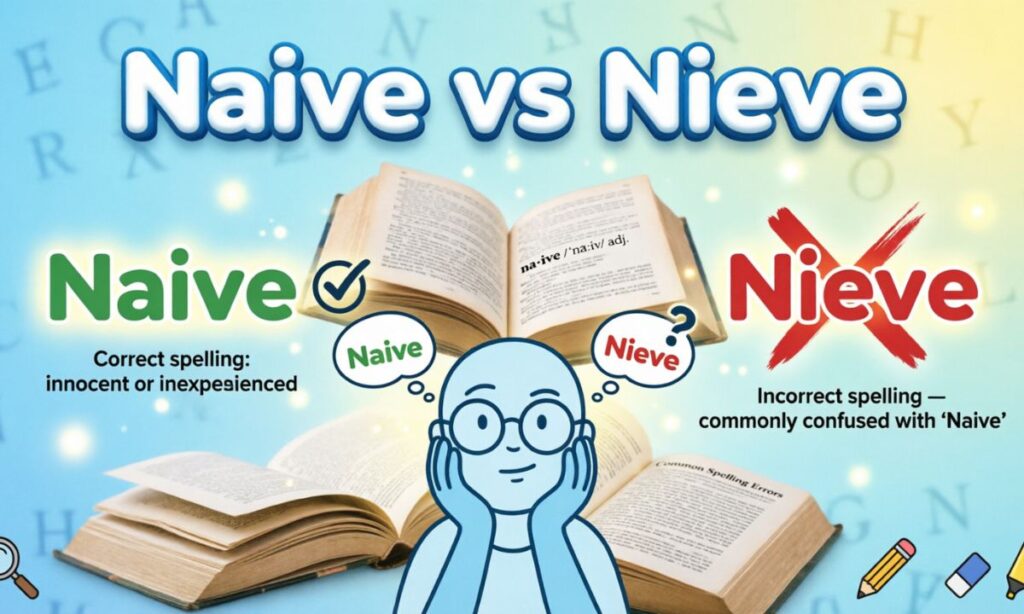
The answer to naive vs nieve is simple. Naive is the correct English spelling. Nieve is always incorrect in English. There are no exceptions, no regional variations, and no informal contexts where nieve becomes acceptable.
Every major English dictionary, including Merriam-Webster, Oxford, Collins, and Cambridge, recognizes only naive (and its accented form naïve) as the standard spelling. If you write nieve in a professional email, academic essay, or published article, it will be flagged as an error because it is one.
What Does Naive Mean?

Read This: Thumb In or Thumb Out? The Safe Fist Guide (2026)
Naive is an adjective in the English language. It describes someone who lacks experience, sophistication, or practical judgment. The word can carry several shades of meaning depending on the context:
- A person who is innocent and trusting, perhaps too trusting for their own good
- A belief or idea that oversimplifies a complex situation
- A decision that ignores obvious risks or complications
- A perspective that reflects limited exposure to the real world
The word sits comfortably in both formal and informal writing. It is neither exclusively academic nor exclusively casual. In literature, journalism, psychology, and everyday conversation, naive appears consistently and naturally. Understanding the naive vs nieve distinction begins with knowing exactly what the correct word means.
How Naive Is Used in Everyday English?
The word naive adapts well across different sentence structures and tones. It functions as a modifier for people, ideas, plans, and assumptions. Here are the core forms the word takes:
| Form | Example |
| Adjective | She held a naive belief that everyone was honest. |
| Adverb | He naively trusted the contract without reading it. |
| Noun (British) | Her naivety in negotiations cost the company the deal. |
| Noun (French style) | His naiveté about office politics was obvious. |
The adjective form is by far the most common. You will encounter it in book reviews, psychological reports, business analyses, news commentary, and casual social media posts. Every time the question of naive vs nieve comes up, the answer points to the same word, used in the same flexible, established way.
Is Naive an Insult?
This question comes up more often than you might expect. The answer depends entirely on tone and context. Naive is not inherently insulting. When applied to a child or a newcomer in a kind way, it can suggest charming innocence or honest simplicity. A young traveler experiencing a foreign country for the first time might be described as naive with genuine warmth.
However, the word can carry a critical edge when describing adults in professional or high-stakes situations. Calling a business plan naive or describing a negotiator as naive suggests a lack of preparation or worldly understanding that falls short of what was needed. The speaker is not calling the person unintelligent. They are noting a gap between the person’s assumptions and reality. Tone always determines whether naive lands gently or critically.
How to Pronounce Naive (And Why It Causes Confusion)
Naive is pronounced in two syllables: nah-EEV. Some speakers render it as ny-EEV depending on their accent. Both pronunciations are understood and accepted. The stress falls on the second syllable.
Here is the core problem that fuels the naive vs nieve confusion. When people hear the word spoken, the ending sounds like “eev.” Their instinct is to spell that sound using familiar English letter patterns. Words like believe, relieve, retrieve, achieve, and receive all use the “ieve” pattern.
So the brain maps the sound of naive onto that familiar pattern and produces nieve. This is phonetic reasoning, and it is entirely logical. It is also entirely wrong in this case, because naive follows French spelling conventions rather than standard English phonics rules.
The Origin and History of Naive
Understanding etymology is one of the fastest ways to lock in correct spelling. Naive comes directly from the French word naïf (masculine) and naïve (feminine), meaning natural, innocent, or artless. The two dots above the letter “i” in the French original are called a diaeresis. Their function is to signal that the two adjacent vowels, “a” and “i,” are pronounced separately rather than blended into a single sound.
English borrowed the word and kept its structure intact. Both naive and naïve are accepted in modern English. The accented version preserves the visual cue from French, while the non-accented version reflects the modern tendency to simplify special characters in digital writing. American English leans heavily toward naive without the diaeresis. British and literary English sometimes retains naïve for stylistic elegance.
Nieve never appeared at any point in the historical evolution of this word in English. It is not an alternate archaic spelling. It is not a regional variant from any English-speaking country. It simply does not exist in the English language. This historical fact is the strongest possible answer to the naive vs nieve question.
Is Nieve a Real Word?
Nieve is a real word. It is just not a real English word. In Spanish, nieve means snow. It is a fully recognized, commonly used noun in Spanish-language writing and conversation. This is a significant source of the naive vs nieve confusion.
Writers who speak or read Spanish have a stored familiarity with the word nieve. When they hear the English adjective naive spoken aloud, their brain retrieves the visually similar and phonetically close Spanish word and applies it. The result is a genuine error that feels completely natural to the person making it.
What Nieve Means in Other Languages
Since nieve exists outside English, it helps to know where it belongs and where it does not:
| Language | Word | Meaning |
| Spanish | nieve | snow |
| English | naive | innocent, inexperienced, lacking judgment |
| English | nieve | not a word; a misspelling of naive |
| French | naïve | natural, innocent (the origin of naive) |
Seeing these side by side makes the naive vs nieve distinction completely clear. The Spanish snow word and the English adjective for inexperience are unrelated in meaning, origin, and usage. Borrowing nieve into an English sentence about a person’s character or judgment is a cross-language error, not an acceptable spelling choice.
Naive vs Nieve: Side-by-Side Comparison
| Feature | Naive | Nieve |
| Correct in English | Yes | No |
| Dictionary recognized | Yes | No |
| Meaning in English | Inexperienced, innocent | Has no English meaning |
| Part of speech | Adjective | Not applicable |
| Origin | French (naïf/naïve) | Spanish (snow) |
| Accepted in formal writing | Yes | Never |
| Accepted in informal writing | Yes | Never |
| British English | Correct (naive or naïve) | Incorrect |
| American English | Correct (naive) | Incorrect |
Correct Examples of Naive in Sentences
These sentences demonstrate how naive fits naturally into real writing:
- It would be naive to assume the market will recover on its own.
- She was naive about the level of competition she would face.
- The investor made a naive decision by ignoring the risk report.
- Analysts described the government’s approach as dangerously naive.
- He naively signed the contract without consulting a lawyer.
- Her naivety was endearing at first but costly in the long run.
- The report criticized the naive assumption embedded in the original model.
Each sentence above reflects real-world use from journalism, business writing, and academic analysis. The naive vs nieve question disappears entirely once you see how naturally the correct form flows.
Incorrect Examples Using Nieve (With Corrections)
These examples show the error and its fix:
| Incorrect | Correct |
| She was too nieve to recognize the manipulation. | She was too naive to recognize the manipulation. |
| The plan sounds a bit nieve, doesn’t it? | The plan sounds a bit naive, doesn’t it? |
| Don’t be so nieve about how companies operate. | Don’t be so naive about how companies operate. |
| His nieve optimism created real problems. | His naive optimism created real problems. |
| It was nieve to think the deadline would hold. | It was naive to think the deadline would hold. |
Every corrected sentence shows the “ai” vowel order that correctly spells naive. The naive vs nieve confusion always resolves in the same direction.
Why This Mistake Keeps Happening?
The persistence of the naive vs nieve error comes from four specific causes:
- Phonetic spelling instinct. English speakers map sounds to familiar letter combinations. The “eev” sound triggers the “ieve” pattern from words like believe and relieve.
- Spanish language crossover. Bilingual speakers and Spanish learners recognize nieve visually and apply it in English by mistake.
- The diaeresis effect. The accented form naïve draws attention to the letter “i,” sometimes causing writers to overthink the vowel order.
- Inconsistent English spelling rules. English regularly violates its own phonics patterns, which leaves learners unsure when those patterns apply.
Understanding these causes makes the naive vs nieve error easier to spot and avoid in your own writing.
How to Remember the Correct Spelling of Naive?
Use these practical memory techniques to lock in the correct form permanently:
- Connect it to its origin. Naive comes from French naïf. French spelling keeps “ai” together. Lock that vowel order in your mind.
- Think alphabetical. The letters “a” and “i” appear in alphabetical order within the word: n-a-i-v-e. That natural sequence helps many writers remember.
- Build a phrase. “Always Informed” uses “ai.” Naive people often lack information. The letters “ai” stand for that idea.
- Use spell check as a habit. Tools like Grammarly flag nieve immediately. Running a quick check before publishing catches the error before it reaches your audience.
- Write it out. Physically writing naive five times with the correct spelling reinforces motor memory and visual recognition together.
Naive vs Similar Words People Confuse
Naive sits in a neighborhood of words that overlap in meaning but differ in nuance. These comparisons come up frequently alongside the naive vs nieve question:
| Word | Meaning | Key Difference from Naive |
| Gullible | Easily deceived | Stronger negative tone than naive |
| Innocent | Free from guilt or wrongdoing | Broader and more positive than naive |
| Inexperienced | Lacking practice or exposure | More neutral and specific than naive |
| Unsophisticated | Lacking complexity or refinement | Applies more to style than judgment |
| Credulous | Overly willing to believe | Very close in meaning; slightly more formal |
These distinctions matter in precise writing. Naive sits between innocent and gullible on the scale of trust and worldly experience. Choosing the right word from this group improves the accuracy of your writing well beyond simply solving the naive vs nieve spelling problem.
Where You’ll Commonly See Naive Used
The word naive appears across a remarkably wide range of writing contexts:
- Academic writing. Psychology papers use naive to describe experimental participants who are unaware of a study’s purpose. Economics papers describe naive expectations in market behavior models.
- Business journalism. Financial writers call projections naive when they underestimate risk or overestimate growth.
- Literature and fiction. Characters described as naive are often protagonists early in their journey, before experience changes their worldview.
- Social media and casual conversation. The word appears in opinion posts, comment sections, and personal reflections, usually to describe a past self or someone making a predictable mistake.
- News analysis. Political journalists use naive to describe diplomatic approaches that misread the intentions of another party.
In every context above, nieve would be wrong. The correct answer to naive vs nieve applies equally across all these settings.
Read This: Emersion Vs Immersion: Understanding the Real Difference
Case Study: Naive Assumptions in Business
A technology startup launches a subscription product with the assumption that early adopters will convert to paid plans at a 40 percent rate. The team builds financial projections around that number without testing it against user behavior data.
Six months into the launch, the actual conversion rate sits at 8 percent. The runway disappears faster than anticipated. An industry consultant reviews the original business plan and notes that the 40 percent assumption was naive, disconnected from category benchmarks and customer research.
This scenario plays out in boardrooms and business schools regularly. The word naive in this context carries real weight. It does not call the founders unintelligent. It identifies a specific failure of experience and research that shaped a flawed assumption.
The word naive earns its place precisely because it communicates that gap between expectation and reality without being cruel. No other word from the list of synonyms carries that same balance of precision and fairness. And none of this would work if someone wrote nieve in the consultant’s report. The credibility of the analysis depends partly on the credibility of the language.
Conclusion
The naive vs nieve question has one answer: always write naive. The word is an English adjective borrowed from French, describing someone who lacks experience, sophistication, or practical judgment. It accepts the accented form naïve as a stylistic variant in literary or formal contexts. It works the same way in British English, American English, and every other standard dialect of the language.
Nieve is a Spanish word for snow and has no place in any English sentence where you mean to describe a person’s inexperience or a plan’s lack of realism. The confusion between naive vs nieve comes from phonetic instinct, Spanish language familiarity, and the irregular patterns of English spelling. Now that you understand the origin, meaning, correct usage, and the specific reasons the mistake happens, you can write naive confidently every time and recognize nieve immediately as the error it always is.