
If you have ever typed a message and paused, unsure whether to write complaint or complain, you are not alone. These two words look nearly identical, sound similar, and describe the same general situation. Yet they are grammatically different in a way that matters deeply in professional writing, customer service, healthcare, and everyday conversation.
This guide breaks down everything you need to know about complaint or complain, including their meanings, grammar rules, real-life examples, and memory tricks that will lock the difference in place for good.
What Is the Difference Between Complain and Complaint?
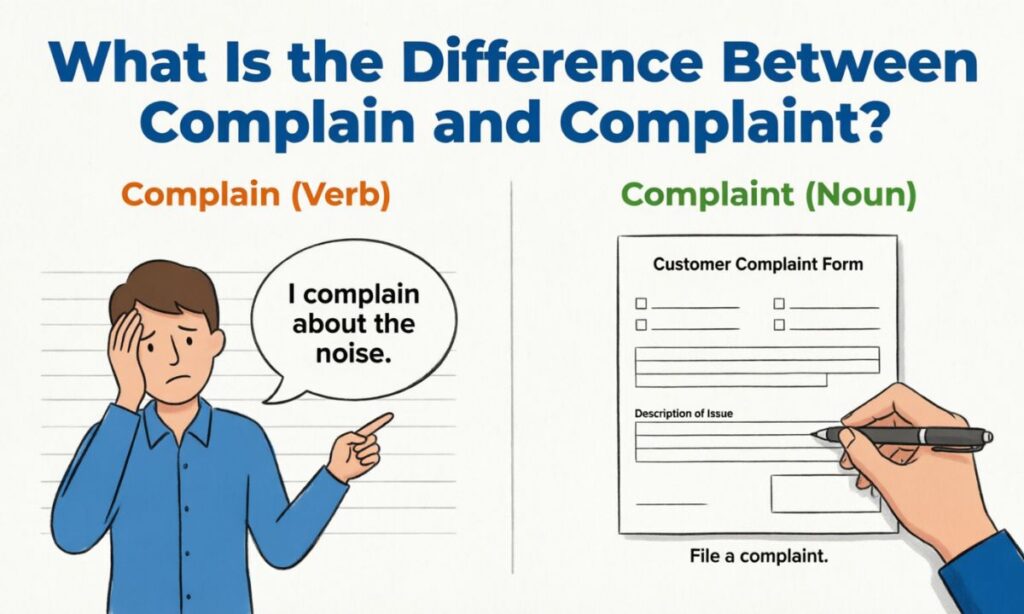
The core difference between complaint or complain comes down to the part of speech each word belongs to.
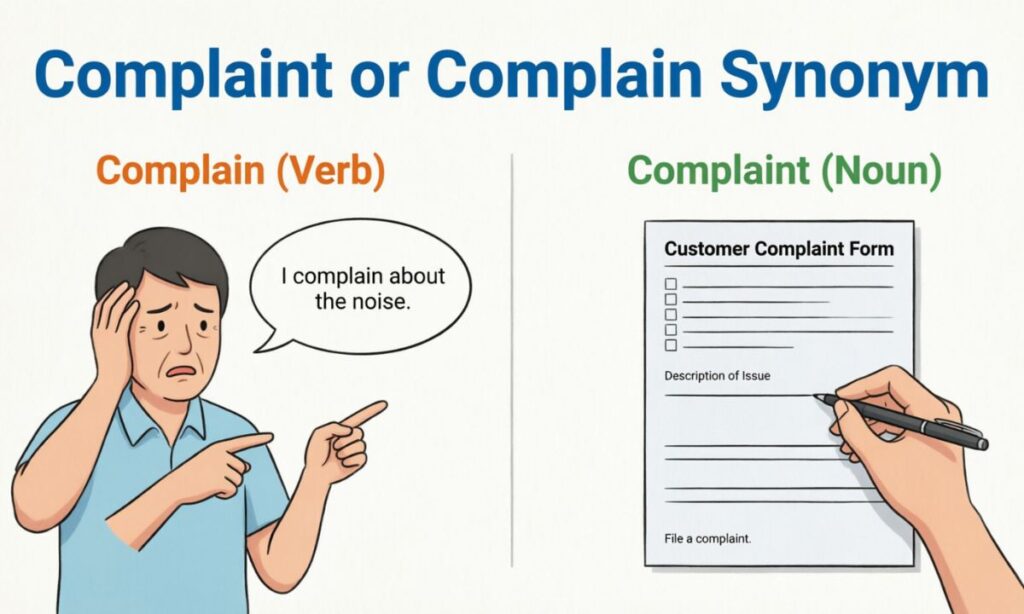
Complain is a verb. It describes the action of expressing dissatisfaction or unhappiness.
Complaint is a noun. It names the statement, document, or expression of dissatisfaction itself.
In simple terms: you complain (verb), and what you make is a complaint (noun). One is the action, the other is the result of that action. Mixing them up produces grammatically incorrect sentences that confuse readers and reduce your credibility.
Complaint or Complain – Quick Answer
| Word | Part of Speech | Function | Example |
| Complain | Verb | Describes the action | “I want to complain about this.” |
| Complaint | Noun | Names the issue or document | “I filed a complaint yesterday.” |
Whenever you are describing something someone does, use complain. Whenever you are referring to the thing itself, the statement, the form, or the formal report, use complaint.
Complaint and Complain in a Sentence
Here are direct examples that show complaint or complain in action:
- “She decided to complain to the manager about the cold food.”
- “The manager received her complaint and promised to act on it.”
- “Customers often complain when deliveries arrive late.”
- “The company logged every complaint in their customer service system.”
- “He did not want to complain, but the noise was unbearable.”
- “Her formal complaint was submitted to the HR department.”
Notice how complain always follows a subject and acts as the verb in the sentence. Complaint is always a thing you can file, make, receive, handle, or read.
Read This: Bachelor vs Batchelor: When to Opt for One Term Over Another
Complaint vs Complain Meaning Explained in Simple English
Meaning of “Complaint” (Noun)
A complaint is a statement that something is wrong, unfair, or unsatisfactory. It can be spoken or written. In formal settings, it is often a documented record that gets submitted, reviewed, and processed.
According to Cambridge Dictionary, complaint means “a statement that something is wrong or not satisfactory.”
A complaint can refer to:
- A formal letter or form submitted to an organization
- A verbal expression of dissatisfaction in a store or office
- A legal document filed in court
- A medical symptom reported to a doctor
- A grievance raised in a workplace setting
In all these uses, the complaint is the thing that exists. It can be counted (“three complaints”), modified (“a formal complaint”), or described (“a written complaint”).
Meaning of “Complain” (Verb)
To complain means to express dissatisfaction, pain, or unhappiness about something. It is the act of speaking up when something goes wrong.
You complain about something. You complain to someone. You do not “complaint” anything. The word only works as a verb.
Common ways to use complain include:
- “She complained about the delayed delivery.”
- “He often complains when the Wi-Fi is slow.”
- “They complained to the airline about lost luggage.”
- “Stop complaining and take action.”
Complaint or Complain Grammar Difference
Understanding the grammar behind complaint or complain makes choosing the right word automatic.
Complain follows standard verb conjugation rules:
- Present: complain / complains
- Past: complained
- Present participle: complaining
- Infinitive: to complain
Complaint follows standard noun rules:
- Singular: complaint
- Plural: complaints
- With articles: a complaint, the complaint, my complaint
- As a modifier: complaint form, complaint letter, complaint department
The key grammar test: if you can replace the word with another verb like “say” or “report,” use complain. If you can replace it with a noun like “issue” or “grievance,” use complaint.
Complaint or Complain Synonym
Knowing the synonyms for each word helps you write more naturally and vary your language without losing accuracy.
Synonyms for complaint (noun):
- Grievance
- Objection
- Gripe
- Protest
- Grumble
- Lament
- Criticism
- Charge
- Ailment (in medical contexts)
Synonyms for complain (verb):
- Grumble
- Gripe
- Moan
- Object
- Protest
- Find fault
- Express dissatisfaction
- Voice concerns
When choosing a synonym, always match the part of speech. Replace a noun with a noun and a verb with a verb.
Complaint or Complain Meaning
The shared meaning behind complaint or complain is dissatisfaction. Both words refer to the idea that something is wrong or not meeting expectations. The difference is how that dissatisfaction is expressed grammatically.
Complaint names the dissatisfaction as a thing. “I have a complaint” means you are holding or presenting a named issue.
Complain describes the act of expressing dissatisfaction. “I want to complain” means you are about to take the action of voicing that issue.
Both words come from the Latin word complangere, meaning “to bewail” or “lament.” Over centuries of English use, the language separated the action from the result, giving us two distinct but related words.
Complaint vs Complain – Part of Speech Table
| Feature | Complaint | Complain |
| Part of Speech | Noun | Verb |
| Can be plural | Yes (complaints) | No |
| Used with articles | Yes (a complaint) | No |
| Used with “to” (infinitive) | No | Yes (to complain) |
| Can be conjugated | No | Yes |
| Common collocations | file, make, lodge, handle | want to, begin to, continue to |
Sentence Structure Guide
| Sentence Type | Use Complaint | Use Complain |
| “I filed a ___” | complaint | No |
| “She wants to ___” | No | complain |
| “The ___ was resolved” | complaint | No |
| “He continued to ___” | No | complain |
| “We received one ___” | complaint | No |
Complaint vs Complain in Real Life Contexts
Everyday English Examples
In casual everyday speech, both words appear naturally. The key is knowing which role each plays.
- “He would complain every time it rained.”
- “Her only complaint was that the pizza was cold.”
- “Stop and think before you complain publicly.”
- “They took the complaint seriously and offered a refund.”
Professional and Business Usage
Using “Complaint” in Business
In business contexts, complaint functions as a formal document or customer record:
- “Please submit your complaint using the online form.”
- “Our team resolved over 200 customer complaints last quarter.”
- “A written complaint was sent to the regional office.”
- “The complaint department handles all unresolved issues.”
Using “Complain” in Business
In business contexts, complain describes what a customer or employee does:
- “Customers frequently complain about long wait times.”
- “She felt it was appropriate to complain to her supervisor.”
- “Employees should not complain publicly about internal policies.”
- “He chose to complain through the proper channels.”
Healthcare and Legal Usage
Healthcare
In medical settings, the word complaint is the standard term for a symptom or health concern a patient reports:
- “The patient’s chief complaint was persistent lower back pain.”
- “She came in with a complaint of dizziness and nausea.”
- “The doctor documented the complaint before the examination.”
In healthcare, you would never write “the patient chiefed complain.” The noun form is always required in clinical documentation.
Legal
In legal contexts, a complaint is a formal document filed with a court:
- “The attorney filed a complaint against the manufacturer.”
- “A formal complaint was submitted to the regulatory authority.”
- “The plaintiff’s complaint outlined three specific violations.”
In contrast, to complain in a legal context simply means to speak up:
- “The client began to complain about billing irregularities.”
Common Mistakes with Complaint and Complain
Wrong
“I want to complaint about my order.”
Correct
“I want to complain about my order.” (Verb needed after “to”)
Wrong
“She filed a complain with the agency.”
Correct
“She filed a complaint with the agency.” (Noun needed after “a”)
Wrong
“The customer complain was handled quickly.”
Correct
“The customer complaint was handled quickly.” (Noun needed as subject)
Wrong
“He always complaint about the weather.”
Correct
“He always complains about the weather.” (Verb needed, conjugated form)
Simple Memory Tricks to Never Forget the Difference
Memory Trick 1
Complaint ends in a T, and so does “document.” A complaint is a document, a thing, a noun. If you can file it, read it, or submit it, it is a complaint.
Memory Trick 2
Complain ends in N, like “action.” Complain is the action you take. If you are doing something, use complain. “I will complain” follows the same pattern as “I will explain” or “I will obtain.”
Memory Trick 3
Replace the word in your sentence. Try swapping complaint with “grievance” and complain with “grumble.” If “grievance” fits, use complaint. If “grumble” fits, use complain. The sentence will reveal the right choice immediately.
Complaint vs Complain in Tenses and Forms
Forms of Complain (Verb)
| Tense | Form | Example |
| Simple Present | complain / complains | “They complain daily.” |
| Simple Past | complained | “She complained last week.” |
| Present Participle | complaining | “He is complaining now.” |
| Past Participle | complained | “They have complained before.” |
| Infinitive | to complain | “She wants to complain.” |
Forms Related to Complaint (Noun)
| Form | Example |
| Singular | “One complaint was filed.” |
| Plural | “Multiple complaints were received.” |
| Possessive | “The complaint’s resolution took a week.” |
| With adjective | “A formal complaint was submitted.” |
Complaint or Complain – Usage in Different Situations
In Casual Conversation
- “I just want to complain for a minute, okay?”
- “My only complaint is the service was slow.”
- “She never complains, even when things go wrong.”
In Text Messages
- “I’m going to complain to the restaurant right now.”
- “Did your complaint ever get resolved?”
- “He kept complaining about the Wi-Fi the whole trip.”
In Professional Emails
- “I am writing to formally complain about the service received on June 10.”
- “Please find the complaint form attached to this email.”
- “We have reviewed your complaint and are working on a resolution.”
In Official Complaints
- “This formal complaint is submitted in accordance with Section 4 of the Consumer Act.”
- “The complainant chose to complain through written correspondence.”
- “A copy of the complaint has been forwarded to the relevant authority.”
Complaint vs Complain – Mini Learning Table
| Situation | Right Word | Reason |
| Filing a form | complaint | It is a document (noun) |
| Expressing frustration | complain | It is an action (verb) |
| Medical symptom | complaint | Named issue (noun) |
| Talking to a manager | complain | Action taken (verb) |
| Court document | complaint | Legal filing (noun) |
| Writing an email | complain or complaint | Depends on sentence role |
Real World Case Study: Complaint vs Complain in Business
Imagine a customer who had a bad experience at a hotel.
In conversation, they would say: “I need to complain about the dirty room I was given last night.”
When they speak to the front desk, they say: “I have a complaint about my room.”
When the hotel records the interaction, they write: “Customer complaint received regarding room cleanliness on June 17.”
When the manager follows up, they email: “We acknowledge your complaint and will ensure this does not happen again.”
In every step, the action is complain and the documented record is complaint. The two words work together to tell the full story of the same situation.
Engaging Mini Quiz – Test Yourself
Choose the correct word for each blank:
- “She wanted to ___ about the long wait.” (complain / complaint)
- “He filed a formal ___ with the company.” (complain / complaint)
- “The ___ was resolved within 24 hours.” (complain / complaint)
- “They always ___ when the internet is slow.” (complain / complaint)
Answers: 1. complain 2. complaint 3. complaint 4. complain
Simple Visual Explanation
Think of it this way:
Complain = the arrow (action, movement, doing)
Complaint = the target (thing, result, the issue itself)
You shoot the arrow (complain) and it hits the target (complaint). One cannot exist without the other, but they play completely different roles.
Powerful Usage Tips
Follow these tips to always use complaint or complain correctly:
- If a word follows “to,” it must be a verb. Use complain. (“I want to complain.”)
- If a word follows “a” or “the,” it must be a noun. Use complaint. (“A complaint was filed.”)
- If a word is the subject of a sentence, it is a noun. Use complaint. (“The complaint was resolved.”)
- If a word follows a helping verb, it is a verb. Use complain. (“She will complain.”)
- In healthcare writing, always use complaint for patient-reported symptoms.
Helpful Examples You Can Use Anytime
- “I would like to complain about the damaged packaging.”
- “Please submit your complaint using the form on our website.”
- “The customer continued to complain throughout the call.”
- “We received your complaint and will respond within 48 hours.”
- “It is natural to complain when expectations are not met.”
- “His complaint was handled professionally and with care.”
Read This: Symptomatology vs Symptomology: Meaning And Differences (2026)
Expert Quote
Grammar authority Cambridge Dictionary defines complaint as “a statement that something is wrong or not satisfactory” and complain as “to say that something is wrong or not satisfactory.” The distinction is clear: one names the issue, the other describes the act of raising it.
Conclusion
The complaint or complain question has a clear and simple answer. Complain is the verb. Complaint is the noun. They share the same root meaning but serve different grammatical roles in every sentence.
Use complain when describing what someone does. Use complaint when referring to the thing someone makes or submits. Apply the memory tricks, study the tables, and test yourself with the mini quiz above. With a little practice, choosing between complaint or complain will become second nature in all your writing.