
Have you ever stopped halfway through typing and wondered whether it should be summarize or summarise? You are not alone. This tiny spelling gap trips up students, content writers, business professionals, and even people who have spoken English their whole lives. The good news is that the answer is simpler than it looks once you understand where the confusion comes from.
In this guide, you will learn exactly when to use summarize or summarise, why the spelling changes depending on where you are writing from, and how to stay consistent so your writing always looks polished and professional. We will also walk through real examples, grammar rules, and common mistakes so the summarize or summarise question never slows down your writing again. By the end, you will never second guess this word again.
Summarize or Summarise: What’s the Actual Difference?
The core truth about summarize or summarise is this: both words mean exactly the same thing. There is no difference in grammar, definition, or function. The only thing that changes is a single letter, and that letter depends on the variety of English you are writing in.
Both words mean to express the main points of something in a short and clear way. Whether you are condensing a long article, a meeting, a book chapter, or a research paper, you are doing the same action regardless of which spelling you pick.
- Summarize uses a Z and belongs to American English.
- Summarise uses an S and belongs to British English.
That is the entire difference. There is no version that is more correct or more advanced. The choice simply reflects regional spelling habits, similar to color versus colour or organize versus organise.
Why American and British English Spell It Differently?
To understand summarize or summarise properly, it helps to look at the history behind English spelling itself. Many English words that end in ize or ise come from a Greek suffix that was originally written with a Z sound. Over centuries, British English slowly shifted toward using S in many of these words, while American English kept closer to the original Z form during its own spelling standardization in the eighteenth and nineteenth centuries.
This pattern shows up across dozens of similar word pairs, not just summarize or summarise. Words like realize and realise, organize and organise, and recognize and recognise follow the exact same rule. Once you understand this pattern, you can apply it instantly to hundreds of other words without needing to look each one up individually.
Spelling reform movements in the United States, led partly by figures like Noah Webster, pushed for simplified and standardized American spellings. Britain never adopted these same reforms in full, which is why the two regions drifted apart over time even though they share the same root language.
Summarize or Summarise: Which One Is Correct?
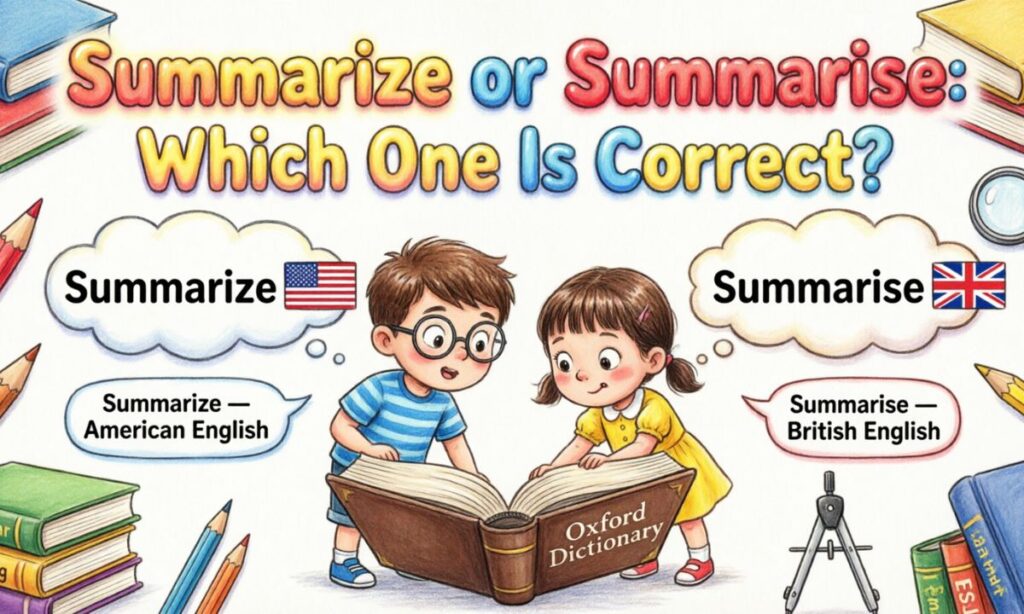
Here is the part that finally puts the debate to rest. Both summarize and summarise are completely correct. Neither spelling is a mistake, a typo, or an inferior version of the other. The only thing that matters is matching your spelling choice to your audience and staying consistent throughout your writing.
| Spelling | Region | Example Style Guides |
| Summarize | United States, Canada, Philippines | AP Style, Chicago Manual of Style, Merriam Webster |
| Summarise | United Kingdom, Australia, New Zealand | Oxford style (mixed), Cambridge, most UK newspapers |
Read This: Seamless vs Seemless: The Ultimate Grammar Guide for 2026
If you are writing for an American audience, summarize is the expected choice. If your readers are in the UK, Australia, or New Zealand, summarise will feel more natural and familiar to them. For international or mixed audiences, either spelling works, but you should pick one and use it consistently from start to finish.
Summarize vs Summarise in Academic Writing
Academic writing tends to be one of the strictest areas when it comes to spelling consistency. Professors, journals, and institutions usually expect writers to follow one regional standard throughout an entire paper, so understanding summarize or summarise in this context really matters. Getting summarize or summarise wrong in a formal paper can look careless even when the content itself is strong.
US Academic Standards
American universities, journals, and academic publishers almost always expect summarize with a Z. This includes most psychology, business, and science journals published in the United States, along with style guides like APA and Chicago. If you are a student writing for a US institution, summarize is the safe and expected default.
UK Academic Standards
British, Australian, and many Commonwealth universities expect summarise with an S. UK based academic journals, dissertation guidelines, and most Commonwealth grading rubrics follow this standard. Students writing essays, theses, or research papers for these institutions should consistently use summarise rather than switching back and forth.
A useful tip: always check your institution’s specific style guide before submitting any academic work. Some universities lean toward Oxford spelling, which actually allows the Z form even in British contexts, so it is worth confirming rather than assuming.
Summarize or Summarise in Professional Writing
Workplace writing has its own expectations, and getting summarize or summarise right can subtly signal professionalism and attention to detail. Business emails, reports, presentations, and internal documentation should all follow one consistent spelling style based on the company’s location or target market.
Use summarize in:
- Emails and reports for US based companies or clients
- Business proposals following American English standards
- Marketing content aimed at a US audience
- Internal documentation for American organizations
- Resumes and cover letters submitted to US employers
Use summarise in:
- Emails and reports for UK, Australian, or New Zealand companies
- Business documents following British English conventions
- Marketing content aimed at Commonwealth audiences
- Internal documentation for UK based organizations
- Resumes and cover letters submitted to British employers
If your company operates internationally, check whether there is an established house style. Many global companies pick one spelling convention for all official communication to avoid the appearance of carelessness across teams and regions.
Examples: Summarize vs Summarise in Real Sentences
Seeing summarize or summarise used in actual context makes the distinction much easier to remember. Below are practical examples from both spelling traditions.
American English Examples
- Please summarize the quarterly report before our Friday meeting.
- The assistant can summarize long documents in just a few seconds.
- She summarized the entire chapter in two short paragraphs.
- Can you summarize the client’s main concerns for the team?
- The article summarizes recent changes to the tax code.
British English Examples
- Please summarise the quarterly report before our Friday meeting.
- The assistant can summarise long documents in just a few seconds.
- She summarised the entire chapter in two short paragraphs.
- Can you summarise the client’s main concerns for the team?
- The article summarises recent changes to the tax code.
Notice that every sentence carries the exact same meaning. Only the regional spelling changes, which confirms that this is purely a stylistic choice rather than a grammatical one.
Verb Forms and Grammar Rules
Understanding how summarize or summarise behaves across different verb forms helps you apply the rule correctly no matter the tense or sentence structure you need.
Base Forms
The base forms are summarize in American English and summarise in British English. These are used in present tense statements and instructions, such as “I summarize articles for my blog” or “I summarise articles for my blog.”
Past Tense
In the past tense, American English uses summarized, while British English uses summarised. Both follow the regular pattern of adding ed to the base verb, with the only change being the underlying z or s.
Present Participle
For ongoing actions, American English uses summarizing and British English uses summarising. Example: “She is summarizing the report” versus “She is summarising the report.”
Noun Form
The related noun also follows the same regional split. American English uses summarization, while British English typically uses summarisation. However, many writers in both regions simply use the word summary instead, since it avoids the spelling question entirely and sounds more natural in everyday writing.
| Form | American English | British English |
| Base verb | summarize | summarise |
| Past tense | summarized | summarised |
| Present participle | summarizing | summarising |
| Noun | summarization | summarisation |
Why Writers Still Get Confused
Even experienced writers mix up summarize or summarise from time to time, and there are a few clear reasons why this keeps happening.
- Global content consumption means readers constantly see both spellings online, blending the two together in memory.
- Autocorrect and spellcheck tools sometimes default to whichever regional setting is active on a device, silently changing one spelling to the other.
- Many writers read content from both American and British sources daily, which naturally blurs which version feels default.
- Educational materials from different countries are often mixed together in online research, especially for students studying abroad.
- Some people simply were never taught that this is a regional difference rather than a grammar rule.
Once you recognize that this confusion is extremely common, it becomes much easier to slow down, check your audience, and apply the correct version with confidence instead of guessing.
Summarise Oxford Dictionary
The Oxford Dictionary’s position on summarize or summarise is actually more nuanced than most people realize. Oxford University Press has traditionally favored the Z spelling on etymological grounds, since it more closely reflects the original Greek suffix the word descends from. This means that within strict Oxford style, summarize is technically considered the preferred form, even though it is published from the UK.
However, the more commonly used Oxford online dictionary lists summarise as the primary British entry, since the S spelling is what the vast majority of British speakers and publications actually use in everyday writing. This is why you will see UK newspapers, Cambridge style guides, and most British institutions favoring summarise, even though Oxford’s own formal house style leans toward summarize.
The takeaway is simple: outside of specialized academic or publishing contexts that follow strict Oxford house style, summarise remains the standard expectation for general British English writing.
How to Choose the Right Spelling Every Time?
Choosing correctly between summarize or summarise does not have to involve guesswork. Follow this simple decision process whenever you are unsure.
- Identify your audience. Are your readers primarily American, or are they British, Australian, or part of another Commonwealth country?
- Check for an existing style guide. Schools, companies, and publications often already have a documented preference.
- Look at your platform’s language setting. Many writing tools and devices are set to a specific English variant by default.
- Stay consistent. Once you choose a spelling, use it throughout the entire document, email, or article without switching.
- When in doubt, default to summarize. It tends to be more widely recognized globally due to the dominance of American media and software.
This simple checklist removes the guesswork and ensures your writing always feels intentional rather than accidental, no matter which side of the summarize or summarise divide your audience falls on.
Common Mistakes to Avoid
Even with a clear understanding of summarize or summarise, certain mistakes still show up frequently in everyday writing. Being aware of these patterns helps you avoid them in your own summarize or summarise decisions going forward.
- Mixing both spellings within the same document, such as using summarize in one paragraph and summarise in another.
- Assuming one spelling is more correct or more formal than the other, when both are equally valid.
- Forgetting to update related word forms, like writing summarize but then using summarised in the past tense.
- Ignoring your institution’s or company’s established style guide.
- Letting autocorrect silently switch your spelling without noticing the change.
Summarize or summarise online
Online writing adds another layer of complexity to the summarize or summarise question. Search engines, AI writing tools, and global content platforms often default to American spelling since the majority of internet traffic and content originates from US based platforms. This is part of why summarize appears more frequently in blog posts, software interfaces, and digital tools, even on websites with international audiences.
If you are publishing content for global reach through search engines, summarize may slightly improve discoverability simply because more people search using that spelling. However, if your website specifically targets a British, Australian, or New Zealand audience, summarise will feel more natural and trustworthy to those readers. Search data consistently shows that people typing summarize or summarise into Google are usually looking for the same answer regardless of which version they typed first.
Summarize or Summarise in Education and Technology

Education and technology are two areas where summarize or summarise comes up constantly, and the spelling choice often depends on the platform rather than personal preference.
In schools, the expected spelling typically matches the country’s educational system. American schools teach and expect summarize, while British, Australian, and many international schools teach summarise. Standardized tests and curriculum materials generally follow whichever spelling matches their country of origin.
In technology, most software tools, including AI assistants, browser extensions, and writing apps, default to American English and therefore use summarize. This includes summarization features found in note taking apps, email clients, and productivity tools. Users in the UK or other English speaking regions can often switch their language settings to British English if they prefer to see summarise instead throughout the interface.
Quick Reference Guide
Here is a simple table you can bookmark for quick checks whenever summarize or summarise comes up in your writing.
| Situation | Recommended Spelling |
| Writing for a US audience or company | Summarize |
| Writing for a UK, Australian, or NZ audience | Summarise |
| Academic paper for a US institution | Summarize |
| Academic paper for a UK or Commonwealth institution | Summarise |
| General global blog content | Either, but stay consistent |
| Software or app development for international users | Summarize as default, with regional settings |
Read This: Complaint or Complain: What’s the Real Difference? (2026)
Frequently Asked Questions
Is “summarize” or “summarise” correct?
Both are correct. Summarize is American English, and summarise is British English. Neither version is wrong.
Which spelling should I use in business communication?
Match your spelling to your audience or client’s region, and keep it consistent throughout all communication.
Does the spelling affect grammar or meaning?
No. The grammar, definition, and usage rules stay identical regardless of which spelling you choose.
Can I mix “summarize” and “summarise” in the same document?
You should avoid this. Mixing spellings looks inconsistent and can make your writing appear less polished.
Is “summarize” more common online?
Yes, summarize generally appears more often online due to the volume of American content and US based platforms.
Conclusion
At the end of the day, the summarize or summarise debate comes down to one simple factor: regional spelling preference, not correctness. Summarize belongs to American English, while summarise belongs to British English, and both carry the exact same meaning, grammar, and usage rules. Anyone researching summarize or summarise for the first time can rest easy knowing there is no wrong answer here, only a regional one.
The real key to mastering this word is consistency. Identify your audience, check any relevant style guides, and stick with your chosen spelling throughout your writing, whether it is an email, an academic paper, or a blog post. Once you internalize this simple rule, you will never have to pause and second guess summarize or summarise again, and your writing will come across as clear, confident, and professional every single time.