
Have you ever used the words implicit vs complicit in a sentence and paused to wonder if you chose the right one? You are not alone. These two words look and sound deceptively similar, yet they carry entirely different meanings. Mixing them up can change the entire message you are trying to communicate, and in serious contexts like legal proceedings or ethical debates, that mix-up can be costly.
This guide breaks down the implicit vs complicit distinction in plain, simple language. You will find clear definitions, practical sentence examples, common mistakes, synonyms, and a handy comparison table. By the end, you will know exactly when to use each word with complete confidence.
Understanding Implicit vs Complicit: Key Differences
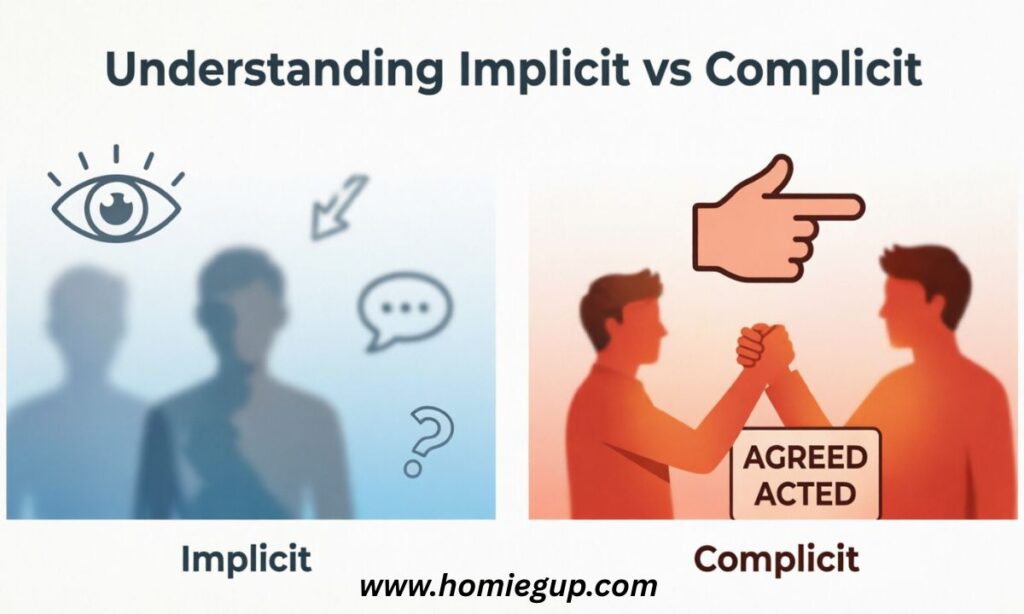
Before diving into individual definitions, here is the simplest way to frame the implicit vs complicit comparison:
- Implicit is about meaning. It describes something that is suggested, hinted at, or understood without being directly stated.
- Complicit is about action or inaction. It describes someone who is involved in, or helps enable, a wrongdoing.
One word belongs to the world of communication and understanding. The other belongs to the world of ethics, law, and moral responsibility. Keeping this distinction in mind makes every future use of implicit vs complicit much easier.
Define Implicit
The word implicit comes from the Latin implicitus, a past participle of implicare, meaning “to fold in” or “to entwine.” When something is implicit, it is folded into the message without being openly unwrapped.
According to Merriam-Webster, implicit means “capable of being understood from something else though not clearly or directly stated.” In everyday usage, it covers three related but distinct ideas:
- Implied meaning — something understood without being said outright. Example: the implicit agreement in a group that everyone cleans up after themselves.
- Inherent quality — something present in the nature of a thing. Example: the risks implicit in any financial investment.
- Unquestioning trust or faith — complete and unconditional. Example: she had implicit trust in her mentor.
When you describe something as implicit, you are saying it exists beneath the surface of direct expression. It is the unspoken rule, the understood expectation, the underlying message that thoughtful people can read between the lines.
Part of speech: Adjective Adverb form: Implicitly Antonym: Explicit
Define Complicit
The word complicit traces back to the Latin complicare, meaning “to fold together.” Someone who is complicit is, in a sense, “folded together” with wrongdoing, whether as an active participant or as a knowing bystander who did nothing to stop it.
According to Merriam-Webster, complicit means “helping to commit a crime or do wrong in some way.” Dictionary.com defines it as “choosing to be involved in an illegal or questionable act, especially with others.” The key element in both definitions is awareness combined with participation or enablement.
Complicit arrived in English around the mid-1800s as a back-formation from complicity, which itself came from French complicité in the 1600s. Its related family includes: accomplice, complicity, and complicitous.
Someone can be complicit in two ways:
- Active involvement — directly participating in the wrongdoing.
- Passive enablement — knowing about the wrongdoing and choosing silence or inaction, which allows it to continue.
Part of speech: Adjective Noun form: Complicity Related words: Accomplice, complicitous, co-conspirator
How To Properly Use The Words In A Sentence

Read This: Wheaten vs Wheat: When To Use Each One? What To Consider
Understanding the definitions is one step. Knowing how to correctly drop each word into a sentence is another. The core rule of implicit vs complicit usage is this: if you are describing a hidden or implied meaning, use implicit. If you are describing moral or legal involvement in wrongdoing, use complicit.
How To Use “Implicit” In A Sentence
Implicit works when you want to signal that something is understood, suggested, or embedded without being stated directly. It can describe messages, agreements, trust, threats, biases, or assumptions.
Key sentence patterns:
- There is an implicit [noun] in [situation].
- His/Her [action] carried an implicit [message/meaning/threat].
- The [concept] is implicit in [something broader].
Examples:
- The professor’s feedback carried an implicit suggestion that the student should revise the thesis entirely.
- There is an implicit understanding among teammates that everyone pulls their weight.
- Her silence was an implicit rejection of his proposal.
- The contract contained an implicit obligation to maintain confidentiality.
- Implicit bias in hiring decisions can prevent qualified candidates from advancing.
- The danger is implicit in the nature of the job itself.
- He gave her his implicit trust, never questioning her judgment.
How To Use “Complicit” In A Sentence
Complicit works when someone shares responsibility for a wrongdoing, either by participating in it or by knowingly allowing it to happen. It almost always appears with the preposition “in.”
Key sentence patterns:
- [Person/entity] was complicit in [wrongdoing].
- By [action/inaction], they became complicit in [problem].
- [Entity] cannot deny being complicit in [issue].
Examples:
- The manager was complicit in the cover-up by shredding important documents.
- The government became complicit in the crisis by ignoring early warnings.
- Staying silent when you witness workplace harassment makes you complicit in it.
- She refused to be complicit in her colleague’s dishonest report.
- The getaway driver was complicit in the robbery, even though she never entered the bank.
- International companies that ignored the labor violations were deemed complicit in the abuse.
Implicit vs Complicit Meaning: Side by Side
When exploring implicit vs complicit meaning, the contrast becomes crystal clear when you place them next to each other:
| Feature | Implicit | Complicit |
| Core meaning | Implied, understood without being stated | Involved in or enabling wrongdoing |
| Part of speech | Adjective | Adjective |
| Domain | Communication, meaning, understanding | Ethics, law, moral responsibility |
| Typical context | Messages, agreements, bias, trust | Crimes, cover-ups, ethical failures |
| Ethical weight | Neutral | Negative, carries moral/legal weight |
| Common pairing | Implicit in, implicit trust, implicit bias | Complicit in |
| Latin root | Implicare (to fold in) | Complicare (to fold together) |
| Antonym | Explicit | Innocent, uninvolved |
The implicit vs complicit distinction is ultimately the difference between what is communicated and what is done. One is linguistic; the other is behavioral.
More Examples Of Implicit and Complicit Used In Sentences
Examples Of Using Implicit In A Sentence
Reading multiple examples is the fastest way to internalize correct usage of implicit vs complicit in real writing.
- The job listing had an implicit requirement for weekend availability, even though it was never written down.
- Parents often rely on implicit communication to set expectations without spelling out every rule.
- There was an implicit tension in the room after the announcement was made.
- The study uncovered implicit racial biases in the way participants responded to resumes.
- His body language sent an implicit message of disagreement even as he nodded politely.
- The organization placed implicit pressure on its members to donate at every event.
- An implicit assumption in the model is that all participants behave rationally.
- Her tone of voice carried an implicit warning that should not be ignored.
- The novel’s ending leaves the fate of the protagonist implicit rather than spelled out.
- There is an implicit social contract between citizens and their government.
Examples Of Using Complicit In A Sentence
- The auditors were found complicit in hiding the company’s financial losses.
- Bystanders who do not report ongoing abuse can become complicit in perpetuating it.
- The local police department was accused of being complicit in the corruption scheme.
- He insisted he was not complicit in the decision, despite receiving regular updates.
- Media outlets that amplify false information risk becoming complicit in its spread.
- She felt morally complicit simply by accepting the gift, knowing where it came from.
- The school board was complicit in the bullying by failing to act on repeated complaints.
- Nations that fund armed groups can be considered complicit in their activities.
- Being complicit is not always about what you do; sometimes it is about what you choose not to do.
- The executive team was complicit in the fraud through deliberate silence and inaction.
Implicit vs Complicit Synonym Guide
When writing or speaking, it helps to know which words can stand in for each term. Synonyms are especially useful when you want to avoid repetition or when the exact word feels too formal for a given context.
Synonyms for Implicit:
- Implied
- Unspoken
- Tacit
- Inferred
- Unstated
- Inherent
- Underlying
- Understood
- Suggested
- Latent
Synonyms for Complicit:
- Involved
- Culpable
- Accessory
- Responsible
- Accountable
- Implicated
- Participating
- Knowing
- Aiding
- Enabling
Notice that the synonyms for implicit tend to describe states of communication or understanding. The synonyms for complicit tend to describe states of moral or legal involvement. This holds true to the core implicit vs complicit distinction.
Common Mistakes To Avoid
Even experienced writers mix up implicit vs complicit. Here are the most frequent errors and how to avoid them.
Using Implicit When You Mean Complicit
This is the most common mistake in the implicit vs complicit pair. People sometimes say things like “She was implicit in the cover-up” when they mean “She was complicit in the cover-up.” Implicit in that sentence makes no grammatical or logical sense because you are not describing a hidden meaning. You are describing participation in wrongdoing. Always ask: am I talking about a hidden meaning, or am I talking about involvement in something wrong?
Failing To Recognize The Ethical Implications
When you call someone complicit, you are making a moral and potentially legal claim. Swapping the word implicit for complicit softens that claim in a misleading way. If a manager was genuinely involved in covering up workplace misconduct, calling their role “implicit” in the situation underplays the seriousness of what occurred. Use the right word to represent the reality.
Overgeneralizing The Concept Of Implicit
Some writers assume that implicit means “anything not said out loud.” That is an oversimplification. Not all unspoken things are implicit in the technical sense. Implicit specifically refers to meaning that is embedded and can be reasonably understood by a thoughtful reader or listener. Random silence or ambiguity is not automatically implicit communication.
Context Matters: Choosing Between Implicit vs Complicit
The right word depends heavily on the situation. Here are several real-world contexts where the implicit vs complicit choice comes up regularly.
Legal Proceedings
In a courtroom, precision matters enormously. Lawyers use complicit to describe individuals who aided, abetted, or knowingly allowed a crime to occur. Implicit, by contrast, might describe what a contract implied or what a law’s meaning was understood to include. Using one in place of the other in a legal document or testimony could have serious consequences.
Ethical Dilemmas
Ethicists and philosophers often discuss both words in the same breath. A person might have an implicit understanding that something is wrong, yet still choose to remain complicit in it. The two concepts can coexist: you can implicitly know and still be complicit through silence.
Personal Relationships
In relationships, implicit communication is everywhere. Partners often rely on implicit cues like tone, body language, and habit to understand each other. But in matters of trust, someone who knowingly allows a betrayal to happen may be complicit in hurting the other person, even without taking direct action.
Societal Issues
Discussions about systemic racism, environmental harm, or social injustice regularly involve both terms. Implicit bias describes prejudice that operates beneath conscious awareness. Complicit describes the broader societal or institutional role in allowing injustice to continue. Understanding the implicit vs complicit difference helps people speak about these issues with greater accuracy.
Exceptions To The Rules: When Things Get Complicated
Language is rarely perfectly neat. There are situations where the implicit vs complicit line can feel blurry, and knowing about these exceptions makes you a more careful writer and speaker.
Cultural Differences
In some cultures, indirect communication is highly valued, and things that appear explicit to outsiders carry strong implicit meanings to insiders. In those cultural contexts, what counts as implicit versus what counts as a stated agreement can vary. Similarly, definitions of complicity can shift based on cultural norms around loyalty, silence, and community responsibility.
Legal and Ethical Frameworks
Different legal systems define complicity differently. In some jurisdictions, simply knowing about a crime and failing to report it makes someone legally complicit. In others, active assistance is required. Ethical frameworks like consequentialism and deontology also weigh complicity differently, making the word more flexible in philosophical debates than it appears in everyday speech.
Contextual Ambiguity
Sometimes a situation is genuinely ambiguous. Was the supervisor’s implicit approval of the flawed process an act of complicity in what went wrong afterward? Was a bystander’s silent observation enough to make them complicit? These gray areas do not change the core implicit vs complicit meanings, but they do remind us that applying either word to complex situations requires careful thought.
Individual Communication Styles
Some people communicate almost entirely through implicit signals, relying on context, tone, and shared history. Others prefer explicit statements. Neither style is wrong, but the dominant communication style in a relationship or organization affects how often the word implicit is needed to describe everyday interaction.
Evolving Language Usage
Language changes over time. The word complicit itself is a relatively recent addition to English, first recorded in the mid-1800s. As social conversations around accountability, institutional behavior, and systemic harm have grown, the word complicit has expanded into wider usage. Today it describes everything from individual wrongdoing to corporate negligence to governmental failure. Being aware of this evolution helps you use the word appropriately in modern contexts.
Quick Comparison Table: Implicit vs Complicit
| Category | Implicit | Complicit |
| Definition | Implied or understood without direct statement | Involved in or enabling wrongdoing |
| Word type | Adjective | Adjective |
| Part of speech family | Implicitly (adv), implication (n) | Complicity (n), complicitous (adj) |
| Latin root | Implicare: to fold in | Complicare: to fold together |
| Ethical tone | Neutral | Negative/judgmental |
| Common preposition pairing | “implicit in” | “complicit in” |
| Used for | Communication, meaning, trust, bias | Crime, misconduct, ethical failure |
| Opposite word | Explicit | Innocent, uninvolved |
| Synonyms | Tacit, implied, unspoken, inherent | Culpable, involved, accountable |
| Example context | Implicit bias, implicit trust, implicit agreement | Complicit in fraud, complicit in silence |
Read This: Rug Vs Rag: How Are These Different? When To Use Them?
Final Thoughts
The implicit vs complicit distinction is one that matters across everyday conversations, professional writing, legal settings, and public discourse. To recap: implicit describes something that is understood or implied without being directly stated, while complicit describes involvement in or enabling of wrongdoing, whether through action or deliberate inaction.
Getting implicit vs complicit right is not just about grammar. It is about choosing language that accurately reflects reality. When you say someone was complicit, you are making a claim about their moral or legal responsibility. When you say something is implicit, you are pointing to a hidden layer of meaning. These are not interchangeable ideas, and the words that represent them should not be used interchangeably either.
Use this guide as your reference point whenever the implicit vs complicit question comes up. The more you practice, the more naturally the right choice will come to you.
Frequently Asked Questions
What is the main difference between implicit vs complicit?
Implicit means something is implied or understood without being stated directly. Complicit means being involved in or helping to enable a wrongdoing. They are entirely different in meaning and use.
Can a person be both implicit and complicit at the same time?
Yes. A person can have an implicit understanding that something is wrong and still be complicit in it through their silence or inaction.
Is implicit always a neutral word?
Mostly yes. Implicit is neutral in tone. However, phrases like “implicit bias” carry a negative connotation depending on context.
Does complicit require direct participation?
No. You can be complicit through inaction, silence, or passive enablement, even if you never directly took part in the wrongdoing.
What is the noun form of complicit?
The noun form is complicity, which refers to the state of being involved in wrongdoing.
What is the noun form of implicit?
The related noun is implication, which refers to a conclusion or meaning that can be inferred without being stated outright.