

Have you ever typed a caption after a ski trip and stopped mid-sentence, suddenly unsure whether to write “skiid” or “skied”? That tiny moment of doubt is more common than most people realize. The question of skiid or skied confuses English learners, travel bloggers, sports writers, and even confident native speakers. The word looks simple, but English spelling rules around verbs that end in vowels can feel surprisingly tricky.
The good news is that this question has one clear, definitive answer. Once you understand the grammar rule behind it, you will never pause over skiid or skied again. This guide breaks down everything from the correct spelling and its origin, to slang usage, British and American differences, common mistakes, and plenty of real sentence examples. By the end, you will write with complete confidence.
Skiid: What It Is and Why People Write It?
Let us start by looking at what “skiid” actually is. Many people encounter the question of skiid or skied and lean toward “skiid” because of a very natural instinct. In English, some verbs double their final consonant before adding a past tense suffix. Think of “run” becoming “ran,” or “stop” becoming “stopped.” That pattern feels familiar, and when someone sees the word “ski” ending in the vowel “i,” the brain tries to apply a similar rule by doubling it.
There is also the influence of the present participle “skiing,” which contains a double “i” in the middle of the word (sk + i + ing). Seeing “skiing” spelled with two consecutive vowels makes some writers think the past tense should also reflect that pattern, producing “skiid.” The logic feels reasonable. But it is wrong.
Skiid is not a real word. It does not appear in any standard English dictionary. It is not accepted in formal writing, academic papers, news articles, travel blogs, or any professional context. It is simply a spelling error that has spread because of understandable but incorrect reasoning.
Why “Skiid” Never Became a Real Word
English does not double vowels when forming the past tense of a verb. The doubling rule in English applies to certain consonants, not vowels. For example, verbs like “stop,” “drop,” and “plan” double their final consonant because they follow the consonant-vowel-consonant pattern. Ski does not fit that pattern because it ends in a vowel, not a consonant.
Additionally, English actively avoids stacking the same vowel twice at the end of a word when forming the past tense. This is a natural spelling tendency that keeps words readable and pronounceable. Creating “skiid” would violate that tendency and produce an awkward letter combination that English grammar simply does not support.
Read This: Village vs Subdivision: Unraveling Commonly Confused Terms
Skied: The One Correct Spelling
When answering the question of skiid or skied, the answer is always “skied.” Full stop. There is no debate, no regional exception, and no informal context where “skiid” becomes acceptable.
Skied is the past tense and past participle of the verb “ski.” It follows standard English grammar rules for verbs that end in the vowel “i.” When you want to describe skiing that happened in the past, whether yesterday, last winter, or at any point before the present moment, “skied” is the word you use.
Full Conjugation Table of “Ski”
| Tense | Form | Example Sentence |
| Simple Present | ski / skis | I ski every winter. She skis in the Alps. |
| Present Participle | skiing | They are skiing down the mountain. |
| Simple Past | skied | He skied for the first time last year. |
| Past Participle | skied | She has skied in five different countries. |
| Future Simple | will ski | We will ski in Colorado next month. |
| Past Perfect | had skied | They had skied before the storm arrived. |
This table makes it easy to see how “skied” functions as both the simple past and the past participle. Whether you are writing in first, second, or third person, “skied” works the same way every time.
Skiid or Skied: Quick Answer
If someone asks you for a quick answer on skiid or skied, here it is:
Skied is correct. Skiid is always wrong.
- Skied = the correct past tense and past participle of the verb “ski”
- Skiid = a spelling mistake with no place in standard English
You should use “skied” in every context: travel writing, social media posts, school essays, sports journalism, academic papers, and casual conversation. There is no situation, no dialect, and no style guide that accepts “skiid” as a valid alternative.
The Origin of “Ski” and “Skied”
Understanding where the word comes from makes it even easier to remember the correct spelling. The question of skiid or skied is partly a question about word history, and the history is surprisingly straightforward.
The word “ski” comes directly from the Norwegian word “ski,” which itself descended from the Old Norse word “skíð,” meaning a stick of wood or a snowshoe. Old Norse, the language spoken by the Vikings and their descendants across Scandinavia, used this word to describe the long wooden runners used for travel across snow.
According to the Oxford Advanced Learner’s Dictionary, the word entered English in the mid-18th century, borrowed directly from Norwegian without any spelling change. The first recorded use in English appeared around 1745. As skiing spread across Europe and eventually worldwide as a popular winter sport, English adopted the term completely into its verbal system.
When English borrowed “ski” and began using it as a verb (to ski, meaning to glide over snow on skis), it applied standard English conjugation rules. Those rules said: add “-ed” to form the past tense. No letter changes. No doubling. Just “ski” plus “ed” equals “skied.”
Historical written examples confirm how quickly this form was standardized. Travel accounts from the late 19th century already used “skied” correctly and consistently. The spelling was never in dispute. The confusion around skiid or skied is a modern phenomenon, likely driven by the internet, social media, and the rapid spread of misspelled words across informal digital writing.
Skiid or Skied in Slang

The internet has a habit of creating its own grammar. So it is worth addressing whether “skiid” has any life in slang, even if it has none in formal English.
The honest answer is that “skiid” has no established slang meaning either. It does not appear in Urban Dictionary with a recognized informal definition. It is not used by any known online community to mean something other than its attempted past tense use. If you encounter “skiid” in a comment section or a text message, it is almost certainly a typo or a genuine spelling mistake rather than an intentional slang term.
“Skied,” on the other hand, does appear in informal and slang-adjacent contexts. In casual sports writing and social media posts about winter travel, “skied” is used exactly as you would expect. Sentences like “I skied it” or “We skied that slope” feel natural and modern without being grammatically incorrect.
Some younger writers also use “skied” in a figurative sense to describe moving quickly, performing smoothly, or gliding through a challenge, drawing on the imagery of an athlete skiing down a mountain with speed and ease. While this extended metaphorical use is informal, it is built on the correctly spelled word “skied,” not on “skiid.”
The bottom line on skiid or skied in slang contexts: only “skied” has any real-world usage, formal or informal. “Skiid” remains a misspelling in every context.
British English vs American English Spelling
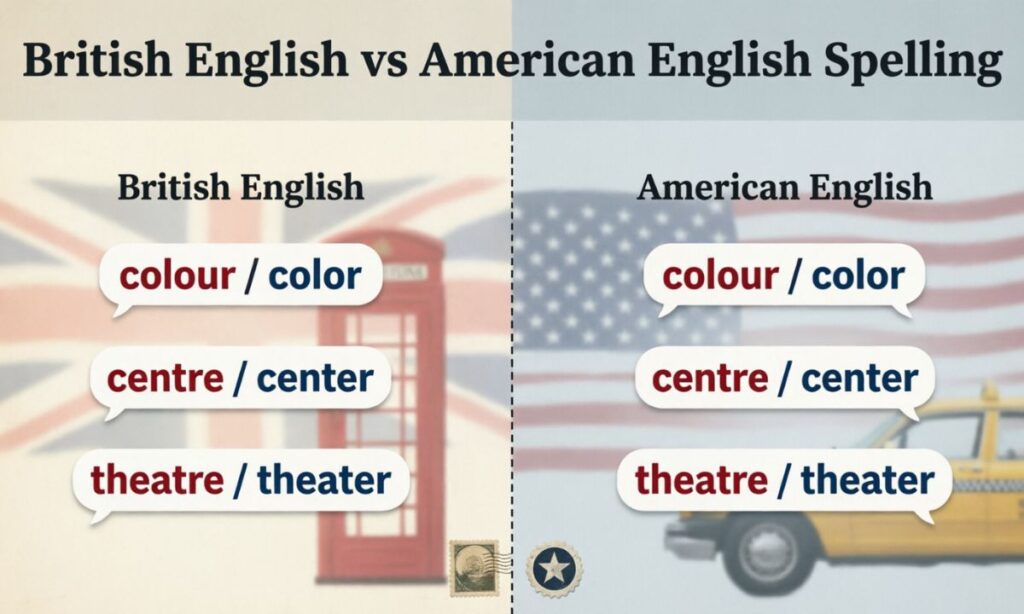
One of the most common reasons people hesitate between two spellings is the difference between British English and American English. Many spelling variations do exist between the two, such as “colour” versus “color,” “honour” versus “honor,” or “travelling” versus “traveling.” So it is fair to ask whether skiid or skied follows a similar pattern.
It does not. There is no regional spelling difference here.
Both British English and American English use “skied.” There is no version of this word where one dialect prefers a different spelling. The Oxford English Dictionary, which is the authoritative reference for British English, uses “skied.” Merriam-Webster, the leading American English dictionary, also uses “skied.” Cambridge Dictionary, widely used across both regions and internationally, lists “skied” as the only correct form.
This is an important point to understand when thinking about skiid or skied. It is not a case where you might be right in one country and wrong in another. You are simply right or wrong everywhere in the world, and the correct form is always “skied.”
British vs American English: Spelling Comparison Table
| Word | British English | American English |
| Color/Colour | colour | color |
| Traveled/Travelled | travelled | traveled |
| Skied | skied | skied |
| Skiing | skiing | skiing |
| Skier | skier | skier |
As the table shows, “skied” is one of the rare spellings that remains perfectly consistent across both major branches of the English language. There is no ambiguity and no regional nuance to worry about.
Skiid or Skied: Meaning Explained
Now that the spelling question is settled, it helps to understand the full meaning of “skied” and how it fits into everyday communication.
Skied is the past tense and past participle of the verb “ski.” As a verb, “ski” means to travel or glide over snow using a pair of long flat runners attached to your boots, typically as a sport or recreational activity. These runners, also called skis, can be made from wood, fiberglass, metal, or composite materials, and they come in different types depending on whether you are downhill skiing, cross-country skiing, or ski jumping.
When you say “I skied,” you are communicating that this activity happened at a point in the past. The action is complete. The experience occurred before the current moment. “Skied” is a clean, simple past tense form with no complications attached to it.
Skied as a past participle works with auxiliary verbs like “have,” “has,” and “had.” This creates perfect tense constructions that describe actions with a specific relationship to the present or to another point in time.
- “I have skied in Japan” means you completed that action at some point before now, and it is relevant to the present moment.
- “She had skied before the avalanche warning was issued” places the action before another past event.
Understanding this dual role of “skied” as both simple past and past participle helps you use it correctly across all tenses and sentence structures.
Which Spelling Should You Use?
By now the answer to skiid or skied is crystal clear, but let us summarize it in a way that is easy to remember and apply in real writing situations.
Always use “skied.” Here is a simple decision framework:
- Are you writing about a skiing activity that already happened? Use “skied.”
- Are you using a perfect tense construction with “have,” “has,” or “had”? Use “skied.”
- Are you writing formally or informally, in British English or American English? Use “skied.”
- Are you writing for a blog, a school paper, a sports article, or a social media post? Use “skied.”
- Is there any situation where you should use “skiid”? No. Never.
Memory Trick for Skiid or Skied
One of the best ways to remember the correct spelling is to compare “ski” with similar verbs that follow the exact same pattern:
| Verb | Past Tense | Wrong Form (Never Use) |
| die | died | diid |
| tie | tied | tiid |
| lie | lied | liid |
| ski | skied | skiid |
When you line them up together, the pattern becomes obvious. No English verb in this group doubles its vowel. They all simply add “ed.” Ski follows the same rule, producing “skied” every single time.
Common Mistakes with “Skiied” or “Skied”
You may also notice a third misspelling floating around online: “skiied” with three vowels in a row. This is another common error worth addressing specifically. When people search for the correct past tense of ski, they sometimes type “skiied,” adding both an extra “i” and the standard “ed” ending.
“Skiied” is also incorrect. There is no form of this verb that uses three consecutive vowels. The verb “ski” adds only “ed” to become “skied,” with no additional letters of any kind.
The Three Forms People Write Incorrectly
| Misspelling | Why People Write It | Correct Form |
| skiid | Doubling the vowel like “stopped” | skied |
| skiied | Combining “skiing” + “ed” visually | skied |
| ski’d | Using an apostrophe as a shortcut | skied |
All three incorrect forms stem from the same root confusion: trying to apply a doubling or combining rule that simply does not exist for this verb. When the question is skiid or skied, or skiied or skied, the answer is always the same. One clean spelling. No extras. Just “skied.”
Skied in Everyday Examples
Seeing “skied” used correctly in real sentences helps reinforce the correct spelling and shows how naturally the word fits into different types of writing.
Casual and Social Media Examples
- “We skied all morning and spent the afternoon warming up in the lodge.”
- “My daughter skied for the first time today and absolutely loved it.”
- “I skied that black diamond run on my last day and survived.”
- “We skied in Austria last February and the powder was absolutely incredible.”
- “He skied across the finish line three seconds ahead of his nearest competitor.”
Travel Writing Examples
- “The family skied the famous slopes of Zermatt before heading to Geneva.”
- “She had skied in Japan, Canada, and Norway before attempting the Swiss Alps.”
- “The group skied off-piste for two consecutive days under the guidance of a certified instructor.”
Academic and Formal Writing Examples
- “The athletes skied under extreme weather conditions during the qualifying round.”
- “Participants skied varying terrain types as part of the endurance assessment.”
- “Historical records show that Scandinavian hunters skied across frozen lakes as far back as 6000 BCE.”
Perfect Tense Examples
- “I have skied in six different countries over the past decade.”
- “She has skied competitively since the age of nine.”
- “They had skied the entire route before the weather turned dangerous.”
- “He had never skied before that trip to Vermont, but he picked it up quickly.”
Skiid or Skied: Google Trends and Usage Data
Online search data consistently shows that far more people search for “skied” than “skiid,” which reflects the reality of how these words are actually used. “Skied” appears regularly in published news articles, official sports results, travel guides, academic journals, and major dictionaries. “Skiid” appears in user-generated content, comment sections, and social media posts as an error.
When major publications like the BBC, The New York Times, The Guardian, and Sports Illustrated cover alpine sports events, they universally use “skied.” Olympic coverage, ski resort announcements, and national ski federation reports all use “skied” exclusively. There is zero evidence in professional publishing of “skiid” being used intentionally or correctly.
Google’s autocorrect and spell-check systems flag “skiid” as an error and suggest “skied” as the correction. Microsoft Word, Google Docs, and most word processors underline “skiid” with a red squiggle indicating a spelling error. This is further proof that the debate over skiid or skied is settled at every level of language technology.
Usage Frequency Comparison
| Term | Dictionary Recognized | Professional Publishing Use | Search Volume Intent |
| skied | Yes | Extremely high | Confirmation of correct spelling |
| skiid | No | Zero | Confusion or typo |
| skiied | No | Zero | Visual confusion with “skiing” |
| ski’d | No | Extremely rare | Informal shorthand |
Read This: Wheaten vs Wheat: When To Use Each One? What To Consider
Comparison Table: Skied or Skiied
Here is a final at-a-glance comparison covering all the key facts about skiid or skied, skied or skiied, and related spellings.
| Question | Answer |
| What is the correct past tense of ski? | Skied |
| Is “skiid” a real word? | No, it is always a spelling error |
| Is “skiied” correct? | No, it is also a spelling error |
| Does British English spell it differently? | No, both British and American English use “skied” |
| Is “skied” also the past participle? | Yes, it functions as both simple past and past participle |
| What is the present participle of ski? | Skiing (not skiing or skiiing) |
| Does the doubling rule apply here? | No, English does not double vowels in past tense forms |
| Where does “ski” come from? | Norwegian “ski,” from Old Norse “skíð” (stick of wood) |
| Is “skied” used in formal writing? | Yes, in all professional and academic contexts |
| Can “skiid” be used in slang? | No, it has no established slang meaning either |
Conclusion
The debate over skiid or skied might feel like a small grammar question, but getting it right matters. Correct spelling signals professionalism, clarity, and respect for your reader. Whether you are posting about a weekend ski trip, writing a sports article, completing a school assignment, or sending a professional email, using the wrong spelling creates an impression you probably do not want to make.
To summarize everything covered in this guide: skied is the only correct past tense and past participle of the verb ski. Skiid is always a spelling error. Skiied is also always wrong. British English and American English both agree. Every major dictionary agrees. Every spell-check tool agrees. And now you agree too.
The rule is simple once you internalize it. Verbs that end in the vowel “i” simply add “ed” to form the past tense. Die becomes died. Tie becomes tied. Ski becomes skied. No doubling. No extra letters. No exceptions.
The next time you write about gliding down a snowy mountain, you will not hesitate. You will type “skied” with total confidence, because you know exactly why it is right. That confidence is what separates a careful writer from one who guesses. And now when anyone around you confuses skiid or skied, you will have everything you need to set the record straight.