
If you have ever stopped mid-sentence wondering whether to write baby vs babies, you are not alone. This small grammar question trips up students, bloggers, parents, and even professional writers every single day. Choosing the wrong form does not just look careless; it can change the meaning of your sentence entirely.
In this guide, you will get a clear, complete breakdown of baby vs babies, the possessive forms, the grammar rules behind them, common mistakes to avoid, and how to use both forms correctly in any context.
Baby vs Babies: Basic Definitions
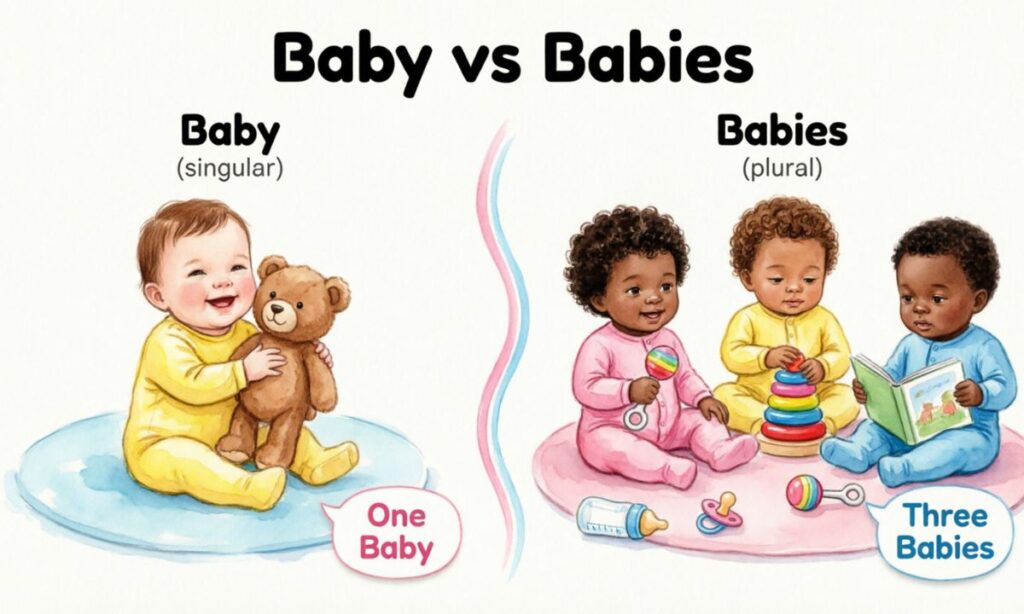
At the heart of the baby vs babies debate is a simple concept: number.
Baby is the singular noun. It refers to one infant, one very young child, or one person you address affectionately.
Babies is the plural noun. It refers to two or more infants or young children.
| Form | Type | Meaning | Example |
| Baby | Singular noun | One infant | The baby is sleeping. |
| Babies | Plural noun | Two or more infants | The babies are sleeping. |
| Baby’s | Singular possessive | Belongs to one baby | The baby’s toy is lost. |
| Babies’ | Plural possessive | Belongs to multiple babies | The babies’ blankets are soft. |
The word baby can also function as an adjective, as in “baby shower” or “baby steps,” and even as a verb meaning to treat someone with too much softness, as in “She babies her youngest child.” However, in the baby vs babies conversation, the noun forms are what matter most.
Read This: Women or Woman: The Ultimate Guide Using Them Correctly
Baby’s or Babies’ Possessive
Once you move past the basic baby vs babies distinction, possessive forms add another layer of confusion. Here is how they break down:
Baby’s is the singular possessive form. You use it when one baby owns or is associated with something.
- The baby’s crib is brand new.
- What is the baby’s name?
- The baby’s first word surprised everyone.
Babies’ is the plural possessive form. You use it when multiple babies own or share something. The apostrophe goes after the “s,” not before it.
- The babies’ diapers need changing.
- The hospital stored all the babies’ records.
- The babies’ mothers waited anxiously outside.
A quick rule to remember: if you can replace the word with “belonging to one baby,” use baby’s. If you can replace it with “belonging to multiple babies,” use babies’.
Never write “babies’s.” That form does not exist in standard English and is always incorrect.
When to Use “Baby”
Understanding baby vs babies starts with knowing exactly when the singular form is appropriate. Use baby in the following situations:
- Referring to one specific infant: The baby cried all night.
- Using it as a term of endearment: You are my baby.
- As an adjective modifying a noun: baby food, baby shower, baby blue.
- With singular verbs: The baby is hungry. The baby needs a nap.
- In idiomatic expressions: She is the baby of the family. Do not throw the baby out with the bathwater.
Notice that the singular baby always pairs with singular verbs like “is,” “was,” “needs,” and “cries.” This subject-verb agreement is one of the most common errors writers make when they confuse the baby vs babies forms.
When to Use “Babies”
The plural form babies is the correct choice in these situations:
- Referring to two or more infants: Three babies were born in the same hospital room.
- Making general statements about infants: Babies need constant attention in their first months.
- In research, health, and parenting content: Babies develop motor skills rapidly in the first year.
- Metaphorically, for new or young things: The startup is still the baby of the industry. When there are multiple such entities, they become the babies of the industry.
- With plural verbs: The babies are eating. The babies were crying.
The baby vs babies distinction in subject-verb agreement is critical. You would never say “The babies is sleeping.” That sentence is grammatically wrong. Always pair babies with plural verbs.
Grammar Rules and Patterns
The baby vs babies rule is not random. It follows a well-established pattern in English grammar that applies to dozens of other words.
Subject-Verb Agreement
Subject-verb agreement is the cornerstone of correct usage in the baby vs babies debate. A singular subject takes a singular verb; a plural subject takes a plural verb.
- The baby is crying. ✅
- The babies are crying. ✅
- The baby are crying. ❌
- The babies is crying. ❌
When writers confuse baby vs babies, they often mix up the verb that follows. Always check: is there one baby or more than one? Match your verb accordingly.
Pluralization Rule
English has a specific rule for words that end in a consonant followed by the letter “y.” In those cases, you drop the “y” and add “ies” to form the plural. This is exactly how baby becomes babies.
This same rule applies to many familiar words:
| Singular | Plural |
| Baby | Babies |
| Lady | Ladies |
| City | Cities |
| Fly | Flies |
| Candy | Candies |
However, if the word ends in a vowel followed by “y,” you simply add “s.” That is why “toy” becomes “toys” and “day” becomes “days.” The baby vs babies rule only applies when a consonant comes before the “y.”
Articles Usage
Articles work differently with baby vs babies, and getting them right sharpens your writing considerably.
- Use “a” or “an” with the singular: A baby needs love. (indefinite article)
- Use “the” with either form: The baby is here. The babies are here. (definite article)
- Use no article with the plural in general statements: Babies need sleep. Babies cry often.
Edge Cases
A few edge cases in the baby vs babies debate are worth noting:
Compound nouns: Phrases like “baby bottle,” “baby clothes,” and “baby monitor” keep “baby” in singular form even when referring to multiple items. You say “baby clothes for all the babies,” not “babies clothes.”
The verb “to baby”: When “baby” functions as a verb, it conjugates as: I baby, you baby, she babies, we baby, they baby. Here, “babies” is a verb form, not a plural noun. Context makes the difference clear.
Collective reference: In medical or scientific writing, “the baby” can sometimes refer to infants as a category. Phrases like “the baby’s brain develops rapidly” use the singular to make a universal claim about all infants.
Common Mistakes and How to Avoid Them
The baby vs babies topic generates a surprising number of recurring errors. Here are the most common ones and how to fix them:
Mistake 1: Writing “babys” as the plural. This is the most frequent error. “Babys” is never correct in standard English. The plural is always babies.
- ❌ Three babys were born today.
- ✅ Three babies were born today.
Mistake 2: Using an apostrophe to form the plural. Apostrophes do not make nouns plural. Writing “baby’s” when you mean more than one baby is a grammatical error.
- ❌ The baby’s are sleeping.
- ✅ The babies are sleeping.
Mistake 3: Confusing baby’s (possessive) with babies (plural). These two forms look similar but serve completely different purposes.
- ❌ I heard the babies cry, so I picked up the babies toy.
- ✅ I heard the babies cry, so I picked up the baby’s toy.
Mistake 4: Wrong subject-verb agreement.
- ❌ The babies was born premature.
- ✅ The babies were born premature.
Quick Fix Tip: Before you finalize any sentence with “baby” in it, ask yourself two questions: Am I talking about one or more than one? Am I showing ownership? Those two answers will always point you to the correct form in the baby vs babies conversation.
Baby vs Babies Reddit
The baby vs babies question comes up frequently on Reddit, particularly in communities like r/grammar, r/English, and r/NewParents. Here is what real users commonly say about this topic:
Most Reddit users agree on the basics: babies is the plural, baby’s is the singular possessive, and “babys” is always wrong. The confusion tends to cluster around the possessive forms.
A popular question that appears often: “Is it ‘the baby’s room’ or ‘the babies’ room’?” The answer depends entirely on how many babies share the room. One baby’s room uses baby’s; a shared nursery for multiple infants uses babies’.
Another common Reddit thread topic involves the verb form. Many users are surprised to learn that “she babies him” is grammatically correct because “babies” here is the third-person singular present tense of the verb “to baby,” not a plural noun at all.
The baby vs babies threads on Reddit consistently show that even fluent English speakers make these errors, which confirms that the possessive-versus-plural distinction is genuinely tricky for many people.
Usage in Writing and Speech
Formal Writing
In formal writing, precision matters. Whether you are drafting a medical report, an academic paper, or a professional blog post, the baby vs babies distinction must be exact.
In formal contexts:
- Use baby when referring to a single subject: The infant, referred to hereafter as the baby, showed strong reflexes.
- Use babies for plural references: Premature babies require specialized neonatal care.
- Use baby’s for singular possessive: The baby’s birth weight was recorded at 3.2 kilograms.
- Use babies’ for plural possessive: The babies’ health outcomes improved after the intervention.
Style guides including the Chicago Manual of Style and the Oxford Style Guide both confirm that babies is the only accepted plural form of baby in formal writing.
Informal Speech
In everyday conversation, the baby vs babies distinction is still important, but the stakes feel lower. People use “baby” as a term of affection constantly, and nobody corrects it. You might say “Come here, baby” to a toddler, a partner, or even a pet.
In informal speech, “babies” is also used metaphorically. Calling a group of new employees “the babies of the team” or referring to someone’s passion project as “their baby” are both common in casual conversation.
Nuances
Some nuances in the baby vs babies discussion go beyond basic grammar:
Emotional register: “Baby” carries warmth and intimacy. “Babies” is more clinical and neutral. Writers in parenting blogs often prefer “baby” even in general statements because it feels more personal.
Metaphorical use: Both forms extend beyond literal infants. “Baby” can mean a beloved project, a youngest sibling, or a term of address. “Babies” can describe inexperienced people or new developments in an industry.
Regional tone: In British English and American English, both baby vs babies forms are identical. There is no spelling variation between the two dialects, which makes this rule universally applicable.
Pronunciation and Style Tips
Pronouncing baby vs babies correctly is straightforward but worth reviewing:
- Baby is pronounced: BAY-bee (two syllables, stress on the first)
- Babies is pronounced: BAY-beez (two syllables, stress on the first, ends with a “z” sound)
The “ies” ending in babies produces a soft “z” sound at the end, just like “ladies” and “cities.” Never pronounce it “BAY-bee-iz” with three syllables; that sounds unnatural and is incorrect.
Style tips for using baby vs babies in your writing:
- In headlines and titles, capitalize both forms: Baby vs Babies.
- In product descriptions, use the plural when addressing a general audience: “Great for babies 0 to 12 months.”
- In social media captions, both forms appear constantly. Just make sure you are using the right one. “Babies everywhere!” means multiple infants. “Baby’s first smile!” means one baby’s milestone.
- When in doubt, reread your sentence and mentally replace “baby” or “babies” with a specific number. “One baby is” or “two babies are” will confirm which form is right.
Read This: Lessor vs Lessee: Understanding, Rights and Responsibilities
Conclusion
The baby vs babies distinction is one of those grammar points that seems minor until you get it wrong in a professional or public context. To summarize everything covered in this guide:
- Baby is singular. Use it for one infant, one affectionate address, or as an adjective.
- Babies is plural. Use it for two or more infants, general statements, or metaphorical references.
- Baby’s is the singular possessive. One baby owns something.
- Babies’ is the plural possessive. Multiple babies own something.
- Babys is never correct. Avoid it in every context.
The baby vs babies rule follows a predictable pattern: consonant plus “y” becomes “ies” in the plural. Once that clicks, you will never second-guess yourself again.
Whether you are writing a parenting blog, a medical report, a social media caption, or a formal essay, mastering baby vs babies gives your writing accuracy, credibility, and polish. Keep this guide bookmarked and come back to it whenever the baby vs babies question pops up in your work.