
Picture this: you are drafting a recipe, or describing your dog’s gorgeous golden coat, or perhaps writing about Northern Irish cuisine — and you pause. Should you write wheaten or wheat? Both words orbit the same grain, both look related, and yet they behave completely differently in a sentence.
The wheaten vs wheat confusion is more common than you might think. Cooks, writers, pet owners, and nutritionists all run into it. The good news? Once you understand what each word actually does in the English language, the choice becomes simple and automatic.
This guide covers everything: definitions, grammar rules, sentence examples, nutrition comparisons, cultural context, regional exceptions, and exercises to sharpen your skills. By the end, the wheaten vs wheat distinction will feel completely natural.
Define Wheaten
Wheaten is an adjective — and that single grammatical fact explains most of what you need to know about it.
Derived from Old English hwǣten, wheaten is built from the word wheat plus the suffix -en, which in English signals “made of” or “pertaining to.” Think of “wooden” (made of wood), “golden” (made of gold), or “silken” (made of silk). Wheaten follows the exact same pattern: it means “of, pertaining to, or made from wheat.”
Wheaten carries three distinct usages in modern English:
1. Culinary and Baking: Wheaten describes food products made from wheat flour. A wheaten loaf, wheaten flour, wheaten porridge, wheaten crackers — in each case, the word functions as a modifier telling you what the food is made from.
2. Color: Wheaten also describes a pale yellow-beige color — the warm, golden hue of ripe wheat stalks in a late-summer field. Interior designers, fashion writers, and animal breeders use it this way regularly.
3. Breed Descriptor: The Soft-Coated Wheaten Terrier — an Irish breed recognized by the American Kennel Club in 1973 — takes its name from the wheaten color of its silky, wavy coat. Breeders, veterinarians, and dog enthusiasts use the term wheaten to describe any coat that matches this pale golden-brown shade.
Dictionary confirmation: Wiktionary traces wheaten directly from Middle English wheten and Old English hwǣten, confirming its use as an adjective meaning “of or made from wheat” and “of a pale yellow-beige color, like that of wheat.” Dictionary.com lists it with the same dual meaning.
Key grammatical rule: Wheaten always modifies a noun. You will never say “I bought some wheaten.” You would say “I bought some wheaten flour” or “the bread had a wheaten flavor.” Without a noun following it, wheaten is incomplete.
Define Wheat
Wheat is primarily a noun — and a powerfully specific one at that.
Wheat refers to any of several cereal grains of the genus Triticum that produce flour used in baking, cooking, and food manufacturing. It is one of the world’s most widely cultivated crops and a staple food across dozens of cultures on every inhabited continent.
Wheat comes in multiple varieties, each suited to different uses:
| Wheat Variety | Best For | Key Characteristic |
| Hard Red Winter Wheat | Bread, rolls | Nutty flavor, high gluten (11–15% protein) |
| Hard Red Spring Wheat | Bread flour, high-protein baking | Highest protein content (12–14%) |
| Soft Red Winter Wheat | Cakes, pastries, crackers | Lower gluten (5–9% protein) |
| Hard White Wheat | Lighter whole-grain bread | Milder flavor, same nutrition as hard red |
| Soft White Wheat | Cookies, pancakes, pastries | Mildest flavor, low gluten |
| Durum Wheat | Pasta, semolina | Hardest variety, very high protein |
Read This: Symptomatology vs Symptomology: Meaning And Differences (2026)
Beyond food, wheat is used in animal feed, biofuel production, and industrial applications. The grain itself consists of three components: the bran (fibrous outer layer, rich in B vitamins and minerals), the germ (reproductive kernel, rich in vitamin E and healthy fats), and the endosperm (the starchy white interior that becomes white flour when isolated).
Dictionary confirmation: Merriam-Webster defines wheat as “a cereal grain that yields a fine white flour used chiefly in breads, pasta, pastry, and crackers.” WikiDiff describes it as “any of several cereal grains, of the genus Triticum, that yields flour as used in bakery.”
Wheat as a color word: Interestingly, in some dictionary entries, wheat is also listed as an adjective meaning “of a light brown color, like that of wheat” — which creates a small overlap with wheaten. However, this adjectival use of wheat is far less common than wheaten in practice. You would more naturally say “wheaten-colored” than “wheat-colored.”
How To Properly Use The Words In A Sentence?

Understanding wheaten vs wheat at the definition level is step one. Knowing how they function grammatically is what makes you a confident writer.
The core rule is this:
- Wheat = noun → stands alone as the subject or object of a sentence
- Wheaten = adjective → always modifies another noun
Never use them interchangeably. They belong to different grammatical categories and serve different roles. Mixing them up is like swapping “gold” and “golden” — both relate to the same metal, but “I found gold” and “I found a golden opportunity” are entirely different sentences doing entirely different things.
How To Use Wheaten In A Sentence
When you use wheaten, it must appear before (or occasionally after) a noun it describes. It answers the question: What kind of?
Correct examples:
- The bakery specializes in traditional wheaten bread baked fresh every morning.
- Her wheaten terrier bounded across the park with boundless energy.
- The walls were painted in a soft, warm wheaten tone that made the room feel cozy.
- He used wheaten flour to give the scones a denser, more rustic texture.
- The wheaten oats in this recipe add a nuttier depth of flavor than processed oats.
- She preferred the taste of wheaten crackers over rice crackers.
- The wheaten porridge was thick, hearty, and deeply satisfying on a cold morning.
- Farmers once fed their livestock a diet of wheaten hay throughout the winter months.
What to notice: In every sentence above, wheaten appears directly before a noun — bread, terrier, tone, flour, oats, crackers, porridge, hay. That is the grammar pattern you should follow every time.
How To Use Wheat In A Sentence
When you use wheat, it functions as the noun itself — the grain, the crop, the ingredient. It can be the subject, the object, or appear in compound nouns like “wheat flour,” “wheat germ,” or “wheat bread.”
Correct examples:
- The farmer planted wheat across forty acres in early autumn.
- Durum wheat is the variety most commonly used to produce pasta.
- Wheat is one of the three most important cereal crops in global agriculture.
- The nutritionist recommended switching from white flour to whole wheat for better fiber intake.
- Wheat production in North America declined slightly due to drought conditions last season.
- The recipe calls for two cups of whole wheat flour.
- A severe wheat allergy can make dining out genuinely challenging.
- Spelt and emmer are ancient forms of wheat that have seen a revival in artisan baking.
What to notice: In each sentence above, wheat is the thing itself — it is what the sentence is about or what is being used. It does not describe something else; it is the subject or object.
More Examples Of Wheaten & Wheat Used In Sentences
More exposure to real-world usage is the fastest way to make the wheaten vs wheat distinction automatic. The following additional examples reflect how native speakers naturally use both words across different contexts.
Examples Of Using Wheaten In A Sentence:
- The Irish grandmother always made her wheaten bread with a mix of wholemeal and plain flour.
- His coat had a beautiful, soft wheaten sheen in the afternoon sunlight.
- The health food store stocks a popular brand of wheaten biscuits made with stone-ground flour.
- She baked a loaf of wheaten bread every Sunday and left it to cool on the windowsill.
- The wheaten crackers paired beautifully with a sharp aged cheddar.
- Nutritionists sometimes recommend wheaten products over highly refined alternatives for fiber content.
- The puppy’s coat started dark brown but gradually lightened to a classic wheaten shade.
- The menu described the soup as served with “homemade wheaten bread” — a Northern Irish touch she loved.
Examples Of Using Wheat In A Sentence:
- Global wheat prices rose sharply due to supply disruptions earlier in the year.
- The agronomist explained that hard red wheat produces better bread than soft white wheat.
- A diet high in whole wheat has been linked to improved cardiovascular health.
- The mill processes over five hundred tons of wheat into flour every week.
- Ancient civilizations in the Fertile Crescent first cultivated wheat over ten thousand years ago.
- Triticale is a hybrid grain bred from wheat and rye for high-yield farming.
- The gluten in wheat is what gives bread dough its elastic, stretchy quality.
- Selecting the right variety of wheat makes a noticeable difference in the texture of homemade bread.
Wheaten vs Wheat Nutrition
Nutrition is one of the most practical contexts where the wheaten vs wheat distinction matters. When people talk about wheat from a nutrition standpoint, they typically mean the raw grain or its flour. When they talk about wheaten products, they usually mean finished foods — especially bread — made from wheat flour.
Here is how the nutritional profile of wheat as a grain and wheaten bread as a finished product compare:
| Nutrient (per 100g) | Whole Wheat Grain | Wheaten Bread | White Bread |
| Calories | ~339 kcal | ~224–265 kcal | ~238 kcal |
| Carbohydrates | ~72g | ~43g | ~44g |
| Dietary Fiber | ~12g | ~4–7g | ~2–9g |
| Protein | ~14g | ~8–9g | ~8g |
| Fat | ~2g | ~2–3g | ~3g |
| B Vitamins | High (thiamine, niacin, folate) | Moderate | Low (unless enriched) |
| Minerals | Magnesium, phosphorus, zinc | Moderate | Low |
Key nutritional takeaways:
- Whole wheat in its natural grain form has the highest fiber and nutrient density because it includes all three kernel components — bran, germ, and endosperm.
- Wheaten bread, particularly when made from wholemeal flour, retains more nutrients than white bread because it preserves more of the bran and germ.
- White bread, made from refined wheat flour, loses much of the bran and germ during milling, which significantly reduces fiber, vitamins, and minerals — though many commercial varieties are enriched afterward.
- A single slice of wheaten bread typically provides around 100–120 calories, making it a moderate-calorie, fiber-rich choice.
Wheaten Bread vs Wheat Bread Calories
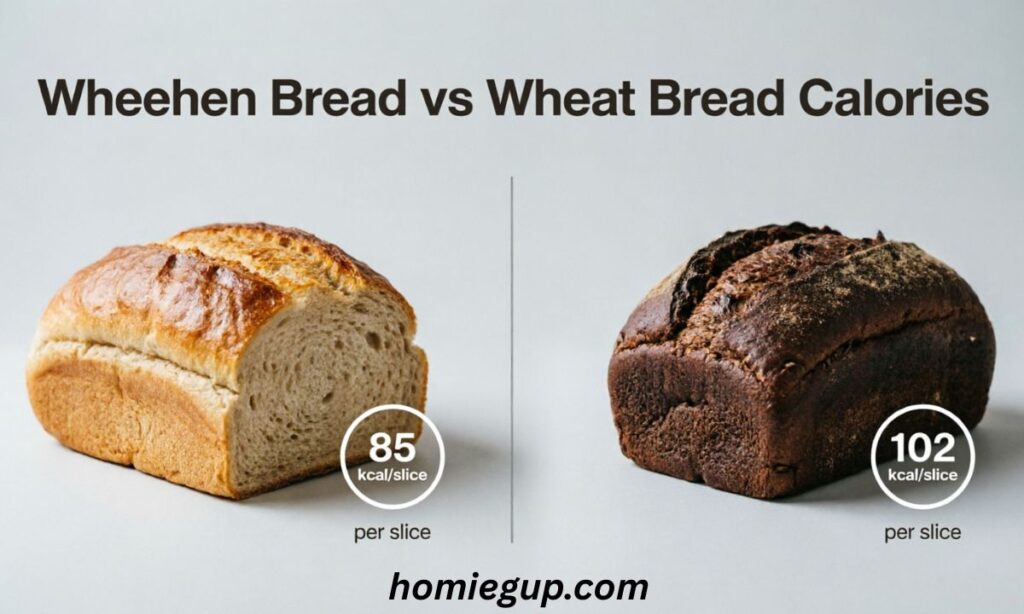
This is a comparison many health-conscious readers search for. The short answer: they are often the same thing, described differently.
“Wheaten bread” commonly refers to traditional Irish or British-style bread made with wholemeal wheat flour, sometimes blended with plain flour. “Wheat bread” is a broader commercial term covering any bread made from wheat — including refined white wheat bread.
| Bread Type | Calories per Slice | Fiber | Protein |
| Traditional wheaten bread (Irish style) | 74–120 kcal | 2–4g | 3–5g |
| Whole wheat bread (commercial) | 81 kcal | 2g | 4g |
| White wheat bread (commercial) | 77 kcal | 0.5g | 3g |
| Wholemeal wheat bread | 90–100 kcal | 3–5g | 4–6g |
The calorie difference between wheaten bread and standard wheat bread is small. The bigger difference is in fiber and micronutrient content — traditional wheaten bread made from wholemeal flour consistently offers more of both.
Common Mistakes To Avoid
Now that we have covered definitions and usage in the wheaten vs wheat debate, let’s address the errors that trip people up most often.
Mistake #1: Using “Wheaten” As A Synonym For “Wheat”
This is the most frequent mistake. Because wheaten clearly derives from wheat, many writers assume the two words are interchangeable. They are not.
Incorrect: “I need to buy some wheaten from the grocery store.” Correct: “I need to buy some wheat from the grocery store.”
Wheaten cannot stand alone as a noun. It has no independent meaning without a noun following it. If you find yourself writing wheaten at the end of a sentence with nothing after it, you have made this error. Replace it with wheat.
Mistake #2: Using “Wheat” When Referring To A Specific Variety Of Wheaten
The reverse error also occurs. Writers sometimes use wheat as an adjective to describe the color of something or to modify a noun, when wheaten would be the cleaner, more precise choice.
Awkward: “The dog had a beautiful wheat-colored coat.” Better: “The dog had a beautiful wheaten coat.”
Awkward: “She baked wheat bread using wholemeal flour.” Better: “She baked wheaten bread using wholemeal flour.”
While “wheat bread” is an accepted compound noun in modern English (especially in the US), using wheaten as a modifier is grammatically cleaner and more precise when you want to emphasize that the food is made from wheat.
Tips To Avoid Making These Mistakes
Three practical questions to ask yourself before writing:
- Is the word standing alone or modifying something? If standing alone → use wheat. If modifying → use wheaten.
- Am I referring to the grain/crop itself? If yes → wheat.
- Am I describing a product, color, or characteristic? If yes → wheaten.
Context Matters
The wheaten vs wheat question does not have a single answer that fits every situation. Context shapes the correct choice significantly.
Culinary Context
In culinary writing, wheaten typically appears in traditional and artisan food descriptions. Irish wheaten bread, wheaten scones, and wheaten biscuits are fixed phrases with cultural meaning. In broader commercial food writing, wheat more often appears in compound nouns: wheat bread, wheat flour, wheat germ. Both are correct in their context.
Nutritional Context
In nutritional writing, wheat almost always dominates because nutrition science deals with the grain itself — its composition, protein content, gluten structure, and variety. You would write about “the nutritional profile of whole wheat” not “the nutritional profile of whole wheaten.”
Cultural Context
In Irish and Northern Irish culture, wheaten bread is a deeply embedded term. It describes a specific regional style of soda bread made with wholemeal flour, often without yeast. Calling it “wheat bread” in that context would feel generic and miss the cultural specificity entirely.
Geographic Context
In the United States, “wheat bread” is the dominant term found on grocery store shelves and in recipes. In Ireland, the United Kingdom, and parts of Europe, “wheaten bread” or “wheaten loaf” is more commonly used. Neither is wrong; both reflect regional conventions.
Exceptions To The Rules: Wheaten Bread vs Wheat Bread
No grammar guide is complete without acknowledging the genuine exceptions that exist in everyday language. Here are the three main ones in the wheaten vs wheat debate.
1. Regional Differences
As mentioned, “wheat bread” in American English and “wheaten bread” in Irish or British English can describe similar or even identical products. A writer targeting a US audience should use “wheat bread”; a writer targeting an Irish or UK audience should use “wheaten bread.” Neither is a grammar error — they are regional conventions.
2. Technical Terminology
In agricultural and botanical writing, wheat is always used as the noun because technical terminology requires precision about the species (Triticum). You would never see wheaten in a crop science paper. In baking science and food chemistry, wheat similarly dominates in technical contexts (wheat starch, wheat protein, wheat bran).
3. Brand Names
Some commercial bakeries and food brands use “wheaten” in their product names as a marketing choice — to evoke a sense of naturalness, tradition, or artisanal quality. This use falls outside strict grammatical rules and is a deliberate branding decision. Seeing “Wheaten Crackers” on a package does not mean wheaten functions differently in those cases; the brand is simply using the adjective as a product identifier.
Practice Exercises
Reading about wheaten vs wheat is useful. Practicing it locks the knowledge in place.
Exercise 1: Fill In The Blank
Choose the correct word — wheaten or wheat — for each sentence below.
- The bakery in Belfast is famous for its traditional ________ bread.
- The farmer harvested three hundred tonnes of ________ before the first frost.
- Her dog had a silky, ________ coat that shone in the sunlight.
- Whole ________ flour retains the bran and germ for maximum nutritional benefit.
- The recipe calls for ________ oats, not instant oats.
- Hard red ________ produces flour with a higher protein content than soft white ________.
- The interior designer chose a warm ________ tone for the kitchen walls.
- Ancient Egyptians cultivated ________ along the Nile River thousands of years ago.
Answer Key: 1. wheaten | 2. wheat | 3. wheaten | 4. wheat | 5. wheaten | 6. wheat / wheat | 7. wheaten | 8. wheat
Read This: Bachelor vs Batchelor: When to Opt for One Term Over Another
Exercise 2: Sentence Completion
Complete each sentence using either wheaten or wheat in a way that makes grammatical and contextual sense. There may be more than one acceptable answer.
- The nutritionist recommended whole ________ as a better source of dietary fiber than refined grains.
- She grew up eating ________ bread with butter and jam every morning in County Down.
- The puppy’s ________ coloring made it look like a small, fluffy bundle of golden straw.
- ________ is grown on more land worldwide than any other food crop.
- He baked a batch of ________ scones for the Sunday farmers’ market.
- The food scientist analyzed the gluten structure of several ________ varieties.
Answer Key: 1. wheat | 2. wheaten | 3. wheaten | 4. Wheat | 5. wheaten | 6. wheat
Frequently Asked Questions
What is the main difference between wheaten and wheat?
Wheat is a noun referring to the cereal grain itself, while wheaten is an adjective meaning “made from or relating to wheat.”
Can I use wheaten and wheat interchangeably?
No — they are different parts of speech and cannot substitute for each other without changing the grammar of a sentence.
What does wheaten mean as a color?
Wheaten describes a pale yellow-beige color, like the warm golden hue of ripe wheat stalks in a field.
What is wheaten bread?
Wheaten bread is a traditional Irish and British style of bread made from whole wheat or wholemeal flour, often denser and earthier than standard white bread.
Is wheaten bread healthier than wheat bread?
Traditional wheaten bread made from wholemeal flour typically contains more fiber and micronutrients than refined wheat bread, making it a more nutritious choice.
Why is the dog breed called a Wheaten Terrier?
The Soft-Coated Wheaten Terrier gets its name from the pale golden color of its coat, which resembles the color of wheat grain. It is an Irish breed recognized by the AKC in 1973.
Is wheaten bread the same as whole wheat bread?
They are similar but not identical — wheaten bread is a specific regional term (especially Irish) for a dense wholemeal loaf, while whole wheat bread is a broader commercial category.
How many calories are in a slice of wheaten bread?
A typical slice of wheaten bread contains approximately 74–120 calories, depending on the recipe and density of the loaf.
Can wheat be used as an adjective?
Yes, occasionally — “wheat bread” is an accepted compound noun. But when you want to describe something made from wheat, wheaten is the more precise adjective.
Is wheaten a common word?
Wheaten is more common in Irish, British, and culinary contexts. In American English, it appears most often in the context of wheaten terriers and artisan baking.
Conclusion
The wheaten vs wheat debate comes down to one fundamental grammatical principle: wheat is a noun (the grain), and wheaten is an adjective (made from that grain, or the color of it).
Use wheat when you are talking about the crop, the ingredient, the agricultural commodity, or the species. Use wheaten when you are describing something made from wheat, colored like wheat, or pertaining to wheat in a descriptive sense.
In culinary and cultural writing — especially when referencing Irish or British food traditions — wheaten carries specific meaning and regional flavor that wheat simply cannot replicate. In nutrition, agriculture, and food science, wheat remains the dominant, precise term.
The context you are writing for — culinary, scientific, cultural, or geographic — should always guide your final choice. With the definitions, examples, tables, and exercises in this guide, you now have everything you need to handle the wheaten vs wheat question with confidence, clarity, and precision every single time.