

If you have ever stopped mid-sentence wondering whether to write wise vs wize, you are not alone. This spelling confusion trips up writers across all experience levels, and the reason is surprisingly simple: both words sound identical when spoken aloud. The “s” in wise vs wize produces a sound close to “z,” making the phonetic gap between them almost invisible. Yet on paper, only one of these spellings belongs in standard written English, while the other carries a very specific and limited set of use cases.
When someone searches for wise vs wize, they usually want a clear, definitive answer they can apply right away. This guide breaks down everything you need to know about wise vs wize, from definitions and correct usage to common mistakes, contextual examples, and practice exercises that will sharpen your understanding for good. By the end, the wise vs wize question will never slow you down again.
Define Wise
The word wise is a legitimate, well-documented English word with a long history rooted in Old English. It traces back to the Old English word wīs, which shares linguistic ancestry with Dutch wijs, German weise, and Old Norse vīss. This historical depth explains why the spelling has remained stable for over a thousand years despite pronunciation shifts in the language.
In modern English, wise primarily functions as an adjective. It describes a person, decision, action, or piece of advice that reflects good judgment, sound reasoning, experience, or deep knowledge. When someone is called wise, it means they understand situations with clarity, consider consequences carefully, and typically make choices that prove beneficial over time.
Beyond its role as an adjective, wise can also function as a noun in older or literary usage, where it refers to a way or manner of doing something, as in the phrase “in no wise” meaning “in no way.” As a suffix, wise appears in compound words and adverbial constructions such as streetwise, clockwise, likewise, otherwise, and weatherwise.
Key characteristics of the word “wise”:
- It is the standard, accepted spelling in all formal writing
- It appears in every major English dictionary including Merriam-Webster, Oxford, and Collins
- It functions as an adjective, noun suffix, and archaic adverb
- It is recognized in academic, professional, and casual writing alike
- It is the only correct choice in standard grammar
Synonyms for wise include: sensible, prudent, judicious, knowledgeable, discerning, insightful, shrewd, enlightened, and sage.
Understanding what wise means is the first step toward mastering the wise vs wize distinction confidently. Many people who search for wise vs wize are surprised to learn how deep the roots of the word “wise” actually go.
Define “Wize”
So what exactly is wize? The short answer is that wize is not a recognized word in standard English. It does not appear in formal dictionaries as a standalone entry with its own definition. It carries no official grammatical function in academic or professional contexts. When most writers use wize, they are simply misspelling wise due to the phonetic similarity between the two.
That said, wize does exist in a few very specific, non-standard contexts worth knowing about:
1. Phonetic Misspelling The most common reason wize appears in written text is straightforward: the writer spelled the word the way it sounds. Because the “s” in wise produces a “z” sound, many people instinctively write wize. This is a phonetic error, not a legitimate alternative.
2. Informal and Slang Usage In casual digital communication, texting, and online spaces, wize sometimes appears as a stylized or creative spelling of wise. Urban Dictionary, for example, documents informal uses of wize in slang expressions. However, this usage is non-standard and would be considered incorrect in any formal context.
3. Branding and Marketing Some companies and brands deliberately use wize as part of their name or identity to stand out visually or create a unique stylistic impression. In this narrow context, wize is an intentional creative choice, not a spelling mistake. Examples include tech startups, app names, and marketing campaigns that adopt the alternate spelling for distinctiveness.
4. Archaic or Obsolete Reference Some older texts and resources like Wiktionary list wize as an obsolete form of wise. This is not a practical reason to use it in modern writing, but it does confirm the word has historical traces.
Key characteristics of “wize”:
- It is NOT recognized in standard English dictionaries
- It is considered a misspelling of wise in formal, academic, and professional writing
- It may appear in branding, usernames, informal messages, and slang contexts
- It is not valid in Scrabble or other word games that follow official dictionaries
- It does not have a unique meaning separate from wise
The wise vs wize distinction boils down to this: one is correct English, and the other is informal at best and incorrect at worst.
How To Properly Use The Words In A Sentence?
Read This: Accross Vs Across: Which Is The Correct Spelling And Why?
Knowing when and how to use wise vs wize correctly makes a real difference in the quality and credibility of your writing. Here is a practical breakdown for both words.
How To Use “Wise” In A Sentence
Wise works primarily as an adjective. It describes someone or something that shows good judgment, experience, or knowledge. You can use it to modify nouns (people, decisions, choices, words) or as a predicate adjective following a linking verb.
Structure patterns for using wise correctly:
| Pattern | Example |
| It is wise to + verb | It is wise to save money before spending. |
| A wise + noun | A wise teacher listens before speaking. |
| Subject + was/is wise | Her response was wise and measured. |
| Wise + noun + verb | A wise investor diversifies their portfolio. |
Key usage tips for wise:
- Always use wise in formal essays, reports, academic papers, and professional emails
- Use it when describing people who demonstrate sound judgment or experience
- Use it when referring to decisions or actions that reflect careful thinking
- Never substitute wize for wise in any formal context
How To Use “Wize” In A Sentence
Because wize is not a standard English word, there is no grammatically correct way to use it in formal writing. The only contexts where it carries intentional meaning are:
- Branding contexts: “Download the Wize app to manage your finances.” (where Wize is a brand name)
- Casual or informal digital communication: When a person intentionally uses a stylized spelling for creative or social effect
- Slang or regional informal speech: Where creative spelling choices are understood and accepted by the audience
If you are writing a blog post, academic paper, business email, news article, or any professional content, you should always choose wise and never wize. The wise vs wize question has a clear answer the moment formality enters the picture.
More Examples Of Wise & Wize Used In Sentences
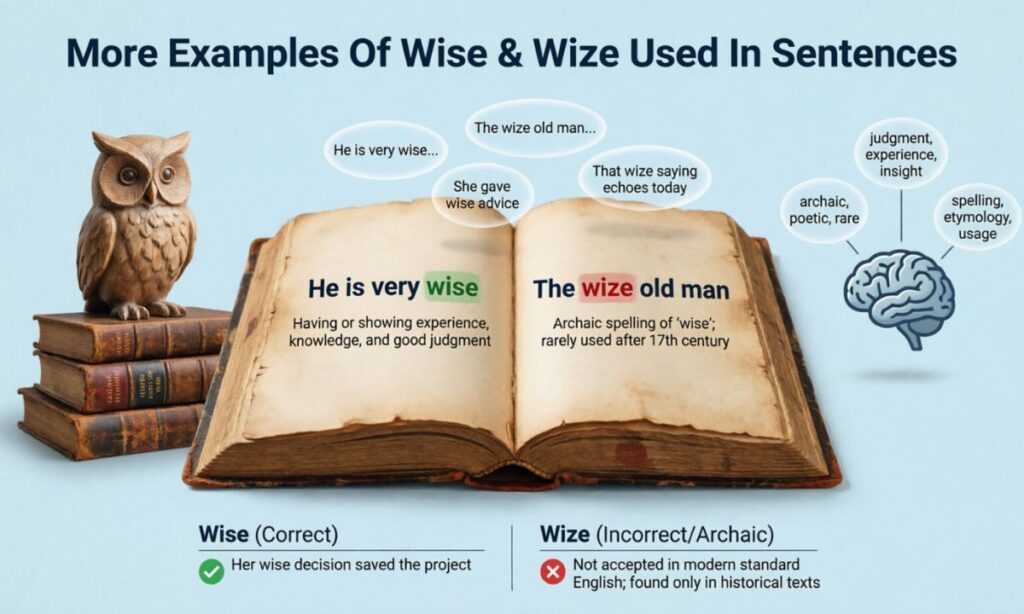
Seeing multiple examples in action is one of the most effective ways to internalize the wise vs wize distinction and make correct choices automatically.
Examples Of Using “Wise” In A Sentence
- It is wise to review your financial goals at least once a year.
- The elder gave the students wise and thoughtful advice before graduation.
- Making a wise investment decision requires patience and research.
- She was wise enough to ask for help rather than struggle alone.
- The wise old mentor always listened carefully before offering guidance.
- It was a wise move to back up all the files before the system update.
- Parents often share wise words that children only appreciate years later.
- The council made a wise and well-considered policy decision.
- He proved himself a wise leader by putting the team’s needs above his own.
- Choosing to study rather than guess was the wise approach to the exam.
Examples Of Using “Wize” In A Sentence
Because wize is not a standard word, the following examples show it only in contexts where it appears intentionally, such as brand names or informal stylized use:
- The startup launched a platform called Wize to help students find tutors online. (brand name)
- She signed up for the Wize budgeting app after seeing it recommended in a podcast. (brand name)
- In the group chat, he typed “that was wize of you lol” as a casual compliment. (informal slang)
- The social media handle @WizeCoach was used by a life skills influencer. (informal branding)
- The underground hip hop collective called themselves W.I.Z.E. as an acronym for their values. (stylized creative use)
Notice that in every legitimate use of wize, it appears within a creative, branded, or informal context. The moment you move into formal writing, wise vs wize has only one correct answer: wise.
Common Mistakes To Avoid
Understanding the wise vs wize difference is not just about knowing definitions. It is about recognizing where writers go wrong and building habits to avoid those errors. Every time you encounter the wise vs wize choice in your writing, pausing for even one second to confirm the context will protect the quality of your work.
Using “Wize” Instead Of “Wise”
This is by far the most common mistake in the wise vs wize debate. Writers type wize when they mean wise simply because the phonetic sound of the word ends in a “z” tone. This is a purely instinctive error driven by pronunciation rather than grammar knowledge.
Why it happens: The “s” in wise produces a voiced sibilant sound that closely resembles the letter “z.” When people write quickly, especially in digital environments, they spell words as they hear them. This results in wize appearing in essays, emails, and formal documents where only wise belongs.
Why it matters: Using wize instead of wise in professional or academic writing immediately signals a spelling error to any reader familiar with standard English. It can undermine your credibility, distract from your message, and reduce the overall quality of your writing.
Using “Wise” Instead Of “Wize”
This mistake is less common but worth addressing. It applies specifically to branded contexts. If you are writing about a company, app, or product whose official name is spelled Wize, then replacing it with wise is technically inaccurate.
For example, if a company is officially named Wize, writing about it as Wise could cause confusion with other brands or services that use the standard spelling. In such cases, respecting the brand’s chosen spelling is the correct approach, even if wize would otherwise be considered non-standard.
Tips To Avoid Mistakes
Follow these practical strategies to keep your wise vs wize usage accurate every time:
- Default to “wise” in all formal writing. If you are writing an essay, report, article, or professional communication, wise is always the correct choice.
- Double-check brand names. If you are referencing a specific product or company, verify the official spelling before writing.
- Use a spell checker. Most modern word processors and grammar tools flag wize as a spelling error, giving you a built-in safety net.
- Read your work aloud. Catching errors is easier when you hear how words sound in context.
- Build vocabulary through reading. Regularly reading well-edited publications reinforces correct spelling naturally over time.
Context Matters
One of the most important principles in the wise vs wize discussion is that context shapes which spelling is appropriate. The wise vs wize question does not have one answer for every situation. Even though wize is incorrect in standard English, there are real-world scenarios where understanding its existence adds useful nuance.
Context determines not only which word you should use but also how your audience will receive it. A spelling that works perfectly in a casual Instagram caption would look completely wrong in a business proposal. Recognizing this distinction helps you make smarter choices every time the wise vs wize question comes up.
The three main context factors to consider are:
- Audience Who will read this? A professor, a client, a casual follower, or a child?
- Purpose Is this to inform, persuade, entertain, or connect?
- Platform Is this a printed document, a social media post, an academic submission, or a marketing asset?
When audience is formal, purpose is professional, and platform is official, the answer to wise vs wize is always wise. When all three factors shift toward informal, creative, or branded territory, wize might appear intentionally, though never as a substitute for correct grammar.
Examples Of Different Contexts
1. Formal Writing
In formal writing such as academic papers, research articles, legal documents, and business reports, only wise is acceptable. There is no room for creative spelling in these environments because readers expect precision and professionalism.
Example: “It would be wise for organizations to adopt a data protection policy before expanding their digital infrastructure.”
2. Informal Writing
In informal writing such as personal blogs, social media posts, text messages, and casual emails, writers sometimes use wize as a stylistic choice. While it is not grammatically correct, the informal environment makes it less jarring to the reader.
Example: “That was a pretty wize move if you ask me lol” (text message between friends)
Even in informal writing, defaulting to wise is a better habit because it keeps your grammar instincts sharp.
3. Branding and Marketing
This is perhaps the one context where wize carries genuine legitimacy. Companies often adopt creative or alternate spellings to trademark their brand identity, appear distinctive in search results, and appeal to younger or tech-oriented audiences.
Example: “Wize Solutions is a fintech startup helping small businesses manage cash flow through AI-powered tools.”
In marketing copy for such a brand, using Wize as written in their official branding is not only acceptable but necessary for accuracy.
4. Academic or Professional Context
In academic or professional settings, the wise vs wize question has a definitive answer: always use wise. Whether you are writing a thesis, preparing a conference paper, drafting a professional email, or contributing to a peer-reviewed journal, wize has no place.
Example: “The wise allocation of research funds remains a critical factor in determining long-term institutional success.”
Exceptions To The Rules
While the general rule for wise vs wize is clear, a few noteworthy exceptions exist that are worth understanding fully.
Compound Words
When wise appears as part of a compound word or as a suffix, its spelling remains consistent with standard English. Words like streetwise, likewise, otherwise, clockwise, lengthwise, and worldly-wise all use the standard “wise” spelling. The suffix wise in these compound forms has a long history in English and is recognized by all major dictionaries.
Wize does not appear as a standard suffix or compound element. Even in creative brand names that use wize, the broader compounding rules of English still apply to the standard vocabulary.
Informal Writing
As outlined earlier, informal writing is one space where wize occasionally surfaces without the intent to mislead. In text message conversations, social media banter, and online gaming usernames, writers may use wize as a stylized or casual variation. In these spaces, the standards of formal grammar are often relaxed, and creative spelling is common.
Even so, this exception does not make wize correct. It simply means that in certain informal environments, its use is understood and not likely to cause confusion.
Regional Differences
Neither British English nor American English formally recognizes wize as a standard spelling. Both varieties of English use wise consistently in all formal documents and publications. There is no regional dialect or national variety of English where wize is the accepted standard form.
However, in some regional slang traditions, unconventional spellings like wize can appear in creative writing, song lyrics, or street expressions. These uses are culturally specific and do not reflect broader grammar rules.
Practice Exercises
The best way to truly master wise vs wize is to work through practical exercises. These two exercises are designed to test your understanding of the wise vs wize rule and reinforce correct usage.
Exercise 1: Fill In The Blank
Choose either wise or wize to correctly complete each sentence. Think carefully about the context before answering.
- It is always ___ to read the terms and conditions before signing a contract.
- She downloaded the ___ app to help manage her monthly budget more efficiently. (brand name)
- The professor gave ___ feedback that helped the student improve significantly.
- Only a ___ leader puts the welfare of others ahead of personal gain.
- He is ___ enough to know when to speak and when to listen.
- The investor made a ___ decision by diversifying across multiple asset classes.
- In the group chat, she typed “that was totally ___ of you” as a joke. (informal)
- A ___ traveler always keeps copies of their important documents.
Answer Key:
- wise 2. Wize (brand) 3. wise 4. wise 5. wise 6. wise 7. wize (informal) 8. wise
Read This: Headcount or Head Count: Find Out the Right Spelling and Usage
Exercise 2: Sentence Completion
Complete each sentence using the correct word, either wise or wize, and then write one additional sentence of your own using the same word in a similar context.
- It is not ___ to make important decisions when you are angry because ___.
- The startup named ___ launched a new product feature that ___.
- A truly ___ person understands that ___.
- He was ___ enough to ___ before the situation got worse.
Suggested completions:
- It is not wise to make important decisions when you are angry because emotions often cloud rational thinking.
- The startup named Wize launched a new product feature that simplifies expense tracking for freelancers.
- A truly wise person understands that listening is often more valuable than speaking.
- He was wise enough to seek professional advice before the situation got worse.
Final Thoughts
The wise vs wize debate is ultimately a question of context, accuracy, and intent. Wise is the correct, standard English spelling that belongs in every formal, professional, and academic setting. It carries a rich history, a clear dictionary definition, and broad acceptance across all English-speaking communities. Wize, on the other hand, is a non-standard variation that appears primarily through phonetic misspelling, informal stylization, or intentional brand naming.
Understanding the wise vs wize distinction helps you write more clearly, avoid embarrassing errors, and present yourself as a careful and credible communicator. The next time you find yourself choosing between wise vs wize, remember: if it is formal, it is always wise. If it is a brand name, check the official spelling. And if it is a casual text to a friend, context gives you a little more flexibility. Most writers who resolve the wise vs wize confusion once never make the same mistake again.
Clear writing builds trust. Choosing the right word, even when the difference feels minor, is one of the simplest ways to communicate with confidence. Keep the wise vs wize rule in mind and your writing will always reflect the level of care your readers deserve.