
Have you ever used the words “village” and “subdivision” as if they meant the same thing? You are not alone. Many people treat village vs subdivision as interchangeable terms, but doing so leads to genuine confusion, especially in real estate, social studies, and everyday conversation. These two words describe very different types of communities, and understanding the distinction can help you communicate with clarity and confidence.
In this article, you will find a complete breakdown of village vs subdivision, including clear definitions, usage guides, Philippine context, common mistakes, and practice exercises. Whether you are a student, a homebuyer, or simply someone who wants to sharpen their vocabulary, this guide covers everything you need to know.
What Is a Village? A Clear Definition
A village is a small human settlement that is typically found in a rural or semi-rural area. It is larger than a hamlet but smaller than a town. A village grows naturally over time, shaped by the people who live in it, their shared traditions, local governance, and cultural practices.
Villages usually have a population that ranges from a few hundred to a few thousand residents. They have a deep sense of community, where neighbors know each other by name and local festivals, markets, and gathering spots form the heart of daily life.
Key Characteristics of a Village
- Has its own local governance, such as a council or barangay system
- Grows organically rather than through a developer’s blueprint
- Located in rural or semi-rural environments
- Rooted in cultural tradition, local history, and shared identity
- Residents often rely on farming, fishing, or small local trades
- Strong social bonds and a slower pace of life
- May include churches, local shops, schools, and communal spaces
In some parts of the United States, a village is also a legally recognized form of incorporated municipality, smaller in population than a town. In the Philippines, the word “village” is sometimes used to describe a gated residential community, which adds an interesting layer to the village vs subdivision debate in that region.
Read This: Implicit vs Complicit: Clear Differences Explained With Practical Examples
What Is a Subdivision? A Clear Definition
A subdivision is a planned residential development created when a parcel of land is divided into smaller lots for the purpose of building homes. Unlike a village, a subdivision does not grow naturally. It is designed by a developer with a specific layout, organized streets, and a uniform set of amenities.
Subdivisions are most commonly found in urban and suburban areas. They are built to meet the demands of a growing population that wants modern housing close to schools, workplaces, and commercial centers.
Key Characteristics of a Subdivision
- Created by a real estate developer following a planned blueprint
- Located in urban or suburban area
- Features organized streets, sidewalks, and lot boundaries
- May include shared amenities like parks, swimming pools, and gyms
- Often governed by a Homeowners Association (HOA)
- Modern infrastructure including streetlights, drainage, and utilities
- Homes are often uniform in style, built by the same construction company
Understanding subdivision helps clarify the village vs subdivision comparison. A subdivision is built; a village grows. That one sentence captures the core difference between these two commonly confused terms.
Village vs Subdivision: A Side-by-Side Comparison
| Feature | Village | Subdivision |
| Origin | Grows naturally over time | Planned and built by a developer |
| Location | Rural or semi-rural | Urban or suburban |
| Governance | Local council, barangay, or government | Homeowners Association (HOA) or local government |
| Infrastructure | Often simple or developing | Modern, organized, well-equipped |
| Community Feel | Traditional, tight-knit, culturally rooted | Structured, organized, amenity-driven |
| Population | Small, ranging from hundreds to a few thousand | Varies; can be small or large depending on the project |
| Amenities | Local shops, churches, markets | Parks, pools, gyms, security gates |
| Ownership | Community-owned or government-managed | Privately developed and managed |
| Historical Depth | Deep cultural and historical roots | Newer; often lacks historical character |
| Lifestyle | Calm, rural, traditional | Convenient, modern, structured |
This table makes the village vs subdivision comparison easy to visualize and remember.
How To Properly Use the Words In a Sentence?

Knowing the definitions is one thing. Knowing how to use these words correctly in writing and conversation is another. The village vs subdivision distinction matters especially when you are describing a place, writing a real estate listing, or doing academic work.
How To Use “Village” In a Sentence
Use the word “village” when you are describing a small, organically grown community with cultural roots, local governance, and a rural or semi-rural setting.
Examples:
- “My grandmother grew up in a small village in the mountains where everyone gathered for the harvest festival every October.”
- “The village council voted to preserve the old stone chapel at the center of town.”
- “Tourists visit the village to experience traditional weaving and folk art passed down through generations.”
- “The village has no traffic lights, no malls, and no subdivisions, but it has something most cities lack: genuine community.”
- “Relief goods were sent to the remote village after the flooding damaged several homes along the riverbank.”
Notice how the word “village” in each sentence connects to something organic, cultural, traditional, or naturally formed. This is the correct context for using the term.
How To Use “Subdivision” In a Sentence
Use the word “subdivision” when you are referring to a planned residential area developed by a real estate company, complete with organized lots, modern amenities, and structured governance.
Examples:
- “The family moved into a new subdivision on the outskirts of the city, where every home had a small garden and a two-car garage.”
- “The subdivision was developed by a well-known real estate firm and features 24-hour security, a clubhouse, and a swimming pool.”
- “Monthly HOA dues in the subdivision cover street lighting, garbage collection, and landscaping for common areas.”
- “Buyers interested in the subdivision should check zoning regulations before purchasing a lot.”
- “The new subdivision out past the highway will have three hundred homes when construction is complete.”
Each of these sentences uses “subdivision” in a context that is planned, developer-driven, and modern in character.
Village vs Subdivision in the Philippines
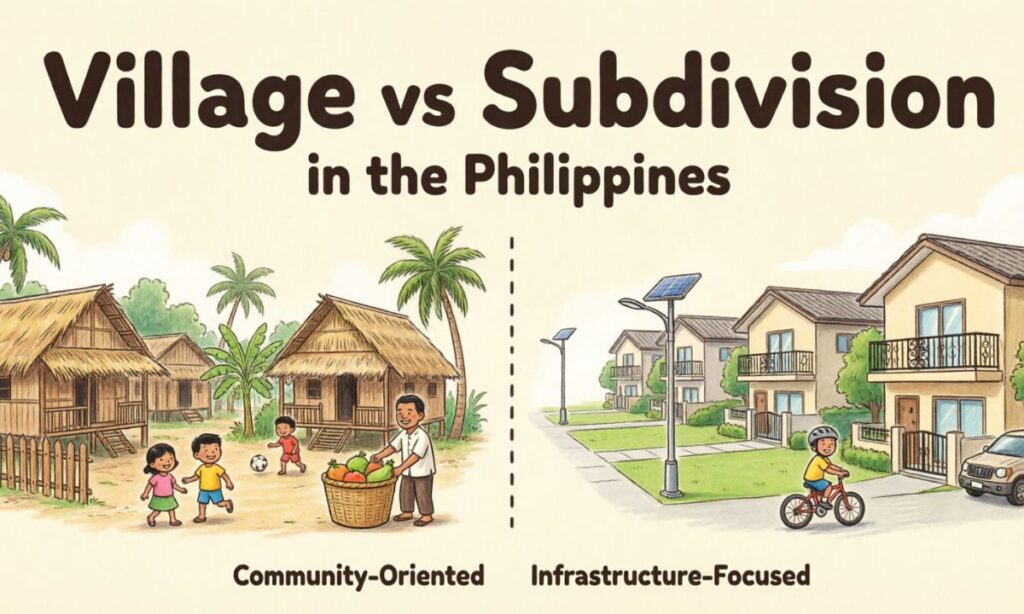
The village vs subdivision debate takes on a unique dimension in the Philippines. In Filipino real estate and everyday language, both terms are widely used, but they carry slightly different meanings than in other countries.
In the Philippines, a subdivision refers to any planned residential development, whether gated or open. Developers like Ayala Land, Camella, Filinvest, and DMCI build subdivisions across the country, ranging from affordable housing projects to premium enclaves. A subdivision in the Philippine context may or may not have a perimeter wall and security gate.
On the other hand, village in the Philippines commonly refers to a gated community or an executive village. These are upscale residential developments with controlled access, round-the-clock security, and a higher standard of amenities. Well-known examples include San Lorenzo Village, Forbes Park, and McKinley Hill Village in Metro Manila.
Philippine Village vs Subdivision: Key Differences
| Aspect | Village (Philippine Context) | Subdivision (Philippine Context) |
| Security | Gated with 24-hour guards and CCTV | May be gated or open access |
| Price Point | Generally higher-end or executive class | Ranges from affordable to mid-range |
| HOA Fees | Higher (₱1,000 to ₱5,000+ per month) | Lower or minimal |
| Developer Profile | Premium real estate brands | Wide range of developers |
| Location | Often in Makati, BGC, Taguig, and premium cities | Found throughout urban and suburban areas |
| Lifestyle | Exclusive, private, and upscale | Practical, family-oriented, community-driven |
This regional difference shows that the village vs subdivision comparison is not just a linguistic exercise. In the Philippines, choosing between the two can have direct implications for your budget, lifestyle, and daily living experience.
More Examples of Village and Subdivision Used in Sentences
Here is a broader set of examples that shows how each word functions in different contexts.
Examples of Using “Village” In a Sentence
- “The mountain village had no paved roads, but its people had a warmth that no city could replicate.”
- “She volunteered at a coastal village teaching children basic literacy skills.”
- “The village elder called a meeting to discuss the construction of a new water pump.”
- “Historical records show that the village has existed for over three hundred years.”
- “Development projects often bypass small villages, leaving them without proper electricity or water supply.”
- “The village market opens every Sunday, selling fresh produce and handmade crafts.”
- “A documentary crew visited the village to record the last remaining speakers of a dying local language.”
- “After retirement, he bought a small plot of land in a quiet village far from the noise of the city.”
- “The village transformed into a tourist destination after a travel blog featured its unique rice terraces.”
- “Every village in the province has a patron saint whose feast day is celebrated with music and food.”
Examples of Using “Subdivision” In a Sentence
- “The subdivision offers three-bedroom units with a starting price of two million pesos.”
- “Residents of the subdivision are required to follow strict rules about exterior paint colors and fence heights.”
- “A new road connecting the subdivision to the main highway will be completed by next year.”
- “The subdivision’s clubhouse is available for private events with a reservation fee.”
- “After years of saving, they finally bought a corner lot in a secure subdivision near the school.”
- “The homeowners in the subdivision voted to increase the monthly dues to fund CCTV upgrades.”
- “Flooding became a problem in the low-lying subdivision during the rainy season.”
- “The real estate agent showed them four different units in the subdivision before they made their decision.”
- “A subdivision is not just a place to live; for many families, it represents financial stability and safety.”
- “The newly launched subdivision near the airport sold out within two weeks of its public offering.”
Common Mistakes To Avoid
Now that you understand village vs subdivision clearly, it is important to identify where most people go wrong.
Mistake 1: Using “Village” To Describe a Subdivision
One of the most frequent errors in the village vs subdivision discussion is calling a planned residential development a “village.” A subdivision is built by a developer with a specific design. It has HOA rules, organized streets, and modern amenities. Calling it a “village” strips away those characteristics and implies a naturally grown, rural community. This causes confusion and misrepresents the nature of the place.
For example, saying “I live in a beautiful village with 24-hour security and a swimming pool” sounds odd because villages do not typically have those features. The correct word in that sentence would be “subdivision.”
Mistake 2: Using “Subdivision” To Describe a Village
The reverse mistake is equally problematic. Calling a traditional, organically grown community a “subdivision” misrepresents its history, character, and governance. A village is a living piece of cultural heritage. Describing it as a “subdivision” implies it was designed, planned, and built for profit, which dismisses its authentic roots.
Saying “the ancient subdivision near the river has been home to the same families for ten generations” would be incorrect. The accurate term is “village.”
Tips To Avoid Making These Mistakes
Follow these practical tips to always use village vs subdivision correctly:
- Ask how the community started. Did it grow naturally over generations? Use “village.” Was it planned by a developer and built from scratch? Use “subdivision.”
- Look at the location. Rural or semi-rural areas point toward “village.” Urban or suburban settings with paved roads and infrastructure point toward “subdivision.”
- Check for HOA or council governance. HOA-governed communities are subdivisions. Locally governed communities are more likely villages.
- Consider the amenities. Gated entry, swimming pools, and gyms are signs of a subdivision. Local markets, churches, and communal farms are signs of a village.
- Research the area before writing or speaking about it. A quick look at the community’s history will confirm the right word to use.
Context Matters: When the Right Word Depends on Circumstances
The correct choice in a village vs subdivision situation is not always black and white. Context plays a significant role in determining which word fits better.
Location
Location is one of the clearest indicators. A community tucked in the mountains, surrounded by farmland and natural terrain, is almost certainly a village. A residential cluster sitting beside a commercial strip, near a school or hospital, and accessible via a planned road network is almost certainly a subdivision.
Lifestyle
The lifestyle associated with each term also matters. Village life is calm, rooted in tradition, and centered around the natural environment. Subdivision life is modern, structured, and built around convenience. If someone describes early morning rice harvests and evening community bonfires, they are talking about a village. If they describe HOA meetings and clubhouse bookings, they are talking about a subdivision.
Personal Preferences
When someone is deciding where to live, their personal preferences will shape their understanding of village vs subdivision. Those who value privacy, modern amenities, and security tend to prefer subdivisions. Those who value open spaces, community spirit, and cultural identity may prefer village living.
Neither lifestyle is superior. The terms simply describe two distinct ways of building and experiencing community.
Exceptions To The Rules
Language is rarely perfect, and there are exceptions in the village vs subdivision debate worth knowing.
Historical Villages
Some communities that began as organic villages were later incorporated into urban planning frameworks. These historical villages may now include some modern infrastructure, yet they retain their original cultural identity and governance structures. The term “village” remains appropriate for them despite the modernization.
Planned Villages
Some developers intentionally design residential communities to mimic the feel of traditional villages. They use narrow winding streets, communal gardens, and locally inspired architecture. These “planned villages” blur the line in the village vs subdivision debate. However, because they are developer-built, they are technically subdivisions with a village aesthetic.
Unincorporated Subdivisions
In some rural areas, developers build residential lots that are not yet covered by a formal HOA or municipal governance. These unincorporated subdivisions may look or feel similar to villages, but they are still classified as subdivisions because of their planned, developer-driven origins.
Regional Differences
As seen in the Philippines, the word “village” can carry a very specific local meaning that differs from its global definition. In some parts of the United States, a village is a legally incorporated municipality. In Australia, “subdivision” can refer to a retirement or planned lifestyle community. Always consider regional usage before applying a single global definition.
Read This: Catagory Vs Category: The Correct Spelling You Must Know
Practice Exercises
Test your understanding of village vs subdivision with these exercises.
Exercise 1: Fill In the Blank
Choose the correct word, either “village” or “subdivision,” to complete each sentence.
- “The ancient ________ near the river is known for its traditional weaving and colorful festivals.”
- “The developer just broke ground on a new ________ that will feature three hundred homes and a community park.”
- “Residents of the ________ pay monthly HOA dues to maintain the swimming pool and gated entry.”
- “Life in the remote ________ is simple, quiet, and centered around farming and family.”
- “The real estate listing described a corner lot inside a secure ________ near the business district.”
Answer Key:
- village
- subdivision
- subdivision
- village
- subdivision
Exercise 2: Identify the Correct Word
Read each description below and determine whether it describes a “village” or a “subdivision.”
| Description | Correct Term |
| A community built by Camella Homes with 24-hour security and a playground | Subdivision |
| A small farming community in the mountains of Bukidnon with a decades-old church | Village |
| A gated executive enclave in Makati with security guards and CCTV | Village (Philippine context) |
| A planned residential development with 150 lots near a new highway | Subdivision |
| A settlement of 500 people in rural Ilocos that has existed since the Spanish era | Village |
Conclusion
The village vs subdivision debate comes down to one simple idea: how a community came to exist. A village grows. A subdivision is built. This single difference shapes everything about how these two types of communities look, feel, and function.
In global usage, a village is a small, organically formed, culturally rooted community most often found in rural areas. A subdivision is a planned, developer-built residential development in urban or suburban settings. In the Philippines, the terms carry additional nuances where “village” often means a gated executive community and “subdivision” covers a broader range of planned housing.
Understanding village vs subdivision is not just a vocabulary exercise. It affects how you communicate about real estate, describe communities in writing, and make informed decisions about where to live. The next time you hear someone mix up these terms, you will know exactly how to set the record straight.
Use “village” for places with roots. Use “subdivision” for places with blueprints. That simple rule will serve you well in any context.