

Have you ever typed “studder” and then stopped, wondering if that even looks right? You’re not alone. Thousands of people search the question “studder or stutter” every single month — and for good reason. These two spellings sound almost identical when spoken aloud, yet only one of them actually exists in the English language.
Whether you’re writing a school assignment, drafting a professional email, or just trying to settle a debate with a friend, getting this right matters. In this article, you’ll get a clear, complete answer — along with everything you need to understand the word, its meaning, its science, and how to use it correctly every time.
Studder or Stutter – Which Spelling Is Actually Correct?
Let’s cut straight to it.
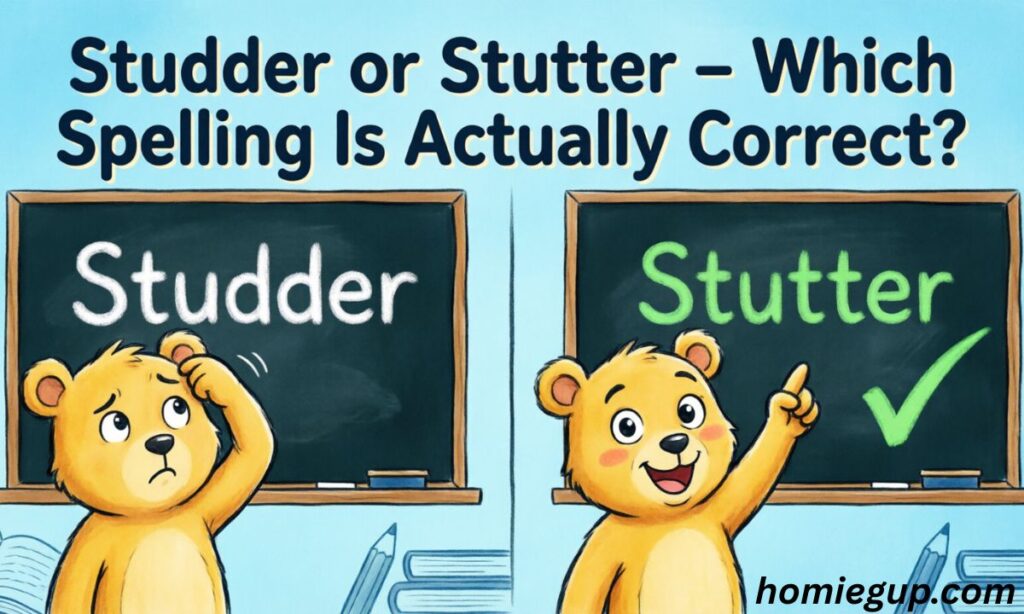
“Stutter” is correct. “Studder” is not a real word.
No major English dictionary — not Merriam-Webster, Oxford, or Cambridge — recognizes “studder” as a valid term. It doesn’t exist as a noun, verb, or any other part of speech. It is purely and simply a misspelling of “stutter.”
The Short Answer: Studder or Stutter?
| Spelling | Correct? | Recognized in Dictionaries? |
| Stutter | ✅ Yes | Yes — Merriam-Webster, Oxford, Cambridge |
| Studder | ❌ No | No — not found in any standard dictionary |
Every time you see “studder” written somewhere, it is a spelling error. The person meant to write “stutter.” Simple as that.
What Does “Stutter” Mean?
The word stutter functions both as a verb and a noun in English.
As a verb: To speak with involuntary disruptions — repeating sounds, prolonging syllables, or experiencing silent blocks mid-speech.
As a noun: The condition or act of speaking this way; a speech pattern characterized by disfluency.
The Cambridge Dictionary defines stutter as: “to speak or say something, especially the first part of a word, with difficulty, for example pausing before it or repeating it several times.”
Beyond speech, “stutter” is also used figuratively to describe anything that moves or progresses in an uneven, halting way — like a car engine that stutters uphill, or an economy with a stuttering recovery.
A Simple Way to Understand Stuttering
Think of stuttering like a song that keeps skipping. The melody is all there — the person knows exactly what they want to say — but the playback keeps interrupting, repeating, or freezing before it moves forward.
That’s exactly what happens during a stutter: the intent is clear, but the physical delivery of speech hits an involuntary roadblock.
Real-World Examples of Stutter in a Sentence
- “He began to stutter when the teacher called on him unexpectedly.”
- “Her stutter became less noticeable after six months of speech therapy.”
- “The old projector started to stutter halfway through the film.”
- “Despite his stutter, he delivered one of the most powerful speeches the audience had ever heard.”
- “She used to stutter badly as a child, but she gradually outgrew it.”
- “The engine began to stutter before finally dying on the highway.”
Why Do People Write “Studder” Instead of “Stutter”?
Read This: Wheaten vs Wheat: When To Use Each One? What To Consider
This is a fair question. If “studder” is completely wrong, why do so many people write it?
Key Reasons Behind the Studder vs Stutter Confusion
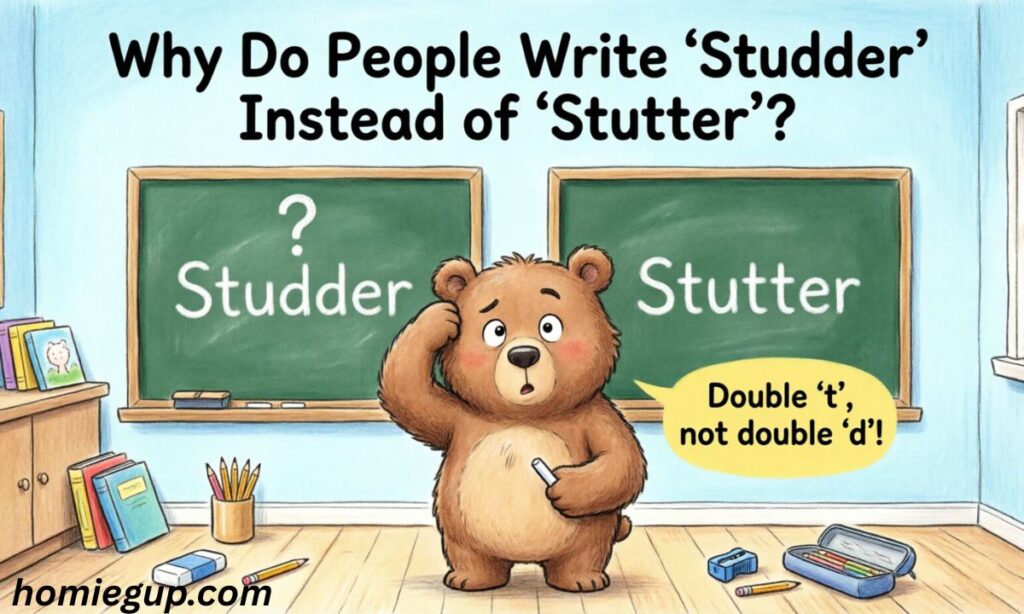
1. Phonetic Spelling When people hear the word “stutter” spoken in casual conversation, the double-T sounds almost like a soft “d” in many accents — especially in American English. The brain registers the sound and tries to spell it phonetically, landing on “studder.”
2. Fast Typing and Autocorrect Gaps In the age of texting and rapid digital communication, fingers often move faster than minds. “Studder” can slip through if autocorrect doesn’t flag it.
3. Lack of Visual Familiarity Many people don’t encounter the written word “stutter” often enough for its spelling to feel automatic. Without that visual reinforcement, guessing “studder” feels natural.
4. The “ud” Sound Pattern English has many common words with the “ud” pattern — mudder, rudder, udder, studded. The brain borrows from these familiar patterns and applies them incorrectly to “stutter.”
Studder vs Stutter – Key Differences at a Glance
| Feature | Studder | Stutter |
| Is it a real word? | ❌ No | ✅ Yes |
| Found in dictionaries? | ❌ No | ✅ Yes |
| Used in formal writing? | ❌ Never | ✅ Always |
| Correct spelling? | ❌ No | ✅ Yes |
| Speech disorder term? | ❌ No | ✅ Yes |
Memory Tip: Think of the double “t” in stutter as a reflection of the word’s own meaning — a sound that repeats. Two T’s, just like the repeated sounds in stuttered speech.
Is “Stutter” Different from “Stammer”?
This is where things get a little more interesting — and where a lot of people get tripped up for the second time.
Are Stutter and Stammer the Same Thing?
Yes — medically and clinically, stutter and stammer refer to the exact same condition.
The difference is purely geographical:
- In American English, the preferred term is stutter / stuttering.
- In British English, the preferred term is stammer / stammering.
The British Stammering Association uses “stammering.” The National Stuttering Association in the United States uses “stuttering.” Both organizations are talking about the same condition, with the same causes and the same treatment approaches.
The World Health Organization’s ICD-11 lists the condition as “Developmental speech fluency disorder” — carefully avoiding either regional preference.
Stutter vs Stammer – Simple Comparison
| Aspect | Stutter | Stammer |
| Condition | Speech fluency disorder | Speech fluency disorder |
| Primary Region | American English | British English |
| Medical Meaning | Identical | Identical |
| Clinical Treatment | Same | Same |
So while the studder or stutter question has a clear wrong answer (“studder”), the stutter vs stammer comparison has no wrong answer — they’re simply regional variations of the same word for the same thing.
The Science Behind Stuttering – A Simple Explanation
Understanding what stuttering actually is makes it much easier to appreciate why the correct spelling matters in medical and professional contexts.
What Happens in the Brain During Stuttering?
Stuttering is not a simple habit or a nervous tic. It is a neurodevelopmental disorder rooted in how the brain coordinates the complex act of producing speech.
When we speak, dozens of brain regions fire in precise sequence — forming language, organizing words, controlling breathing, coordinating lip and tongue movements, and monitoring sound output simultaneously. In people who stutter, research shows there are disruptions in the synchronization of these networks, particularly in the motor-speech pathways.
Studies published in neuroscience journals have identified differences in neural activity between people who stutter and those who don’t — specifically in areas related to speech motor control, auditory processing, and timing.
Key Insight on Stuttering and Brain Processing
Research from NIH-published studies notes that stuttering involves miscommunication within the speech motor network — regions of the brain fail to coordinate smoothly, causing involuntary pauses, repetitions, or blocks in the outward flow of speech.
An Easy Analogy
Imagine your brain as a busy highway with multiple lanes of traffic all heading toward one destination: spoken words. In fluent speakers, traffic flows smoothly. In people who stutter, some lanes suddenly merge without warning, creating bottlenecks and delays — even though the driver (the person) knows exactly where they want to go.
What Causes Stuttering?
Stuttering doesn’t have a single cause. It’s a multifactorial condition, meaning several different factors can contribute.
Main Causes of Stuttering Explained
- Genetics: Stuttering tends to run in families. Research suggests that genetic factors play a significant role, particularly in developmental stuttering.
- Neurological differences: Differences in how the brain’s speech motor networks develop and function are central to why stuttering occurs.
- Developmental factors: Most stuttering begins between ages 2 and 5, during a period of rapid language development when the brain’s systems are under significant demand.
- Neurogenic causes: In some cases, stuttering develops after a stroke, brain injury, or neurological event — this is called acquired or neurogenic stuttering.
- Psychogenic causes: Rarely, stuttering can arise from psychological trauma or significant emotional stress, though this is far less common than developmental causes.
It’s worth stating clearly: anxiety does not cause stuttering. However, anxiety and stress can make existing stuttering noticeably worse in certain situations — such as public speaking, phone calls, or high-pressure conversations.
Important Facts and Statistics About Stuttering
- Stuttering affects approximately 1% of the global adult population — roughly 80 million people worldwide.
- Between 5% and 10% of children experience stuttering at some point during development.
- More than 3 million adults in the United States live with a stutter, according to the National Institutes of Health.
- Stuttering most commonly begins between ages 2 and 6.
- About 75–80% of children who develop stuttering recover naturally, often without formal treatment.
- Roughly 15–20% of cases persist into adulthood and may require ongoing support.
- Stuttering is 3–4 times more common in males than females.
- The condition is found across all cultures, languages, and socioeconomic backgrounds.
Is Stuttering a Speech Disorder?
Yes — officially, stuttering is classified as a speech and language fluency disorder.
What Does a Fluency Disorder Mean?
A fluency disorder means that the normal flow and timing of speech is disrupted. In stuttering, these disruptions take three main forms:
- Repetitions — repeating sounds, syllables, or words (e.g., “I w-w-want to go”)
- Prolongations — stretching out a sound longer than normal (e.g., “Sssssorry, I’m late”)
- Blocks — complete stoppages where no sound comes out, even though the person is trying to speak
The DSM-5 (Diagnostic and Statistical Manual of Mental Disorders, 5th Edition) classifies stuttering under the term “Childhood-Onset Fluency Disorder.”
Common Misconception About Stuttering
Many people assume stuttering is caused by nervousness or low intelligence. Both assumptions are completely false. Stuttering has no connection to a person’s intelligence, personality, or confidence. It is a neurological condition — full stop. Many of history’s most accomplished speakers, including politicians, actors, and business leaders, have lived with a stutter.
When to Seek Help for Stuttering
Not all stuttering requires professional intervention, but certain signs suggest it’s worth consulting a speech-language pathologist (SLP):
- Stuttering persists beyond age 5 without improvement
- The stutter is getting progressively worse, not better
- The child is showing visible physical tension during speech (facial grimacing, eye blinking)
- The stutter is causing emotional distress, social avoidance, or school difficulties
- Stuttering begins suddenly in an adult who has never stuttered before
Can Stuttering Be Treated or Improved?
Yes — there are several effective approaches to managing stuttering, though a complete “cure” does not currently exist for most adults.
Common Stuttering Treatment Options
| Treatment Type | What It Involves |
| Speech Therapy | Working with a licensed speech-language pathologist to develop fluency strategies |
| Fluency Shaping | Techniques to reshape speech patterns — slower rate, controlled breathing |
| Stuttering Modification | Learning to stutter more easily and with less tension, rather than avoiding it |
| Cognitive Behavioral Therapy (CBT) | Addressing the anxiety and avoidance behaviors that can accompany stuttering |
| Electronic Devices | Devices that alter auditory feedback to help fluency in real time |
| Support Groups | Community programs like the National Stuttering Association that build confidence |
Practical Daily Strategies for Stuttering
- Slow your speaking rate — rushing often makes stuttering worse
- Practice diaphragmatic breathing before speaking in high-pressure situations
- Maintain eye contact to reduce the social anxiety loop
- Don’t avoid difficult words — avoidance tends to reinforce the stutter pattern
- Seek supportive environments where you feel safe to speak freely
Real-Life Case Insight
Many people who stutter report that their speech is markedly smoother when they sing, whisper, or speak alone to themselves. This phenomenon — known as the fluency paradox — has fascinated researchers for decades and actually helps guide how certain therapy techniques are developed.
Common Mistakes: Using “Studder” in Writing
Now that we’ve covered the science and meaning, let’s look directly at the writing mistake people make — and how to fix it every time.
Incorrect Usage of Studder
- “He had a bad studder when he was nervous.” ❌
- “The child’s studder improved with therapy.” ❌
- “She couldn’t hide her studder during the presentation.” ❌
- “His studder made ordering at restaurants stressful.” ❌
Correct Usage of Stutter
- “He had a bad stutter when he was nervous.” ✅
- “The child’s stutter improved with therapy.” ✅
- “She couldn’t hide her stutter during the presentation.” ✅
- “His stutter made ordering at restaurants stressful.” ✅
Side-by-Side Examples
| Incorrect (Studder) | Correct (Stutter) |
| She began to studder when anxious. | She began to stutter when anxious. |
| His studder vanished on stage. | His stutter vanished on stage. |
| Studder therapy helped greatly. | Stutter therapy helped greatly. |
| A sudden studder interrupted her. | A sudden stutter interrupted her. |
Real-Life Examples of “Stutter” in Use
The word stutter appears in many different contexts — not just when discussing the speech disorder.
Stutter in Casual Conversation
- “Why do you stutter when you talk to him — do you like him?”
- “He used to stutter as a kid, but you’d never know it now.”
- “She barely noticed her own stutter until someone pointed it out.”
Stutter in Professional Writing
- “The patient presented with a moderate stutter, characterized by initial-syllable repetitions.”
- “Speech therapy significantly reduced the frequency of his stutter over 18 months.”
- “Developmental stuttering is among the most researched fluency disorders in clinical literature.”
Stutter in Digital Communication
- “The video keeps stuttering — is the internet slow?”
- “My game stutters every time a new area loads.”
- “The economy saw a stuttering recovery through the second quarter.”
Note how in the last set of examples, “stutter” moves beyond speech entirely. It’s a versatile word used to describe any process that proceeds in an uneven, interrupted way.
British vs American English – Any Spelling Difference?
When it comes to the studder or stutter spelling question, British and American English are in complete agreement: stutter is the correct spelling in both versions of the language.
The only difference between British and American English on this topic is the choice of word:
- British English favors stammer
- American English favors stutter
But both spell their respective preferred word correctly. “Studder” is not an accepted spelling in any regional variety of English — not British, not American, not Australian, not Canadian.
Google Trends and Search Data: Studder vs Stutter
A look at search behavior reveals just how common this confusion is.
Key Insights from Search Behavior
- Searches for “studder or stutter” spike regularly, showing this is a genuine, recurring source of confusion for English speakers.
- The query “how to spell stutter” and “is studder a word” generate thousands of monthly searches globally.
- Despite the widespread confusion, search engines themselves consistently correct “studder” queries and return results for “stutter.”
What This Tells Us About User Intent
People searching for “studder or stutter” are not confused about the meaning of the word — they generally understand what stuttering is. What they’re unsure about is the correct written form. This is a pure spelling doubt, not a comprehension issue.
The fact that this question gets searched so frequently is itself proof of something important: spelling matters, and people care about getting it right.
Read This: Convertor vs Converter: Which Spelling Is Correct?
What the Cambridge Dictionary Says About Stutter
The Cambridge Dictionary — one of the most trusted references for English language learners and native speakers alike — is unambiguous on this topic.
According to the Cambridge Advanced Learner’s Dictionary, stutter means:
“To speak or say something, especially the first part of a word, with difficulty, for example pausing before it or repeating it several times.”
The Cambridge definition also captures the broader use of the word: describing anything that happens in an irregular, halting, or inconsistent manner.
Notably, “studder” does not appear anywhere in the Cambridge Dictionary — not as a variant spelling, not as an informal usage, not as a historical form. It simply does not exist within the recognized framework of standard English.
Frequently Asked Questions
Is “studder” ever correct in any context?
No. “Studder” is not a recognized word in any version of standard English and should never be used in writing.
How do you remember the correct spelling of stutter?
Think of the double “t” in stutter as mirroring the repeated sounds that define stuttering — two T’s for two sounds.
Does stutter only refer to a speech condition?
No. Stutter can also describe any process that moves unevenly or with interruptions, like a stuttering engine or a stuttering economy.
Are stutter and stammer interchangeable?
Yes — medically they refer to the exact same condition. “Stutter” is preferred in American English; “stammer” is preferred in British English.
Can adults develop a stutter later in life?
Yes. Neurogenic stuttering can develop after a stroke, brain injury, or other neurological event.
Is there a cure for stuttering?
There is no universal cure, but speech therapy and fluency techniques can significantly improve communication for most people who stutter.
Does nervousness cause stuttering?
No. Anxiety does not cause stuttering, but it can make existing stuttering more noticeable in certain situations.
What age does stuttering usually begin?
Most stuttering begins between ages 2 and 6, during the peak period of language development.
Do famous people stutter?
Yes. Many well-known figures throughout history have had a stutter, including politicians, actors, and public speakers.
Is stuttering more common in boys or girls?
Stuttering is approximately 3 to 4 times more common in males than females.
Final Thoughts
Let’s bring this full circle. The studder or stutter debate has one clean, definitive answer: stutter is correct, and studder is not a word.
Every major dictionary confirms it. Every grammar authority agrees. And every time you see “studder” written anywhere — in an article, a social media post, or a school paper — you are looking at a spelling mistake, plain and simple.
Beyond the spelling, though, this topic opens a window into something genuinely fascinating: the real nature of stuttering as a neurological condition that affects how the brain coordinates speech. It’s not a sign of nervousness, low confidence, or limited intelligence. It’s a complex fluency disorder experienced by millions of people around the world — people who deserve both accurate language and genuine understanding.
So the next time you go to type this word, remember: two T’s in stutter, just like the repeated sounds that give the word its meaning.