
Have you ever grabbed what you thought was a cleaning cloth — only to realize it was actually your living room floor covering? You’re not alone. The rug vs rag debate trips up native and non-native English speakers alike, and the confusion makes sense. Both words are short, both rhyme, and both involve fabric. But using the wrong one in the wrong context can leave people scratching their heads.
In this complete guide, you’ll learn the exact meaning of rug vs rag, where each word comes from, how to pronounce them correctly, when to use each one, and how to spot the difference every single time. By the end, you’ll never second-guess yourself again.
What Is the Core Difference Between a Rug and a Rag?
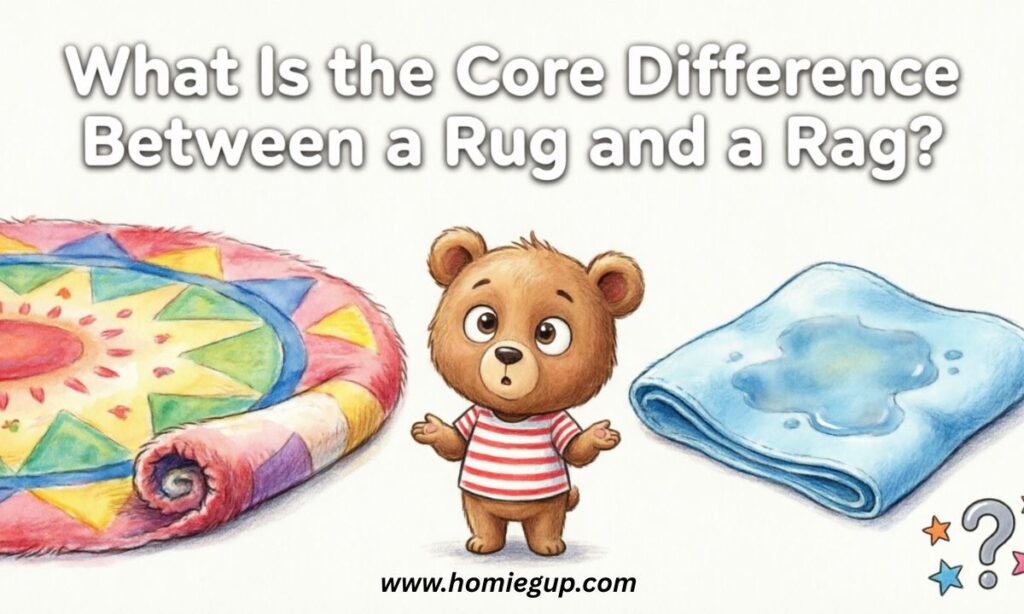
The fastest way to separate rug vs rag in your mind is to think about purpose.
- A rug is a thick piece of woven fabric placed on the floor for decoration, warmth, or comfort.
- A rag is a torn, worn, or leftover piece of cloth used mainly for cleaning, polishing, or wiping.
One lives on your floor and makes the room look beautiful. The other lives under the sink and handles your messes. That’s the heart of the rug vs rag difference — one decorates, the other cleans.
| Feature | Rug | Rag |
| Primary purpose | Decoration / floor covering | Cleaning / wiping |
| Material quality | Thick, woven, often high-quality | Torn, worn, or leftover fabric |
| Where it’s used | Living room, bedroom, hallway, entrance | Kitchen, garage, workshop, bathroom |
| Appearance | Designed with patterns and colors | Formless, faded, or tattered |
| Common materials | Wool, cotton, synthetic fiber, jute | Old cotton, flannel, microfiber scraps |
| Lifespan | Years to decades | Days to weeks |
| Cost | Can be expensive | Usually free (recycled clothing) |
Rug Vs Rag Meaning: A Closer Look
What Does “Rug” Mean?
A rug is a woven, thick floor covering that sits on part of a floor — not the entire floor like a carpet does. Rugs typically measure under four feet by six feet, though larger area rugs exist. They serve both functional and aesthetic purposes: they protect flooring, reduce noise, provide warmth underfoot, and tie a room’s design together.
Interestingly, the word rug also has a secondary meaning in informal usage. In theater slang, a “rug” refers to a toupee or hairpiece worn by a man. So if someone says, “He’s clearly wearing a rug,” they might not be talking about floor décor at all.
What Does “Rag” Mean?
A rag is a piece of cloth that is worn out, torn, or simply leftover — often repurposed for household tasks. Rags are cleaning workhorses: they wipe spills, polish furniture, scrub surfaces, and soak up liquids. When clothes or towels become too worn to use normally, many people cut them into rags rather than throwing them away.
The word rag can also be used figuratively. “Dressed in rags” means wearing very old, tattered clothing. “The local rag” is British slang for a newspaper (often used humorously or dismissively).
Where Do “Rug” and “Rag” Come From?
Read This: Sponser or Sponsor: Which Spelling Is Actually Correct?
Understanding the etymology of rug vs rag helps explain why the two words look and sound so similar — and why people often mix them up.
The Origin of “Rug”
The word rug first appeared in English around the 1550s, originally meaning “a coarse, heavy woolen fabric.” Linguists trace it to Scandinavian roots, specifically the Norwegian dialectal word rugga, meaning “coarse coverlet,” and the Old Norse rogg, meaning “shaggy tuft” or “rough hair.” Some also connect it to the Proto-Germanic root rawwa.
By the early 1590s, the meaning had evolved to include thick blankets and lap-robes used for warmth. Then, by around 1808, the modern meaning — a mat or partial floor covering — had fully taken hold. The famous idiom “sweep something under the rug” (meaning to hide a problem) appeared in written English by 1954, and “pull the rug out from under someone” (to suddenly remove support) was recorded as early as 1936.
The Origin of “Rag”
The word rag has an even older history, appearing in English as early as the early 14th century (around 1300–1320). It derives from Middle English ragge, which itself likely came from Old Norse rögg — the very same root as “rug.” This shared ancestry explains why the two words look so similar.
The Old Norse rögg referred to a “shaggy tuft” or “rough hair.” From that single root, English developed two distinct words: one (rug) that evolved to mean a floor covering, and one (rag) that came to mean a worn or torn piece of fabric.
By the mid-14th century, rags (plural) referred to tattered clothing. The famous expression “rags to riches” — describing a journey from poverty to wealth — was in use by 1896.
Rag Vs Rug Pronunciation: How to Say Them Correctly
One of the most common questions people ask about rug vs rag is how to tell them apart when speaking. The two words sound very similar, which is exactly why non-native English speakers (and even some native ones) often confuse them.
How to Pronounce “Rug”
- Phonetic spelling: /rʌɡ/
- The vowel sound is “uh” — like the sound in “cup,” “bus,” or “mud.”
- Say it like: R-UH-G
- In British and American English, the pronunciation is nearly identical, though some British accents may make the vowel slightly fuller.
How to Pronounce “Rag”
- Phonetic spelling: /ræɡ/
- The vowel sound is “ah” — like the sound in “cat,” “bag,” or “hand.”
- Say it like: R-AH-G
- The key is the short, flat “a” sound, which is different from the rounded “uh” in “rug.”
Quick Pronunciation Memory Trick
| Word | Sounds Like | Vowel Sound |
| Rug | “rug” rhymes with “bug,” “mug,” “jug” | /ʌ/ — short “uh” |
| Rag | “rag” rhymes with “bag,” “tag,” “flag” | /æ/ — short “ah” |
Think of it this way: you drag a rag (both have the /æ/ sound), and you snug under a rug (both have the /ʌ/ sound). That little trick alone will save you from mispronouncing rug vs rag ever again.
How People Use Rug Vs Rag in Real Life?
How People Use a Rug
Rugs appear in nearly every room of a home, and their uses go far beyond just covering a bit of floor space. Here’s how people typically use rugs in everyday life:
- Living rooms: An area rug anchors the furniture, ties the color palette together, and makes the space feel warm and intentional.
- Bedrooms: A soft rug beside the bed means your feet hit something cozy first thing in the morning — not cold hardwood.
- Entryways and hallways: A doormat or runner rug traps dirt, protects the floor, and creates a welcoming first impression.
- Dining rooms: A rug under the dining table defines the eating area and protects the floor from chair scratches.
- Bathrooms: Small bath rugs absorb water and prevent slipping, making them a safety essential.
- Children’s rooms: Colorful, padded rugs create a safe, comfortable play space.
- Offices: A desk rug protects the floor from chair wheels and reduces noise in home offices.
Rugs also appear in figurative language. When someone says they “swept it under the rug,” they mean they hid a problem rather than dealing with it.
How People Use a Rag
Rags are the unsung heroes of household maintenance. Here’s where you’ll find them doing their quiet, essential work:
- Cleaning spills: A rag absorbs liquids quickly without wasting paper towels.
- Dusting surfaces: Old cotton rags are excellent for dusting furniture, shelves, and electronics.
- Applying polish or stain: Woodworkers and furniture restorers often prefer rags for applying oils, stains, and varnishes evenly.
- Washing cars: Microfiber rags are popular for washing, drying, and buffing vehicles.
- Garage and workshop tasks: Mechanics rely on rags to wipe grease, oil, and grime off tools and hands.
- Painting projects: Rags are used to blend, texture, or clean up during painting.
- DIY crafts: Crafters use fabric scraps and rags to make braided rugs, quilts, and stuffed items.
Where Rug and Rag Actually Meet: The Rag Rug
Here’s a fascinating point in the rug vs rag story — sometimes, a rag becomes a rug.
A rag rug is exactly what it sounds like: a rug made from rags. Strips of old fabric, worn-out clothing, or leftover textiles are woven, braided, hooked, or prodded into a backing material to create a colorful, durable floor covering. Rag rugs have a long history in many cultures, particularly in Scandinavia, the United Kingdom, and early American households, where nothing useful was ever thrown away.
Traditional rag rug techniques include:
- Braiding — strips of fabric braided into coils and stitched together flat
- Hooking — fabric strips pulled through a hessian (burlap) backing
- Prodding/Progging — fabric pushed through backing with a pointed tool
- Weaving — strips woven on a loom for a flatter, smoother finish
Modern crafters have revived rag rug making as an eco-friendly, budget-conscious hobby. Old t-shirts, bed sheets, and denim jeans get a second life as charming, unique floor coverings. So while the rug vs rag difference is clear in everyday use, the rag rug proves the two can work beautifully together.
More About Rugs: Types, Materials, and Uses
Rugs come in a remarkable range of styles, sizes, and materials. Understanding the different types helps you choose the right rug for any room or purpose.
Types of Rugs by Material
- Wool rugs: Naturally durable, soft, and stain-resistant. Often handmade and more expensive. Persian and Oriental rugs fall into this category.
- Cotton rugs: Lightweight, washable, and affordable. Great for kitchens and bathrooms.
- Jute and sisal rugs: Natural fiber rugs with a woven, textural look. Best for dry, low-traffic areas.
- Synthetic rugs (polyester, nylon, polypropylene): Budget-friendly, durable, and easy to clean. Good for high-traffic areas.
- Sheepskin and cowhide rugs: Animal hide rugs that add texture and a natural, rustic element to spaces.
- Bamboo and woven grass rugs: Eco-friendly, flat-weave options perfect for warm climates and casual spaces.
Types of Rugs by Style and Placement
- Area rugs: Large rugs that define a seating or living zone within a room.
- Runner rugs: Long, narrow rugs for hallways and staircases.
- Accent rugs: Small rugs that add a pop of color or pattern to a corner or small space.
- Bath rugs: Thick, absorbent rugs designed specifically for bathroom use.
- Outdoor rugs: Made from weather-resistant materials for patios, decks, and porches.
- Rag rugs: Handmade from repurposed fabric strips — the perfect bridge between rug vs rag.
Examples of Rug Vs Rag in a Sentence
Seeing rug vs rag used correctly in context is one of the fastest ways to lock in the difference. Here are clear, practical examples for both words:
Rug — Example Sentences
- The living room felt instantly cozier after she added a cream-colored wool rug between the sofa and the coffee table.
- He accidentally spilled red wine on the rug, and no matter how hard he scrubbed, the stain wouldn’t come out.
- The children loved lying on the thick rug by the fireplace while reading their books.
- She placed a non-slip rug in the bathroom to prevent anyone from slipping on the wet tiles.
- The director tried to sweep the budget scandal under the rug, but the journalists had already found the documents.
- You could tell he was self-conscious about his thinning hair — everyone suspected he was wearing a rug.
- Pull the rug out from under someone, and you destroy the very trust they were counting on.
- My dog has claimed the rug in front of the heater as his own personal bed.
- The antique Persian rug in the hallway was worth more than the furniture surrounding it.
- A runner rug down the hallway protected the hardwood floor from years of foot traffic.
Rag — Example Sentences
- She grabbed a damp rag from the drawer and wiped the kitchen counter clean in seconds.
- He used an old rag to apply wood stain evenly across the surface of the bookshelf.
- The mechanic’s hands were covered in oil, so he reached for a rag hanging from his pocket.
- Don’t throw that old t-shirt away — cut it up and use it as a rag for cleaning the garage.
- She arrived at the charity gala dressed in what the gossip columnist unkindly called “dressed rags.”
- The painter dabbed the wall with a rag to create a textured, faux-finish effect.
- He dismissed the local newspaper as “that old rag,” though he read it every morning without fail.
- A microfiber rag works far better than paper towels for streak-free window cleaning.
- She kept a stack of old cotton rags under the sink for spills, dusting, and polishing.
- The old ship’s deck was scrubbed daily with a heavy wet rag tied to a mop handle.
Read This: Flatform vs Platform: Key Differences and Proper Usage Explained Clearly
Quick Reference: Rug Vs Rag at a Glance
Still unsure which word to use? Run through this simple checklist:
Use “rug” when:
- The item goes on the floor
- Its purpose is decoration, warmth, or comfort
- It has pattern, texture, or design
- You want to define a space or protect flooring
- You’re talking about a hairpiece (informal)
Use “rag” when:
- The item is used for cleaning, wiping, or scrubbing
- The cloth is old, worn, or torn
- It has no specific shape or decorative function
- You’re working in a garage, kitchen, or workshop
- You’re describing tattered clothing (“dressed in rags”)
Frequently Asked Questions
What is the main difference between a rug and a rag?
A rug is a decorative floor covering meant for style and comfort; a rag is a worn or torn piece of cloth used for cleaning and chores.
Can a rag become a rug?
Yes — rag rugs are handmade floor coverings crafted by weaving or braiding strips of old fabric, perfectly bridging the rug vs rag gap.
How do you pronounce rug vs rag differently?
“Rug” uses the /ʌ/ vowel sound (like “cup”), while “rag” uses the /æ/ vowel sound (like “cat”) — a subtle but important distinction.
Is “rug” only used for floor coverings?
No — “rug” can also informally refer to a toupee or hairpiece, as in theater slang.
Can “rag” mean something other than a cleaning cloth?
Yes — “rag” can refer to tattered clothing (“in rags”), a dismissive term for a newspaper (“the local rag”), or even a style of jazz music (“ragtime”).
What is a rag rug?
A rag rug is a floor covering made from strips of recycled fabric or clothing, braided or woven together — an eco-friendly, handmade craft tradition.
Is it a mistake to call a rug a rag?
Yes, in most contexts they are not interchangeable. Calling your living room floor covering a “rag” would sound very odd and suggest it is old and worn out.
Are rugs and carpets the same thing?
No — a carpet typically covers an entire room wall-to-wall or is fixed to the floor, while a rug is a partial, movable floor covering.
Why do people confuse rug vs rag?
They rhyme, they’re both short words, they both involve fabric, and they share the same ancient linguistic root — making mix-ups easy and understandable.
Which is more expensive — a rug or a rag?
Rugs can range from affordable to extremely expensive (thousands for handmade Persian rugs), while rags are typically free, made from repurposed clothing or old textiles.
Conclusion
The rug vs rag comparison ultimately comes down to one thing: purpose. A rug dresses up your floors and makes your space feel complete. A rag rolls up its sleeves and gets the dirty work done. Both are made of fabric, both have roots in the same ancient language, and both have an important role in everyday life — they just play very different parts.
Now that you understand the rug vs rag meaning, their fascinating shared origins, the subtle pronunciation difference between /rʌɡ/ and /ræɡ/, and how each one is used in sentences, you’re fully equipped to use both words confidently and correctly. Whether you’re decorating a room, cleaning a countertop, or building a handmade rag rug, you’ll know exactly which word — and which tool — belongs in your hands.