
If you have ever typed a sentence and paused to ask yourself whether women or woman is correct, you are not alone. This is one of the most searched grammar questions in English writing. The two words look almost identical on the page, yet they carry completely different meanings.
Mixing them up in an email, a resume, or a blog post can instantly reduce your credibility. This guide explains every rule you need, with clear examples, comparison tables, memory tricks, and a practice quiz so you can use women or woman correctly every single time.
The Core Difference Between Women and Woman
The difference between women or woman comes down to a single concept: number.
Woman is the singular form. It refers to exactly one adult female. Women is the plural form. It refers to two or more adult females.
| Word | Number | Example |
| Woman | Singular (one person) | That woman is a doctor. |
| Women | Plural (two or more people) | Those women are doctors. |
Because “woman” is an irregular noun, it does not follow the standard English rule of simply adding an “s” to make it plural. Instead, the spelling changes internally, much like “man” becomes “men.” This irregularity comes directly from Old English, where the word “wifmann” became “wifmenn” in plural form. That ancient spelling shift is why the vowel in the middle changes when you move from woman or woman singular to its plural form.
Think of it like the “man/men” pair. One man, many men. One woman, many women. Same pattern, same logic.
Pronunciation Matters: Why People Confuse Women and Woman
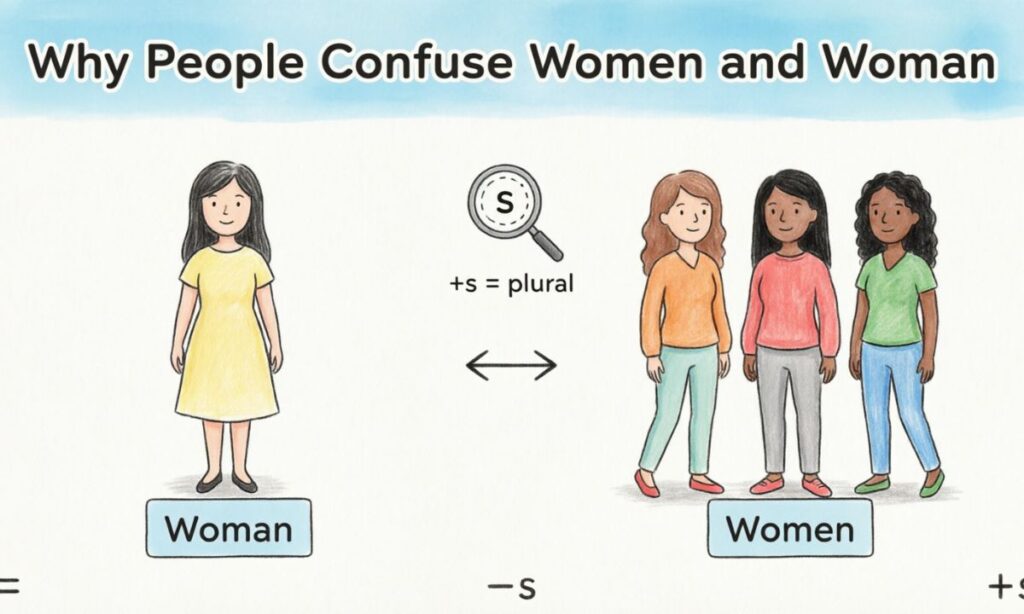
One reason so many writers struggle with women or woman is that these two words do not sound the way they look.
- Woman is pronounced /ˈwʊmən/ (sounds like “wuh-muhn”)
- Women is pronounced /ˈwɪmɪn/ (sounds like “wim-in”)
The vowel in the first syllable changes completely. “Woman” has a “woo” sound, while “women” has a short “wi” sound. Meanwhile, the second syllable of “women” sounds more like “min” rather than “muhn.”
This pronunciation gap is why ESL learners and even native English speakers sometimes write the wrong form. They rely on how the word sounds when spoken quickly, and that sound does not map cleanly onto the spelling. Being aware of this disconnect is the first step to mastering women or woman in your writing.
Read This: Lessor vs Lessee: Understanding, Rights and Responsibilities
Women or Woman in Grammar: How Sentences Change
Choosing the right form of women or woman affects more than just the noun itself. It changes the verb, the pronoun, the article, and any quantifiers in the sentence.
Subject Usage
When the subject of your sentence is singular, use “woman” and pair it with a singular verb.
- The woman is presenting at the conference.
- A woman was chosen to lead the team.
- That woman speaks three languages.
When the subject is plural, use “women” and pair it with a plural verb.
- The women are presenting at the conference.
- Several women were chosen to lead the team.
- Those women speak three languages.
Getting the subject-verb agreement right is critical in formal and academic writing.
Object Usage
The same singular/plural rule applies when the word functions as the object of a sentence.
- Singular object: He thanked the woman who helped him.
- Plural object: He thanked the women who helped him.
Articles
Articles work differently depending on which form you use.
- Use a or the with “woman”: a woman, the woman
- Use the with “women” (never “a women”): the women
Writing “a women” is always incorrect. The indefinite article “a” can only precede singular nouns.
Quantifiers
Numbers and quantity words make the choice easy.
| Quantifier | Correct Form | Example |
| one | woman | One woman raised her hand. |
| two, three, four, etc. | women | Two women raised their hands. |
| several | women | Several women attended. |
| many | women | Many women applied. |
| each / every | woman | Each woman received an award. |
| both | women | Both women agreed. |
| a group of | women | A group of women gathered. |
Common Mistakes and How to Fix Them
These are the errors that show up most often when people write women or woman:
| Incorrect | Correct | Why |
| She is a talented women. | She is a talented woman. | Singular subject needs singular noun. |
| A women called for you. | A woman called for you. | “A” cannot precede a plural noun. |
| The woman in the office are busy. | The women in the office are busy. | Plural verb signals plural noun is needed. |
| Three woman signed the petition. | Three women signed the petition. | Numbers above one require plural form. |
| She’s a strong women leader. | She’s a strong woman leader. | Noun modifier before another noun stays singular. |
One tricky case worth noting: when “woman” or “women” modifies another noun, such as in phrases like “woman doctor” or “women leaders,” context and number still guide the choice. “A woman doctor” refers to one female doctor. “Women doctors” refers to multiple female doctors.
Real-Life Scenarios Where Misuse Hurts
Choosing the wrong form of women or woman is not just a grammar slip. In certain contexts, it can genuinely damage how your work is received.
Professional writing: A resume that says “She served as a women in leadership” instead of “a woman in leadership” signals carelessness to hiring managers who notice these details.
Academic writing: Research papers and essays require precise noun number agreement. Incorrect use of women or woman can lead to lower scores or editorial rejection.
Content creation: Blog posts, social media captions, and marketing copy that misuse women or woman can reduce reader trust. Even one visible error makes readers question the reliability of the entire piece.
Journalism and broadcasting: News anchors and reporters train specifically to avoid these errors because they appear in real time without a safety net.
Email communication: A workplace email that reads “the woman in accounting are ready” will stand out immediately to anyone who reads it.
The good news is that this mistake is entirely preventable. Once the rule for women or woman clicks, you will catch these errors before they go out.
Easy Memory Tricks to Remember the Difference
Here are three fast tricks that work across different learning styles.
Trick 1: The “MAN / MEN” mirror Woman ends in MAN. Women ends in MEN. Just as MAN is singular and MEN is plural, woman is singular and women is plural. This parallel is the most reliable mental shortcut for women or woman.
Trick 2: The vowel clue Woman has an “a” in the middle. Think: “a” for alone, meaning just one person. Women has an “e” in the middle. Think: “e” for extra, meaning more than one person.
Trick 3: The verb test Insert “is” or “are” into your sentence before deciding. If “is” fits, use woman. If “are” fits, use women.
- The ___ is speaking. → The woman is speaking.
- The ___ are speaking. → The women are speaking.
Practice Exercise
Fill in the blank with women or woman:
- I spoke to a _______ from the sales department.
- The _______ at the table are discussing the budget.
- She is the only _______ on the board.
- Both _______ agreed on the new policy.
- Every _______ in the program received a certificate.
Answers: 1) woman, 2) women, 3) woman, 4) women, 5) woman
Women or Woman in Popular Phrases
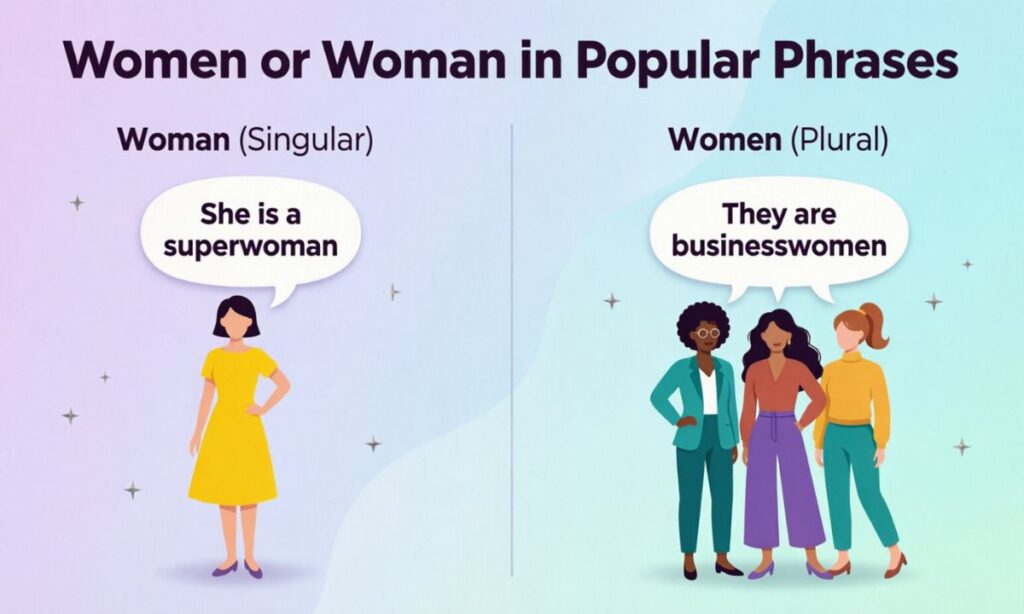
Many everyday phrases use women or woman in a fixed form. Learning these phrases by heart reinforces correct usage.
Phrases that use woman (singular):
- A woman of her word
- A self-made woman
- A woman of means
- Every woman for herself
- Woman of the year
Phrases that use women (plural):
- Women in leadership
- Women’s rights
- Strong women inspire others
- Women across the globe
- Women and children first
Notice that women or woman appears differently depending on whether the phrase describes one individual or a group. Memorizing even a handful of these phrases builds an instinct for the right choice.
Usage Across Different Writing Contexts
How you use women or woman can also depend on the type of writing you are doing.
Formal and academic writing: Precision matters most. Always count the individuals being referenced before choosing women or woman. Subject-verb agreement must be perfect.
Business and professional writing: Short, clear sentences work best. Use woman when addressing a single colleague or client and women when addressing a team or group.
Journalism and news writing: Style guides from major publications follow the same singular/plural rule. There is no regional difference between American English and British English for women or woman. Both varieties use the same spellings and the same grammar rules.
Casual and social media writing: Even in informal contexts, using women or woman correctly marks you as an educated and careful communicator. Autocorrect does not always catch these errors, so manual review still matters.
ESL learning contexts: English learners benefit most from focusing on the verb clue method. Before writing women or woman, test the verb first.
Quick Practice Section: Test Yourself
Try these sentences. Choose the correct form of women or woman:
- That _______ finished the marathon in under four hours.
- The _______ on the panel represent five different industries.
- He interviewed a _______ who founded her company at age 22.
- _______ around the world celebrated International Women’s Day.
- She is a _______ who never stops learning.
- Five _______ from our office were nominated for the award.
- There is one _______ waiting at the front desk.
- The study focused on _______ between the ages of 30 and 50.
Answers: 1) woman, 2) women, 3) woman, 4) Women, 5) woman, 6) women, 7) woman, 8) women
Score 8 out of 8? You have fully mastered the women or woman rule.
Conclusion
The rule for women or woman is simple once you see it clearly. Woman refers to one adult female. Women refers to two or more adult females. This single distinction controls your verb choices, your article choices, and your overall sentence structure. Mistakes with women or woman appear in professional emails, academic papers, news stories, and social media posts every day.
By applying the memory tricks in this guide, checking your verbs before you choose, and practicing with the exercises above, you will write women or woman correctly from this point forward. Clean grammar builds real trust, and knowing when to use women or woman is one of the clearest signs of strong English writing.