
Have you ever typed a word and then stopped to wonder if you spelled it right? That moment of doubt happens to almost everyone when writing catagory vs category. Both versions look familiar at a glance, but only one of them is actually a real English word. If you have been unsure which spelling to use, this guide will clear up the confusion once and for all.
The debate around catagory vs category is more common than you might think. Students, professional writers, native speakers, and even business executives make this mistake regularly. The reason is simple: the way the word sounds when spoken aloud does not perfectly match the way it is written. That small gap between pronunciation and spelling creates a lasting confusion for millions of people worldwide.
By the end of this article, you will know the correct spelling, understand the full meaning, explore the grammatical structure, learn the etymology, and see real-life example sentences that show you exactly how to use this word in writing. Let us get into it right away.
Catagory Vs Category: Which One Should You Use In Writing?
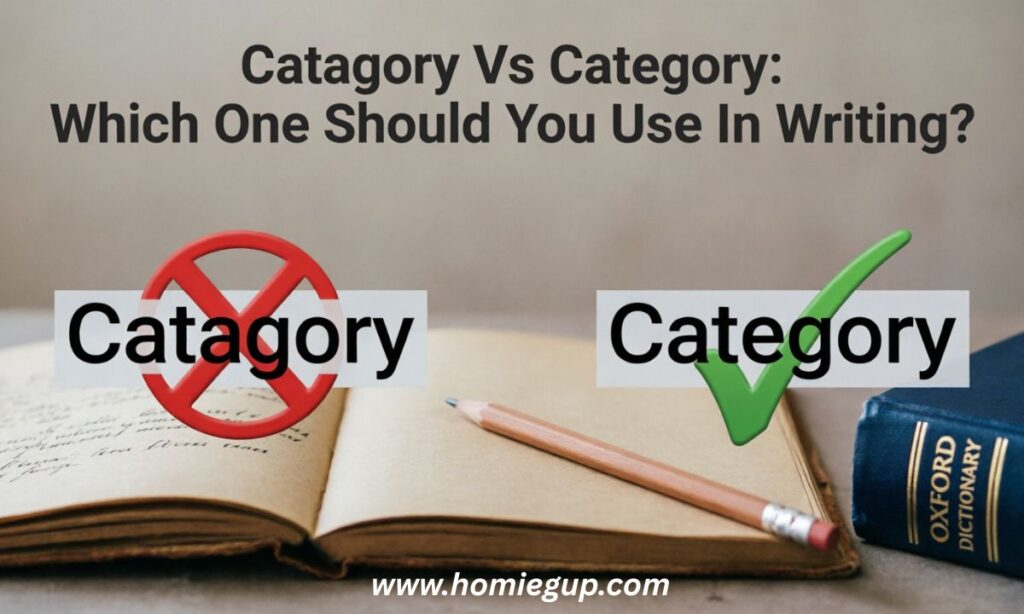
The answer to the catagory vs category question is short and definitive: category is always the correct spelling. The word catagory does not exist in any standard English dictionary, whether British or American. It is a spelling error, nothing more. There is no context, no dialect, and no style guide where catagory becomes acceptable.
Many people assume this might be a British vs. American English difference, similar to words like “colour” and “color.” That is not the case here. Category is spelled identically across all varieties of English spoken around the world. If you write catagory in a school essay, a business email, or a social media post, it will be flagged as a mistake by every grammar and spell-check tool available.
So why does this confusion keep happening? When most people say the word out loud, the second syllable sounds like “uh,” which leads them to write “cata” instead of “cate.” That one phonetic slip causes all the trouble. Understanding this pattern is the first step to fixing it permanently.
Quick Comparison Table: Catagory Vs Category
| Feature | Catagory | Category |
| Correct Spelling | No | Yes |
| Found in Dictionary | No | Yes |
| Used in Formal Writing | Never | Always |
| British English | Incorrect | Correct |
| American English | Incorrect | Correct |
| Spell Check Result | Flagged as Error | Accepted |
| Valid Word | No | Yes |
Meaning of Category
Now that the catagory vs category spelling question is settled, let us talk about what category actually means. According to Merriam-Webster, a category refers to any of several fundamental and distinct classes to which entities or concepts belong. In simpler terms, it is a named group of things or people that share one or more common qualities.
Think about how a supermarket is organized. Products are grouped into sections like dairy, produce, meat, and beverages. Each of those sections is a category. The same idea applies in education, government, sports, business, and everyday life. When you sort or classify things based on shared characteristics, you are placing them into a category.
In philosophy and logic, the word carries a deeper meaning. It refers to a basic concept or a fundamental class of ideas. Aristotle, the ancient Greek philosopher, was among the first to use the concept of categories in a formal intellectual sense, grouping all things in the world into fundamental types.
Here is a clear breakdown of what category means across different fields:
- Everyday use: A group of similar items, people, or ideas sorted together
- Academic use: A division within a classification system used for study or analysis
- Business use: A product segment or market division used for strategic planning
- Grammar use: A general class of words that share the same syntactic behavior
- Philosophy use: A fundamental concept under which all other concepts can be organized
Understanding the full meaning makes it much easier to use the word correctly in any context. And of course, no matter which meaning you apply, the only correct spelling remains category, not catagory.
Read This: Ingage vs Engage: Stop Confusing These Two Words Today
Grammatical Structure of Category
Understanding the grammar behind category helps you use it correctly in sentences. This is especially important when comparing catagory vs category because grammar awareness is what separates confident writers from those who make avoidable errors.
Part of Speech
Category is a noun. More specifically, it is a common noun, meaning it refers to a general class of things rather than a specific named one. Because it is a common noun, you do not capitalize it unless it appears at the beginning of a sentence or is part of a proper title.
Singular and Plural Forms
| Form | Spelling |
| Singular | category |
| Plural | categories |
The plural form follows the standard English rule of replacing the final “y” with “ies.” So when you refer to more than one group or division, the correct word is categories, not “categorys” or “catagories.”
Related Word Forms
| Word Form | Example |
| Noun (singular) | category |
| Noun (plural) | categories |
| Verb | categorize |
| Adjective | categorical |
| Adverb | categorically |
One important rule to remember: category cannot be used as a verb. You cannot say “She categoried the files.” Instead, use the verb form categorize: “She categorized the files.” This is a common grammatical mistake that appears right alongside the catagory vs category spelling issue.
How Category Functions in a Sentence
Category can serve two main roles in a sentence:
- As the subject: “The category was clearly defined by the committee.”
- As the object: “She created a brand new category for the event.”
It can also follow determiners like “a,” “an,” “the,” “this,” “that,” “each,” and “every.” For example: “Each category has its own set of rules.”
Etymology of Category
Tracing the origin of a word helps explain why it is spelled the way it is. When you understand where category comes from, the catagory vs category debate becomes much easier to resolve in your mind.
The word category traces back to the ancient Greek word katēgoria, which originally meant “statement,” “accusation,” or “predicate.” It was formed from two Greek parts: kata (meaning “against” or “down”) and agoreuein (meaning “to speak publicly” or “to harangue in the assembly”). So in ancient Greek, the word was used to describe making a public statement or accusation in the agora, which was the public gathering place in Greek city-states.
Over time, Greek philosophers, particularly Aristotle, began using katēgoria in a more abstract sense to describe fundamental classes or predicates of existence. This philosophical shift changed the word from “public accusation” to “classification.”
The word then passed into Latin as categoria, keeping much of the same meaning. From Latin, it moved into Old French as categorie, and from there it entered Middle English in the late 15th century. As it traveled through languages, the spelling gradually shifted to the modern English form we use today: category.
This long journey across Greek, Latin, French, and Middle English is exactly why the spelling can feel counterintuitive. The word carries marks from multiple languages, and that layered history is precisely what makes people want to write catagory by accident. Knowing this history is a powerful way to remember that the correct spelling preserves the “e” from its Latin and French roots.
Synonyms of Category
If you want to avoid repeating the word category too often in your writing, here are strong alternatives you can use. Each one carries a slightly different tone, so pick the one that best fits your context.
| Synonym | Best Used In |
| Class | Academic and formal writing |
| Division | Business and organizational writing |
| Group | General and everyday writing |
| Type | Casual and descriptive writing |
| Genre | Creative and literary writing |
| Tier | Business and ranking contexts |
| Section | Documents and structured lists |
| Kind | Informal writing and conversation |
| Variety | Descriptive and product writing |
| Bracket | Financial and taxation writing |
| Classification | Scientific and technical writing |
| Rank | Comparative and hierarchical writing |
When writing about the catagory vs category topic, using these synonyms wisely helps your content feel natural rather than repetitive. Always choose the synonym that matches the formality level of your piece.
Antonyms of Category
Antonyms of category are words that suggest disorder, randomness, or the absence of any classification system. These are less commonly used but useful for contrast.
- Disorder: A state without any classification or structure
- Chaos: Complete lack of organization or grouping
- Confusion: A mixed or unclear state with no defined classes
- Miscellany: A random collection with no particular grouping
- Disarray: Items or ideas scattered without any order
These words help when you need to contrast the organized idea of a category with something unstructured or irregular.
Similar Words to Category
Several words are closely related to category and are often confused with it or used interchangeably in everyday writing. Knowing the differences helps you choose the right word every time.
- Classification: The act or process of sorting items into categories
- Taxonomy: A system of classification, especially in biology
- Division: A broad section within a larger organization or system
- Segment: A smaller portion cut from a larger whole
- Subset: A smaller group within a larger category
- Domain: A field or area of knowledge or activity
- Niche: A specialized segment within a broader category
Each of these words has a specific use case. For example, “niche” works well in marketing writing, while “taxonomy” fits better in scientific or academic content.
Usage of Category in Writing
Knowing when and how to use category correctly is just as important as knowing its correct spelling. In the ongoing conversation about catagory vs category, proper usage is the second half of the equation. Here are the main contexts in which category appears:
In academic writing: Researchers group their findings into categories to make data easier to analyze and present. For example, survey responses might be sorted into categories like “strongly agree,” “agree,” and “disagree.”
In business writing: Companies divide their products or services into categories for marketing, sales, and reporting purposes. A retail brand might have categories like “women’s apparel,” “men’s apparel,” and “accessories.”
In everyday writing: People use categories when making lists, organizing content, or describing how things are grouped. Blog posts, website menus, and shopping platforms all use categories to help users navigate.
In grammar: The word itself belongs to the category of common nouns, making it a useful example in language instruction.
Sentences With Category
Reading example sentences is one of the most effective ways to understand how a word is used in real writing. Here are ten well-crafted sentences that demonstrate proper use of category:
- The teacher asked students to place each animal into the correct category based on its habitat.
- Her artwork did not fit neatly into any single category, which made it difficult to judge at the competition.
- The new product line created an entirely fresh category in the fitness equipment market.
- Each category on the website has its own dedicated page with filters for easy browsing.
- Tax authorities placed the income into a higher category, which changed the total amount owed.
- The storm was upgraded to a higher category as wind speeds increased throughout the night.
- He always put his personal goals into a separate category from his professional ambitions.
- The film won the award in the best documentary category at the international festival.
- Schools in the district were ranked based on performance in each academic category.
- The recipe falls into the category of comfort food that families return to again and again.
Each of these sentences shows category functioning naturally as a noun in different real-world situations. None of them would make any sense with catagory substituted in, because catagory is simply not a word.
People Also Ask
Is catagory ever correct in any form of English? No. Catagory is a misspelling and is incorrect in all forms of English, including British, American, and Australian varieties.
What is the plural of category? The plural of category is categories. It follows the standard English rule of replacing the final “y” with “ies.”
How do you pronounce category in American English? In American English, it is pronounced as “KAT-uh-gor-ee,” with four syllables and the stress placed on the first syllable.
What part of speech is category? Category is a common noun. It names a group or classification and cannot be used as a verb or adjective in its base form.
What is the verb form of category? The verb form is categorize, meaning to sort or place something into a specific group or classification.
Why do people misspell category as catagory? The misspelling happens because the spoken word sounds like “cat-uh-gor-ee,” which leads some writers to use “a” instead of “e” in the second syllable.
Is category spelled differently in British English? No. Category is spelled the same way in both British and American English. There is no regional spelling difference for this word.
What are good synonyms for category? Strong synonyms include class, group, type, division, genre, tier, section, kind, and classification.
Read This: Studder or Stutter: The Correct Spelling Everyone Gets Wrong
Final Thoughts
The catagory vs category question has one clear and permanent answer: category is always correct, and catagory is always wrong. There are no exceptions, no regional variations, and no stylistic rules that make the misspelled version acceptable.
Throughout this article, we covered everything you need to know about the correct spelling in the catagory vs category debate. You now understand the full meaning of the word, how it functions as a noun in sentences, the rich Greek and Latin history behind its etymology, which synonyms and antonyms to use as alternatives, and how to apply it naturally in a wide range of writing contexts.
The easiest trick to remember the correct spelling is this: there is a name hidden inside the word. Notice the name “Cate” at the beginning: Cate-gory. If you can remember “Cate,” you will always write the “e” in the right place and avoid the catagory mistake for good.
Going forward, every time you are unsure about catagory vs category, come back to this guide. Share it with a friend who struggles with the same confusion. Good spelling is not just about passing a test. It is about communicating clearly, building credibility, and showing respect for the people who read your words.
Frequently Asked Questions
Which is correct: catagory or category?
Category is the only correct spelling. Catagory is a misspelling that does not appear in any English dictionary.
What does category mean in simple terms?
A category is a group of things or people that share similar qualities and are sorted together under one label.
Can I use catagory in informal writing?
No. Catagory is incorrect even in informal writing and will always be flagged as a spelling error by any grammar tool.
What is the origin of the word category?
It comes from the Greek word katēgoria, which passed through Latin as categoria and French as categorie before entering Middle English.