
Have you ever read the word “flatform” and stopped to wonder whether someone made a typo? Or have you used the word “platform” in a fashion context when you actually needed something more specific? If so, you are not alone. The flatform vs platform debate trips up writers, shoppers, tech professionals, and fashion lovers every single day.
Here is the thing: both words are real. Both belong in the English language. But they mean very different things — and using one when you need the other can lead to genuine confusion, whether you are writing a product description, a business proposal, or a casual blog post.
This complete guide breaks down flatform vs platform from every angle. You will learn their definitions, see them used correctly in sentences, understand when context changes everything, and walk away with practice exercises to test what you have learned. By the end, choosing between the two will feel completely natural.
Define Flatform
A flatform is a specific type of shoe that combines the visual height of a platform with the structural levelness of a flat. The word itself is a portmanteau — a blend of “flat” and “platform” — and it tells you almost everything you need to know about the design.
Unlike a traditional platform shoe, which can have a higher heel than toe, a flatform has a sole that is uniformly thick from heel to toe. There is no tilt, no slope, no elevation difference between the front and back of the shoe. The foot rests on a completely level surface that just happens to sit higher than the ground.
Flatforms first gained serious attention in the fashion world around 2011, when major designers began featuring them on runways. Since then, they have appeared as sandals, sneakers, boots, brogues, and loafers. The appeal is practical as much as aesthetic: flatforms give wearers extra height without forcing the foot into the uncomfortable angle associated with traditional heels.
Key characteristics of a flatform shoe:
- Uniform sole thickness from heel to toe
- No heel elevation above the toe
- Thick, raised base that keeps the foot level
- Available in a wide range of styles (sandals, sneakers, boots, etc.)
- Designed to combine height with comfort and stability
In the context of flatform vs platform footwear, the flatform is the more specialized of the two. It occupies a specific subcategory within elevated shoe design, defined by its commitment to a perfectly flat footbed regardless of how thick the sole becomes.
Outside of footwear, the term flatform appears in very limited situations — primarily in nautical contexts, which we will cover in the exceptions section. In technology, business, and everyday general English, flatform has essentially no usage whatsoever.
Define Platform
The word platform is one of the most versatile and widely used words in modern English. Its original meaning — a raised, flat horizontal surface — has expanded so far over the centuries that today it comfortably spans architecture, transportation, fashion, technology, politics, media, and business.
According to Merriam-Webster, a platform is “a flat horizontal surface that is usually higher than the adjoining area.” That physical definition remains the foundation, but the word has evolved far beyond it.
Here is a breakdown of what platform means across its most common uses:
| Context | What “Platform” Means |
| Architecture / Physical | A raised structure or surface, such as a stage or loading dock |
| Transportation | The boarding area beside railroad or subway tracks |
| Technology / Software | An underlying system (hardware or software) on which applications run |
| Social Media | A digital network where users create, share, and interact with content |
| Politics | A formal declaration of a party’s or candidate’s principles and policies |
| Footwear | A shoe with a thick, raised sole (which may or may not include a heel) |
| Business | A commercial ecosystem that connects buyers, sellers, or service providers |
| Media | A channel or outlet through which content is distributed or opinions are expressed |
This versatility is precisely what makes the flatform vs platform comparison so interesting. Platform adapts to nearly every industry. Flatform, by contrast, lives almost exclusively in the world of footwear.
When used in the context of shoes, a platform sole is a thick layer between the inner and outer sole. Unlike a flatform, a platform shoe can have a heel that is higher than the toe area — meaning the foot may still be positioned at an angle. This is the single most important structural distinction in the flatform vs platform footwear debate.
Read This: Emaculate vs Immaculate: Which One Is The Correct One? (Updated 2026)
How To Properly Use The Words In A Sentence?
Understanding the flatform vs platform distinction is one thing. Using each word naturally and correctly in real writing is another. The rules are straightforward once you know them.
How To Use Flatform In A Sentence
Because flatform is a domain-specific fashion term, it almost always appears in the context of footwear, style, or fashion writing. It is used as a noun (naming a type of shoe) or as an adjective (describing a shoe’s design).
As a noun:
- She wore her favorite flatform to the summer festival.
- The flatform has become a staple in athleisure fashion.
- He gifted her a pair of suede flatforms for her birthday.
As an adjective:
- She laced up her flatform sneakers before heading out.
- The store’s new flatform sandal collection sold out within a week.
- Those flatform boots look great with wide-leg trousers.
In comparison:
- Between the wedge and the flatform, she always chose comfort over height.
- A flatform gives you elevation without the posture problems of a traditional heel.
Never use flatform in a technology, business, or political context. In those areas, the correct word is always platform — no exceptions, no substitutions.
How To Use Platform In A Sentence
Platform’s many meanings mean it can appear in a wide variety of sentences. The key is that its meaning should be clear from context.
Physical / architectural:
- The speaker stepped up onto the wooden platform and addressed the crowd.
- Passengers waited on platform 4 for the delayed train.
Technology / software:
- The application is built to run on a cloud-based platform.
- Developers prefer open-source platforms for their flexibility and community support.
Social media:
- Instagram remains one of the most popular platforms for visual content creators.
- Businesses need to understand which platform best serves their target audience.
Politics:
- The candidate ran on a platform focused on healthcare reform and housing policy.
Footwear:
- She wore strappy platform sandals that gave her an extra three inches of height.
Business / media:
- The podcast uses its large audience as a platform to highlight underrepresented voices.
- The company launched a new e-commerce platform to streamline its sales process.
Social Media Platform or Flatform
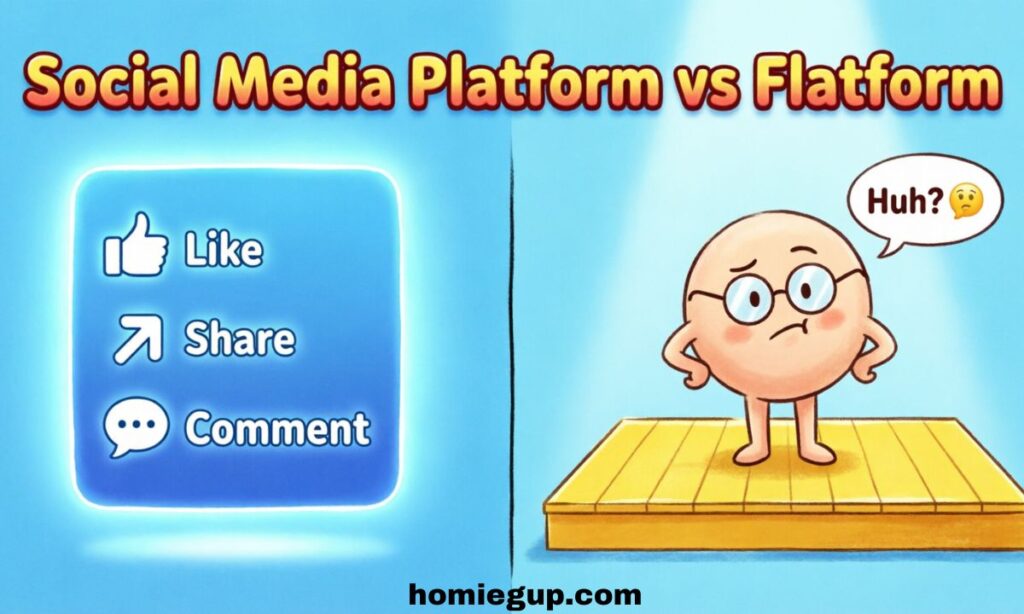
Let’s be absolutely clear on this one: when talking about social media, the correct term is always platform. The word flatform has no application in this space whatsoever.
A social media platform is a digital environment where users create profiles, produce and share content, interact with others, and build communities. Examples include Facebook, Instagram, YouTube, TikTok, LinkedIn, X (formerly Twitter), Pinterest, and Snapchat.
Each social media platform serves a distinct purpose and audience:
- Facebook — broad social networking, community groups, and advertising
- Instagram — visual content, lifestyle, brand promotion, and influencer marketing
- YouTube — long-form video content and creator monetization
- TikTok — short-form video entertainment and viral trends
- LinkedIn — professional networking, B2B marketing, and career development
- Pinterest — content curation, inspiration boards, and visual discovery
- X (Twitter) — real-time news, public discourse, and microblogging
One of the most common mistakes in business and marketing writing is treating all social media platforms as interchangeable. They are not. Each platform has its own algorithm, content format, audience demographics, and advertising model. A strategy that works on LinkedIn may fail completely on TikTok.
In the flatform vs platform context, this section makes one thing very clear: flatform never belongs in a digital or tech conversation. If you are writing about social networks, digital marketing, or online communication, the word you need is platform, every single time.
Online Platform or Flatform
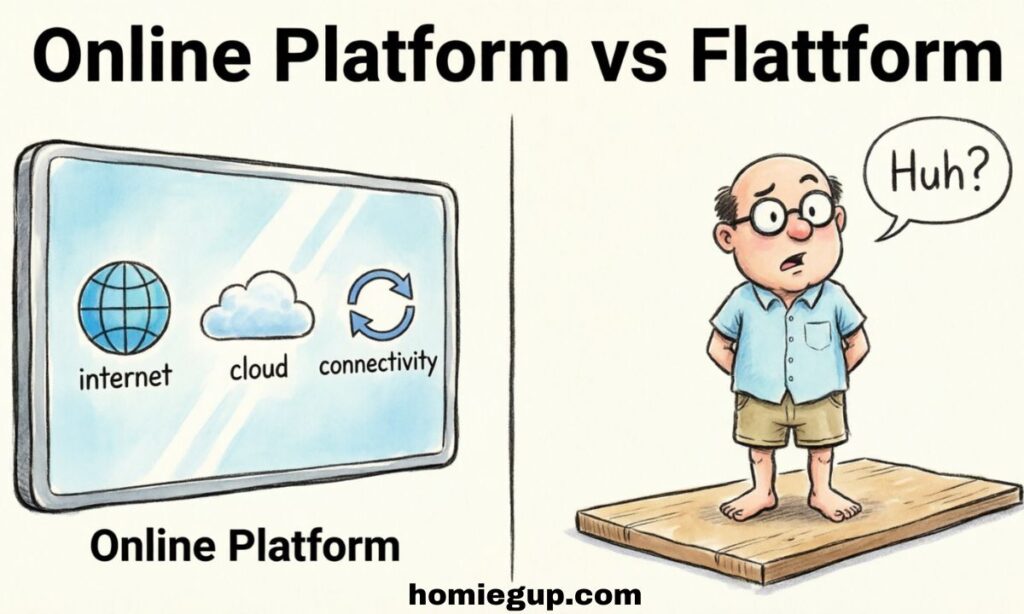
Just as with social media, the phrase online platform always uses platform — never flatform.
An online platform is any digital system or infrastructure that enables interactions, transactions, or the delivery of services over the internet. This is an incredibly broad category that includes:
- E-commerce platforms — Amazon, Shopify, Etsy
- Cloud computing platforms — AWS, Microsoft Azure, Google Cloud
- Learning management platforms — Coursera, Udemy, Khan Academy
- Content management platforms — WordPress, Wix, Squarespace
- Communication platforms — Slack, Zoom, Microsoft Teams
- Marketplace platforms — Airbnb, Uber, Fiverr
The defining feature of an online platform is that it provides a standardized environment where multiple users, businesses, or developers can operate, interact, or build services. The platform handles the foundational infrastructure; the users bring the activity.
When making the flatform vs platform distinction in a digital or online context, there is no gray area. Platform is the correct choice for every digital and technology application. Flatform simply does not exist in this vocabulary.
A useful rule of thumb: if the topic involves a screen, a server, an app, or the internet — use platform. If the topic involves shoes — consider whether you need flatform or platform based on the specific sole structure.
More Examples Of Flatform & Platform Used In Sentences
Seeing the flatform vs platform distinction play out across diverse sentences is one of the fastest ways to internalize which word belongs where.
Examples Of Using Flatform In A Sentence
- The flatform sneaker trend has crossed over from the runway into everyday streetwear.
- She found that wearing a flatform reduced the foot fatigue she used to feel in high heels.
- The boutique stocked flatforms in every color for the summer collection.
- Festival-goers love a good flatform because they offer height on uneven terrain without the instability of a stiletto.
- Her black leather flatform boots became the most complimented item in her wardrobe.
- A flatform is often easier to walk in than a wedge because the foot stays parallel to the ground.
- The designer’s flatform collection blurred the line between casual comfort and high fashion.
- Many orthopedic specialists note that flatforms distribute body weight more evenly than heeled shoes.
- She styled her floral dress with a chunky flatform sandal for a retro-inspired look.
- The flatform’s thick rubber sole gave the sneaker a bold, statement-making silhouette.
Examples Of Using Platform In A Sentence
- The company chose a cloud-based platform to host its customer data securely.
- He delivered his speech from a wooden platform erected in the town square.
- The political party unveiled its platform ahead of the upcoming general election.
- She wore platform heels that added height but still allowed a comfortable heel-to-toe slope.
- YouTube remains one of the most powerful platforms for independent content creators.
- The startup built its entire business on an open-source software platform.
- Train passengers were told to wait on platform 7 for the delayed service.
- The author used her bestselling book as a platform to advocate for educational equity.
- The e-commerce platform processed over one million transactions on its first day of launch.
- A marketing platform like HubSpot helps businesses manage email, social media, and analytics in one place.
Common Mistakes To Avoid
Even experienced writers and professionals make errors when navigating the flatform vs platform distinction. Here are the most common pitfalls — and exactly how to sidestep each one.
Using “Flatform” Instead Of “Platform”
This is the most frequent error, and it typically happens in tech or business writing. Someone unfamiliar with the word “flatform” uses it as a casual or creative variant of “platform.” It is not. Outside of footwear, flatform is essentially meaningless.
Wrong: Our business needs a reliable flatform for managing customer communications. Right: Our business needs a reliable platform for managing customer communications.
Wrong: The new flatform will allow developers to build scalable applications. Right: The new platform will allow developers to build scalable applications.
If you are writing about technology, digital media, business infrastructure, or transportation, the word is always platform.
Assuming All Platforms Are The Same
A subtler but equally damaging mistake is treating all platforms as interchangeable within a category. In technology alone, a social media platform, a cloud computing platform, an e-commerce platform, and an operating system platform are four fundamentally different things.
Each platform type has its own architecture, user base, purpose, and advantages. A business that selects a platform without understanding these differences risks choosing the wrong tool entirely. Research the specific platform’s features, scalability, integration capabilities, and pricing before committing.
Not Understanding The Benefits Of Each Platform
Related to the above, many people choose a digital platform based on name recognition alone rather than suitability. The most popular platform is not always the right one for a specific use case.
For example, a small e-commerce business might thrive on Shopify but struggle on a custom-built platform that demands more technical expertise. A content creator with a niche audience might find more engagement on a specialized community platform than on a mainstream social network. Understanding what each platform offers — and what it demands — is essential for making smart decisions.
Offering Tips To Avoid These Mistakes
Follow these practical guidelines to keep your flatform vs platform usage precise and professional:
- Know the context first. If you are writing about fashion or footwear, flatform may apply. In every other industry, default to platform.
- Look up the specific platform. Before writing about a technology or social media platform, understand what it actually does and who it serves.
- Never use flatform as a synonym for platform. They are not interchangeable. They serve completely different purposes in the English language.
- Proofread with context in mind. When reviewing your writing, ask whether each use of the word fits the surrounding topic. A flatform appearing in a tech article is an immediate red flag.
- Use a dictionary or style guide when uncertain. Merriam-Webster and other authoritative sources are always just a search away.
Context Matters
Perhaps the most important lesson in the flatform vs platform discussion is that context is everything. The same word can shift meaning dramatically depending on the subject matter, industry, and audience.
Examples Of Different Contexts
Fashion Context: In a fashion article, flatform and platform can both appear — but they mean different things. A flatform keeps the foot level; a platform shoe may have a sloped sole. Mixing them up in a product description can frustrate or mislead shoppers looking for a specific design.
“The brand released two new elevated styles this season: a classic platform with a stacked heel and a sleek flatform with a uniform rubber sole.”
Technology Context: In a software or business setting, platform is the only correct term. It refers to the foundational system on which applications, services, or products are built and operated. Flatform belongs nowhere near this conversation.
“The development team migrated to a new cloud platform that supports faster deployment cycles.”
Transportation Context: At a train station or subway, platform refers to the physical boarding area beside the tracks. Flatform does not apply here under any circumstances.
“Passengers should stand behind the yellow line on the platform until the train comes to a complete stop.”
Political Context: A political platform is a set of publicly declared principles, policy commitments, and goals. This is purely figurative — the word platform here means a position or stance, not a physical structure.
“The candidate’s platform emphasized infrastructure investment, affordable housing, and universal broadband access.”
Nautical Context: This is one of the few non-fashion settings where flatform can appear. In shipbuilding and naval design, a flatform refers to a flat surface within the hull of a vessel. This is a specialized, technical usage — more on this in the exceptions section.
Exceptions To The Rules
While the general rules around flatform vs platform are clear, a few industries have edge cases worth knowing.
Nautical Terminology
In naval architecture and shipbuilding, a flatform refers to a flat structural surface within a ship’s hull, typically between decks. This is distinct from a platform, which in nautical contexts usually refers to a raised structure used for observation, diving, or specific operations on or around a vessel.
Sailors and marine engineers must use these terms precisely. Confusing a flatform (a structural interior surface) with a platform (a raised operational structure) in a ship design or safety document can lead to serious miscommunication.
“The engineer’s blueprint indicated a flatform in the lower hull section adjacent to the engine room.”
Shoe Design
In footwear design, flatform and platform are sometimes used loosely by retailers and manufacturers, which creates confusion in the market. Some brands label a shoe as a “platform” even when its sole is perfectly level — which technically makes it a flatform.
Strictly speaking:
- A flatform has a uniformly thick sole with no heel-to-toe height difference.
- A platform shoe has a thick sole that may still have a higher heel than toe.
When shopping for shoes or writing product descriptions, it is worth examining the actual sole geometry rather than relying on the label alone. The distinction matters for comfort, fit, and posture.
Software Development
In software development circles, the term “platform” is sometimes extended creatively. Developers occasionally use phrases like “cross-platform” (software that runs on multiple operating systems), “platform-agnostic” (not tied to any specific system), or “low-code platform” (a development environment with minimal coding requirements).
In all of these compound or modified uses, the root word remains platform — never flatform. If you encounter “flatform” in a software development context, treat it as a typo or error. There is no recognized technical usage of flatform in computing or software engineering.
Practice Exercises
The best way to lock in the flatform vs platform distinction is to test yourself with realistic scenarios. Work through both exercises below, then check your answers.
Exercise 1: Fill In The Blank
Choose either flatform or platform to complete each sentence correctly. Consider the context carefully before answering.
- The passengers crowded onto _______ 3 as the express train approached.
- She wore chunky _______ sandals that kept her feet perfectly level and comfortable.
- The startup built its entire product on an open-source software _______.
- The political party announced a new _______ focused on climate policy and economic reform.
- Those white _______ sneakers give her extra height without any heel discomfort.
- The brand’s new _______ sandal features a three-inch rubber sole that is even from heel to toe.
- A reliable e-commerce _______ can handle thousands of orders per day without slowing down.
- She stepped onto the speaking _______ and addressed the audience with confidence.
- The _______ shoes she chose for the festival were easy to walk in all day.
- Developers need to understand which _______ their application will run on before writing a single line of code.
Answer Key:
- platform | 2. flatform | 3. platform | 4. platform | 5. flatform | 6. flatform | 7. platform | 8. platform | 9. flatform | 10. platform
Read This: Bachelor vs Batchelor: When to Opt for One Term Over Another
Exercise 2: Sentence Writing
Write an original sentence for each of the following prompts. Use either flatform or platform as directed, and make sure the sentence reflects the correct context.
- Write a sentence using flatform in a fashion or styling context.
- Write a sentence using platform in a technology or software context.
- Write a sentence using platform in a transportation context.
- Write a sentence comparing a flatform and a platform shoe.
- Write a sentence using platform in a political or advocacy context.
- Write a sentence using flatform in a product description.
- Write a sentence using platform in a business or marketing context.
Sample Answers:
- She paired her denim overalls with a caramel-colored flatform sandal for a casual summer look.
- The engineering team deployed the new application on a scalable cloud platform that supports up to ten million concurrent users.
- She gripped her suitcase tightly as the train pulled away from platform 9.
- Unlike a traditional platform shoe with its sloped sole, a flatform keeps the foot parallel to the ground from heel to toe.
- The senator built her entire campaign on a platform of affordable childcare and expanded public transit.
- This flatform sneaker features a four-centimeter uniform rubber sole that gives height without putting pressure on the heel.
- The brand leveraged Instagram as its primary marketing platform, growing its follower count by 300% in six months.
Frequently Asked Questions
Is flatform a real word?
Yes, flatform is a legitimate English word — it specifically refers to a type of shoe with a uniformly thick sole and no heel elevation.
Can I use flatform instead of platform in a tech context?
No. Flatform has no recognized meaning in technology. Always use platform in software, computing, and digital media contexts.
What is the main structural difference between a flatform and a platform shoe?
A flatform has an even sole thickness from heel to toe; a platform shoe may still have a higher heel than toe.
Are flatforms comfortable for long-term wear?
Many wearers find flatforms more comfortable than heels because the foot stays level, though extended wear can still affect posture.
What are some synonyms for platform in a tech context?
Common alternatives include system, framework, infrastructure, environment, and ecosystem, depending on the specific use.
When did flatforms become popular?
Flatforms gained mainstream fashion attention around 2011 when high-end designers began including them in runway collections.
Is “social media flatform” ever correct?
No, never. Social media platforms are always called platforms. Flatform does not apply to any digital or online context.
How do I remember which word to use?
Think of it this way: flatform = flat shoe, platform = everything else. When in doubt, ask yourself if you’re talking about footwear with a level sole. If not, platform is almost certainly the right choice.
Conclusion
The flatform vs platform distinction is simpler than it might first appear — but only once you know where each word belongs.
Flatform is a precise, domain-specific fashion term describing a shoe with a uniformly thick sole and no heel elevation. It brings height and comfort to footwear design, and outside of shoes and rare nautical usage, it has virtually no other application.
Platform is one of the most versatile words in modern English. It means a raised surface, a boarding area, a technology system, a social media network, a business environment, a political declaration, and more. Its breadth of meaning is precisely why it appears so frequently across every industry and context.
Here are the key takeaways from this flatform vs platform guide:
- Flatform belongs in fashion and footwear writing — and almost nowhere else.
- Platform is correct in technology, transportation, social media, business, politics, and physical architecture.
- Never use flatform as a substitute for platform in tech or digital writing.
- Not all platforms are the same — research the specific platform before writing about it.
- Context determines meaning: always consider the subject matter before choosing between the two.
Good word choice is a mark of clear thinking. Now that you understand the full flatform vs platform picture, your writing will be more precise, more professional, and more credible — whether you are describing the latest shoe trend or pitching a software product to investors.