
Have you ever typed a sentence, paused halfway through, and wondered whether “uninclined” or “disinclined” was the right word to use? You are not alone. The debate around uninclined vs disinclined trips up even experienced writers, native speakers, and professional editors. These two adjectives look similar, sound similar, and both suggest a lack of willingness. Yet they carry different emotional weights, fit into different contexts, and send completely different signals to your reader.
Choosing the wrong one does not just look like a grammar mistake. It changes the entire tone of your message. Say “uninclined” when you meant “disinclined,” and you may come across as passively indifferent when you actually meant to express firm reluctance. Swap them the other way and your sentence can suddenly sound unnecessarily forceful. In professional writing, academic work, and even casual conversation, that difference matters more than people realize.
This guide settles the uninclined vs disinclined debate once and for all. You will walk away knowing the exact meaning of each word, how to use them correctly in a sentence, which common mistakes to avoid, and how context shapes which one belongs in your writing. By the end, picking between uninclined vs disinclined will feel completely natural.
Definitions At A Glance
Before going deeper, here is a quick-reference snapshot of both words side by side.
| Feature | Uninclined | Disinclined |
| Part of speech | Adjective | Adjective |
| Core meaning | Lacking motivation or interest; neutral stance | Reluctant or unwilling; negative attitude |
| Emotional intensity | Mild, passive | Stronger, more deliberate |
| Formality level | More formal, academic | Common in both formal and casual use |
| Physical meaning? | Yes (not sloped or tilted) | No |
| Typical usage | Academic, formal writing | Everyday speech and professional writing |
| Closest synonyms | Indifferent, unenthusiastic, uninterested | Reluctant, averse, hesitant, loath |
At first glance, the uninclined vs disinclined split looks subtle. In practice, it shapes how your entire sentence is received. Keep reading to understand exactly why.
Uninclined
The word “uninclined” is built from the prefix “un” added to the word “inclined.” When someone is inclined toward something, they feel a natural pull or tendency toward it. Add “un” and that pull simply does not exist. There is no motivation, no enthusiasm, and no particular leaning in any direction.
This is the key feature of uninclined vs disinclined from the “uninclined” side: the absence of inclination is neutral. The person does not feel strongly one way or the other. They have not made a deliberate decision to refuse. They are simply not drawn toward the activity or idea.
What makes “uninclined” interesting is that it also carries a literal, physical meaning. In geometry and physical description, an uninclined surface is one that is level or flat rather than sloped. A road, a ramp, or a platform can be described as uninclined when it has no gradient. This secondary meaning rarely appears in everyday conversation but remains part of the word’s full definition. This dual meaning is something “disinclined” does not share.
In terms of tone, “uninclined” reads as relatively passive and soft. It does not suggest opposition. A person who is uninclined toward something has simply not been moved to pursue it. They might still do it if circumstances changed or someone convinced them. The emotional resistance is low.
Key characteristics of “uninclined”:
- Suggests a neutral, mild lack of interest or motivation
- Does not imply active opposition or resistance
- Carries a more formal, sometimes academic register
- Can describe physical surfaces (level, not sloped)
- Often interchangeable with words like “indifferent” or “unmotivated”
When you are working through the uninclined vs disinclined comparison in your own writing, ask yourself: is the person simply uninterested, or are they actively resisting? If the answer is merely uninterested, “uninclined” is your word.
Disinclined
“Disinclined” shares the same root word but uses a different prefix. “Dis” typically signals negation with a stronger push against something. Someone who is disinclined does not simply lack enthusiasm. They feel a degree of reluctance, mild distaste, or active unwillingness.
Merriam-Webster defines “disinclined” as lacking the will or desire to do something, placing it in a family of words that includes reluctant, hesitant, loath, and averse. Each of these synonyms implies more than indifference. They all suggest that the person has considered the action and moved away from it with some intention.
In the uninclined vs disinclined comparison, “disinclined” carries the heavier emotional load. The resistance here is not accidental or passive. It comes from a mild dislike, disapproval, or deliberate avoidance. The person knows what is being asked and they are moving in the opposite direction.
“Disinclined” is also significantly more common in everyday language than “uninclined.” You will find it in news articles, legal writing, business communications, political speeches, and casual conversation. Merriam-Webster examples from 2026 include real-world uses like banks being disinclined to lend under certain conditions and political figures being disinclined to leave negotiations empty-handed. These are confident, deliberate stances. That is exactly the energy the word brings.
Key characteristics of “disinclined”:
- Suggests active reluctance or mild opposition
- Implies a deliberate decision not to engage
- More commonly used across both formal and informal settings
- No physical or literal alternative meaning
- Synonymous with reluctant, averse, hesitant, and loath
This distinction is the heart of the uninclined vs disinclined debate. “Disinclined” carries intention. “Uninclined” carries absence. Both describe a lack of action, but for very different internal reasons.
How To Properly Use The Words In A Sentence?
Read This: Headcount or Head Count: Find Out the Right Spelling and Usage
Knowing definitions is one thing. Seeing how each word actually functions inside a real sentence is what makes the learning stick. Here is a breakdown of proper usage for both sides of the uninclined vs disinclined question.
How To Use “Uninclined” In A Sentence
“Uninclined” almost always appears before an infinitive verb (to do something) or before a noun phrase. It works well when describing someone whose lack of interest is quiet, mild, or simply a matter of not being drawn toward something.
Sentence structure:
Subject + verb (to be) + uninclined + to + infinitive
Examples of correct usage:
- She felt uninclined to join the conversation after a long day.
- He was uninclined to comment on the ongoing investigation.
- The professor seemed uninclined toward student debate on that particular day.
- Many readers are uninclined to finish articles that lack a clear opening hook.
- I am uninclined to change my morning routine without good reason.
Notice the tone across all five sentences. The resistance is soft. Nobody is pushing back hard. They are simply not moving toward something. That passive quality is what separates the “uninclined” side of uninclined vs disinclined usage.
How To Use “Disinclined” In A Sentence?
“Disinclined” follows the same grammatical pattern but carries a more deliberate tone. The subject is not just indifferent. They are leaning away from the action with some intention.
Sentence structure:
Subject + verb (to be) + disinclined + to + infinitive
Examples of correct usage:
- The board was disinclined to approve the new proposal without further review.
- She felt disinclined to forgive him after what had happened.
- Voters appeared disinclined to support a candidate with no clear economic policy.
- He was disinclined to share personal details in a professional setting.
- The committee remained disinclined to alter its earlier decision.
The shift in tone is unmistakable when you compare these to the “uninclined” examples. In each of these sentences, the person has weighed the option and moved away from it with some degree of conscious choice. That is the defining quality of “disinclined” in the uninclined vs disinclined pair.
More Examples Of Uninclined & Disinclined Used In Sentences
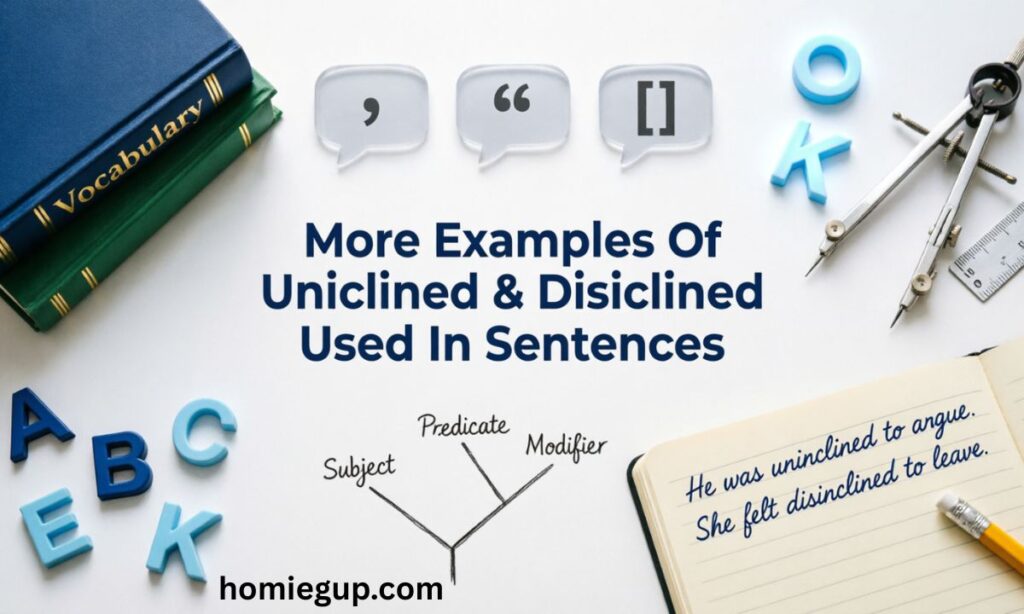
Practice reading both words in multiple sentence types builds stronger intuition. Here is an expanded set of examples for both words.
Examples Of Using Uninclined In A Sentence
- The student was uninclined to study on a Friday evening.
- She remained uninclined toward outdoor activities even in good weather.
- As an introvert, he was uninclined to attend large social events.
- The researcher was uninclined to draw conclusions without more data.
- Children are often uninclined to eat vegetables without some encouragement.
- She was uninclined to engage in office gossip even when invited to.
- He stayed uninclined toward risk even as the market shifted favorably.
- The elderly gentleman was uninclined to update his daily habits.
- Most people are uninclined to volunteer for extra tasks without clear incentives.
- She felt uninclined to revisit that painful chapter of her life.
All of these sentences show the uninclined vs disinclined pattern clearly. The “uninclined” examples reflect a quiet, unmotivated non-action rather than a deliberate refusal.
Examples Of Using Disinclined In A Sentence
- The editor was disinclined to publish the story without verification.
- Management remained disinclined to offer additional overtime pay.
- She was disinclined to sign the agreement without consulting her attorney.
- The senator was disinclined to support the amendment based on its wording.
- He was disinclined to apologize even when clearly in the wrong.
- The investors were disinclined to inject more capital into a failing project.
- After the incident, she was disinclined to trust the company again.
- The coach was disinclined to field a rookie in such a high-pressure match.
- Banks are often disinclined to extend credit to applicants with poor histories.
- The judge was disinclined to grant a continuance for a third time.
These examples reinforce why uninclined vs disinclined is not a trivial difference. The “disinclined” sentences feel measured and deliberate. Something has been considered and rejected, not simply ignored.
Common Mistakes To Avoid
Even careful writers make errors with these two words. Understanding the most frequent pitfalls makes it easier to get things right the first time.
Mistake: Using Uninclined And Disinclined Interchangeably
The most common error in the uninclined vs disinclined conversation is treating both words as exact synonyms. Writers often swap one for the other without realizing that the emotional tone of their sentence has shifted entirely.
For example:
- Incorrect: “The manager was uninclined to approve the budget” (when you actually want to convey that the manager actively resisted the idea)
- Correct: “The manager was disinclined to approve the budget”
Using “uninclined” in the second sentence softens the manager’s stance too much. It suggests mere indifference rather than deliberate opposition.
Mistake: Using Uninclined And Disinclined To Mean The Same Thing As Unwilling
“Unwilling” is a stronger word than either uninclined vs disinclined. It implies a firm, often absolute refusal. Neither “uninclined” nor “disinclined” carries that level of finality.
Consider the difference:
- Unwilling: “She refused to sign and was completely unwilling to discuss it further.”
- Disinclined: “She was disinclined to sign without reading the full terms.”
- Uninclined: “She was uninclined toward formal agreements in general.”
Swapping these three words changes the severity of the statement each time. Treating them as perfect equivalents dilutes your writing and causes confusion for your reader.
Tips On How To Avoid Making These Mistakes
Follow these practical steps whenever you face the uninclined vs disinclined choice:
- Test the emotional temperature. Is the resistance mild and passive? Use “uninclined.” Is the resistance more deliberate and conscious? Use “disinclined.”
- Replace with a synonym and check the fit. “Uninclined” fits best with “indifferent” or “unenthusiastic.” “Disinclined” fits best with “reluctant” or “averse.”
- Read the sentence aloud. If the tone feels too strong for your message, switch to “uninclined.” If it feels too weak, shift to “disinclined.”
- Avoid both words when you mean “unwilling.” If someone flatly refuses, choose “unwilling” or “opposed.”
- Check the context. Formal settings often call for “disinclined.” Academic or descriptive writing may call for either.
Context Matters
The uninclined vs disinclined choice is not made in a vacuum. The setting where you are writing shapes which word fits best. Here is how context changes everything.
Different Contexts
Personal Preferences
In personal settings, both words can appear, but “uninclined” tends to feel more natural when describing gentle preferences.
- “I am uninclined to spend weekends at the mall.”
- “She is disinclined to socialize with people who dismiss her opinions.”
The first sentence describes a mild personal preference. The second describes something with more emotional weight behind it. That distinction reflects the uninclined vs disinclined divide perfectly in everyday personal language.
Business Communication
In professional and business writing, “disinclined” appears far more often. Business communication tends to describe deliberate positions, not vague preferences.
- “The company is disinclined to renegotiate the terms at this stage.”
- “Shareholders are disinclined to support a merger without transparency.”
Using “uninclined” in these sentences would soften the message too much and potentially misrepresent the firmness of the organization’s position. The uninclined vs disinclined choice in business writing leans heavily toward “disinclined.”
Political Discourse
Political language gravitates toward “disinclined” because political actors make deliberate choices. Saying a lawmaker is “uninclined” to vote for a bill sounds accidental. Saying they are “disinclined” communicates that they have assessed the situation and chosen a position.
- “The senator was disinclined to endorse the foreign aid package.”
- “Many voters appear disinclined to support candidates who avoid public debates.”
Political context makes the uninclined vs disinclined split especially important because the difference between indifference and deliberate opposition can have major implications for how a public figure is perceived.
Exceptions To The Rules
Language is rarely absolute. While the uninclined vs disinclined principles above apply broadly, there are situations where the usual rules bend.
Contextual Usage
In literary writing and fiction, authors sometimes use “uninclined” to create a specific atmosphere of quiet resignation rather than active resistance. A character described as uninclined toward life itself, for instance, carries a melancholy that “disinclined” would not produce. The deliberate choice of the softer word becomes a stylistic tool.
Similarly, some formal academic texts use “disinclined” in contexts where the emotional intensity described is relatively mild. The formality of the word, rather than its emotional weight, becomes the primary reason for choosing it.
Regional Differences
British English speakers sometimes use “disinclined” more freely in casual conversation than American English speakers do. American writers tend to prefer “reluctant” in everyday speech, leaving “disinclined” for more formal registers. This means that the uninclined vs disinclined distinction can also shift slightly depending on which variety of English your audience reads.
In some regional dialects and older literary traditions, “uninclined” appears in contexts that modern usage would reserve for “disinclined.” Reading older British novels, for instance, you may encounter “uninclined” used with a level of firmness that contemporary guidance no longer assigns to it.
Personal Preference
Some writers simply prefer one word over the other based on rhythm and sound. “Disinclined” has a sharper, crisper sound. “Uninclined” flows a bit more smoothly in certain sentence structures. When both words technically fit the context and the emotional meaning is genuinely ambiguous, personal stylistic preference can be the deciding factor.
Just remember: while personal preference is acceptable when the words are genuinely interchangeable in that specific moment, it should never override the fundamental uninclined vs disinclined distinction when tone and meaning are clearly at stake.
Practice Exercises
The best way to master uninclined vs disinclined usage is to practice. Work through these exercises to test what you have learned.
Exercise: Fill In The Blank
Choose either “uninclined” or “disinclined” to complete each sentence correctly.
- The committee was __________ to approve the revised budget without a formal audit. (Answer: disinclined)
- She was __________ to try new foods, not because she disliked them, but because she simply had no curiosity about them. (Answer: uninclined)
- After the poor customer experience, the client was __________ to renew the contract. (Answer: disinclined)
- He was __________ toward physical exercise, mostly out of habit rather than any strong aversion. (Answer: uninclined)
- The jury appeared __________ to accept the defense’s explanation without corroborating evidence. (Answer: disinclined)
- As a child, she was __________ to read, not because she hated it, but because nothing had captured her attention yet. (Answer: uninclined)
- The CEO was __________ to comment on the acquisition rumors circulating in the press. (Answer: disinclined)
- Most participants were __________ toward the optional evening session. (Answer: uninclined)
Exercise: Sentence Completion
Complete each sentence using the word in parentheses. Focus on making the sentence feel natural and tonally accurate.
- The professor was __________ to change the exam date, having already rescheduled it twice. (disinclined)
Sample answer: “The professor was disinclined to change the exam date, having already rescheduled it twice.” - Despite the invitation, she remained __________ to attend the fundraiser. (uninclined)
Sample answer: “Despite the invitation, she remained uninclined to attend the fundraiser, feeling neither strongly for nor against it.” - The financial advisor was __________ to recommend high-risk investments to elderly clients. (disinclined)
Sample answer: “The financial advisor was disinclined to recommend high-risk investments to elderly clients.” - He was __________ toward public speaking in general, not because he feared it but because he found it unrewarding. (uninclined)
Sample answer: “He was uninclined toward public speaking in general, not because he feared it but because he found it unrewarding.”
Conclusion
The uninclined vs disinclined question is really a question about emotional intensity and deliberateness. Both words describe a lack of willingness, but they describe very different kinds of unwillingness.
“Uninclined” captures the quiet absence of motivation. There is no strong push in either direction. The person is simply not moved. “Disinclined,” on the other hand, captures a conscious lean away from something. There is mild opposition, deliberate reluctance, or considered rejection built into the word.
When you are writing and face the uninclined vs disinclined choice, ask yourself: is this person passively uninterested, or are they actively pulling back? Passive, mild, neutral? Use “uninclined.” Deliberate, resistant, intentional? Use “disinclined.”
With the definitions, examples, common mistakes, context breakdowns, and practice exercises in this guide covering uninclined vs disinclined, you now have everything you need to choose correctly every time. The next time uninclined vs disinclined appears in your writing, you will know exactly which one belongs there, and your reader will feel the difference even if they never consciously notice it.