

Have you ever typed “sponser” and then paused, wondering if that was right? You are definitely not alone. This is one of the most searched spelling questions in the English language — and for good reason. The two words look almost identical, sound exactly the same when spoken, and yet only one of them is real.
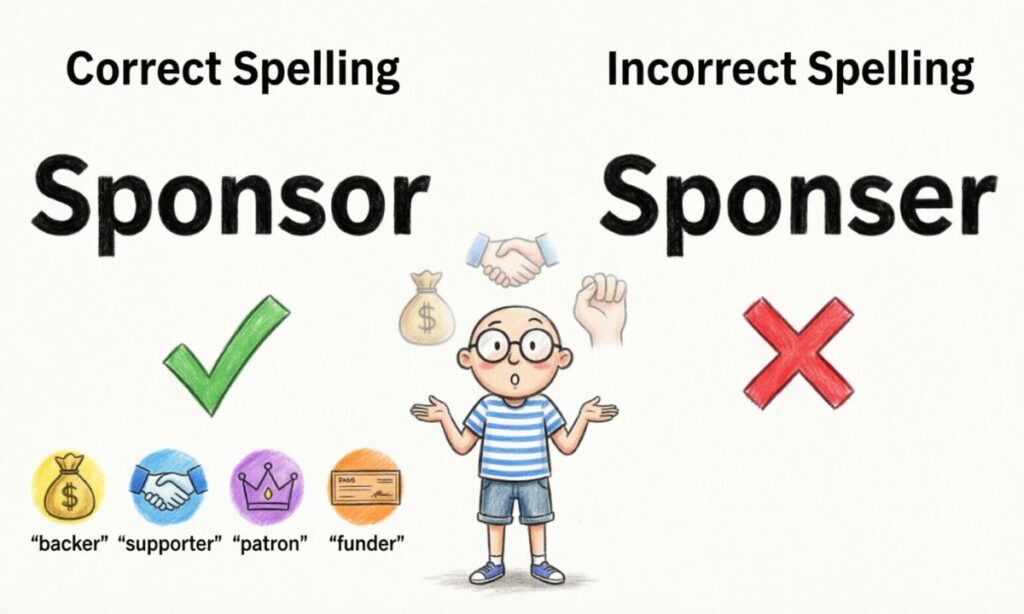
So let’s settle this once and for all. When it comes to sponser or sponsor, there is only one correct answer: sponsor. The form “sponser” does not exist in any dictionary, in any dialect of English, anywhere in the world. It is a misspelling — nothing more, nothing less.
In this guide, you will learn what sponsor actually means, why sponser keeps tripping people up, how to use the word correctly in a sentence, and how to avoid the most common mistakes writers make. Whether you are drafting a business proposal, writing a school essay, or putting together a social media caption, this article will make sure you never second-guess yourself again.
Define Sponsor
The word sponsor is both a noun and a verb, and it has been part of the English language since the mid-1600s. Its roots go back to the Latin word sponsor, which was derived from spondere, meaning “to promise” or “to pledge.” When it first appeared in English, around 1651, it was used in a religious sense — referring to a godparent who made promises on behalf of a child being baptized.
Today, the meaning has expanded considerably.
As a noun, according to the Merriam-Webster Dictionary, a sponsor is “a person or organization that pays for or plans and carries out a project or activity.” It can also mean someone who vouches for another person, proposes legislation, or assumes responsibility for an individual.
As a verb, to sponsor means to provide financial support, backing, or resources to an event, activity, cause, or individual — often in exchange for publicity, recognition, or advertising rights.
Here are the most common ways sponsor is used today:
- Corporate sponsorship — A brand funds a sports team, music festival, or conference in exchange for logo placement and brand visibility.
- Individual sponsorship — A mentor or supporter vouches for and financially backs a person, such as in immigration or recovery programs.
- Legislative sponsorship — A politician who introduces or formally supports a bill in a government body is called its sponsor.
- Religious sponsorship — A godparent who takes responsibility for a child’s spiritual upbringing during baptism.
- Media sponsorship — A company that funds a TV show, podcast, or online content in exchange for product promotion.
The word sponsor is widely used across business, education, politics, sports, charity, and media. Understanding its full range of meanings helps you use it with confidence in any context.
Define Sponser
Here is the short and complete definition of sponser: it does not have one.
“Sponser” is not a word. It does not appear in the Merriam-Webster Dictionary, the Oxford English Dictionary, the Cambridge Dictionary, or any other recognized authority on the English language. It has no accepted meaning, no history, no definition, and no correct usage — in American English, British English, or any other variety.
So why does it exist at all? The answer comes down to phonetics and habit.
When you say the word “sponsor” out loud and quickly — especially in casual conversation — it can sound like “spon-ser.” The brain hears that “-ser” sound and, drawing on familiarity with common English suffixes like “-er” (as in teacher, builder, runner), automatically assumes the word must end in “-er.” This is a perfectly understandable mistake, but it is still a mistake.
The confusion between sponser or sponsor is also reinforced by fast typing, autocomplete errors, and the fact that most people never stop to look the word up. Once a misspelling gets ingrained, it can feel natural — even correct. But the rule here is absolute. “Sponser” is always wrong. Every single time it appears in writing, it needs to be corrected to “sponsor.”
There is also no regional variation to fall back on. Unlike some English words that are spelled differently in British versus American English (like “colour” vs. “color”), sponsor follows the same spelling everywhere in the world. There is no version of English where “sponser” becomes acceptable.
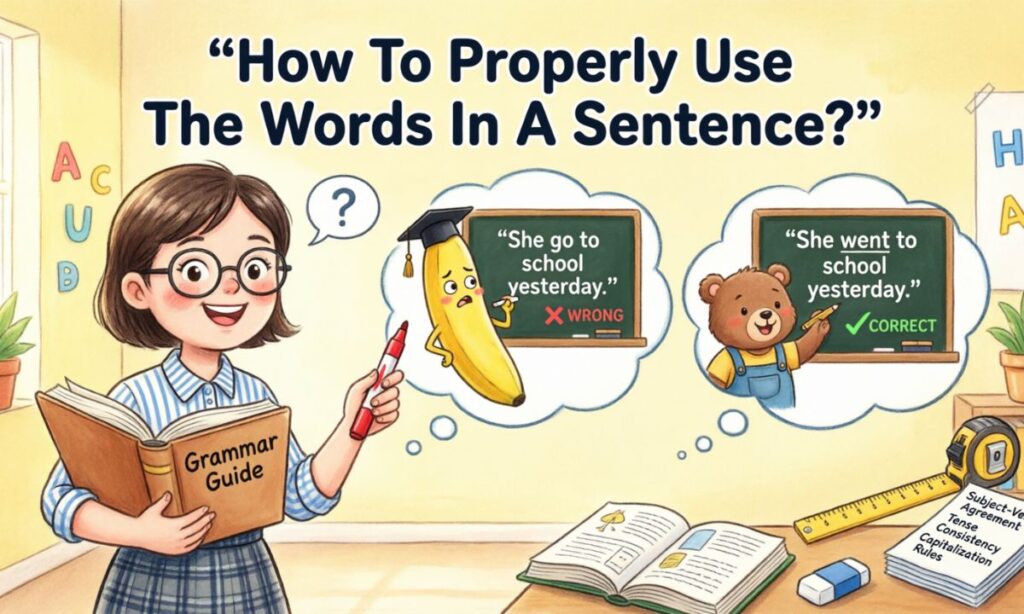
How To Properly Use The Words In A Sentence?
Read This: Flatform vs Platform: Key Differences and Proper Usage Explained Clearly
Understanding the difference between sponser or sponsor is only half the battle. The other half is knowing how to use the correct word naturally and effectively in a sentence. Since “sponsor” functions as both a noun and a verb, it fits into a wide range of sentence structures.
How To Use “Sponsor” In A Sentence
When using sponsor as a noun, it typically refers to the person or entity providing financial support, resources, or backing:
- The event could not have taken place without a generous sponsor.
- Our company is the official title sponsor of the marathon this year.
- She found a sponsor who believed in her research and funded the entire project.
- The nonprofit is actively seeking a sponsor for its annual gala.
When using sponsor as a verb, it describes the act of providing that support:
- The tech giant has agreed to sponsor three upcoming conferences.
- A local business will sponsor the youth soccer league this season.
- We are looking for companies willing to sponsor community arts programs.
Notice that the word sponsor slots cleanly into sentences whether it describes someone (noun) or something someone does (verb). This versatility is one reason it appears so frequently in professional, academic, and everyday writing.
How To Use “Sponser” In A Sentence
You cannot use “sponser” correctly in any sentence — because it is not a word.
Any sentence that contains “sponser” is technically incorrect and should be revised. Here are examples showing the error and the correction:
| Incorrect (Sponser) | Correct (Sponsor) |
| We need a sponser for the event. | We need a sponsor for the event. |
| She acted as a sponser for the charity. | She acted as a sponsor for the charity. |
| The team’s sponser provided new gear. | The team’s sponsor provided new gear. |
| He listed himself as a sponser on the form. | He listed himself as a sponsor on the form. |
The pattern is consistent: wherever “sponser” appears, replace it with “sponsor.” No exceptions.
Sponser or Sponsor Synonym
Once you are confident about sponser or sponsor, it is useful to know the synonyms for the correct word. Expanding your vocabulary helps you avoid repetition and write with more variety and precision.
Here are the most widely used synonyms for sponsor, along with when to use each one:
| Synonym | Best Used When… |
| Patron | Supporting arts, culture, or charitable causes long-term |
| Backer | Funding a startup, business venture, or investment |
| Benefactor | Making charitable donations or gifts to a cause or person |
| Underwriter | Providing financial guarantees, especially in insurance or formal agreements |
| Supporter | General backing for a person, team, or cause |
| Financier | Specifically funding a project with financial resources |
| Advocate | Championing a cause or idea, often publicly |
| Guarantor | Formally vouching for someone’s financial or legal reliability |
| Promoter | Actively publicizing or marketing an event or activity |
| Mentor | Guiding and supporting an individual’s personal or professional development |
While these synonyms overlap with sponsor in meaning, they each carry subtle differences in tone and context. A patron tends to suggest a long-term, often cultural relationship. A backer implies a more investment-focused arrangement. A benefactor is almost always associated with generosity and charity. Choosing the right synonym depends on the specific nuance you want to convey.
More Examples Of Sponsor & Sponser Used In Sentences
Seeing the sponser or sponsor distinction in action is one of the best ways to lock it into your memory. Below are extended example sets showing correct and incorrect usage.
Examples Of Using Sponsor In A Sentence
The following are all correct uses of sponsor as a noun and verb across different real-world contexts:
- A multinational corporation agreed to sponsor the international film festival.
- The athlete was grateful to her sponsor for covering training and travel expenses.
- Our local gym will sponsor the charity run taking place next month.
- The city council voted to sponsor a new public health initiative.
- Every sponsor received prominent recognition in the event program.
- He served as a sponsor for his colleague’s application for permanent residency.
- The podcast found a sponsor whose products aligned perfectly with its audience.
- To sponsor a child means committing to long-term financial and emotional support.
- The government agreed to sponsor research into renewable energy solutions.
- As the lead sponsor, the company had exclusive naming rights to the venue.
Examples Of Using Sponser In A Sentence
Because “sponser” is a misspelling, the following examples demonstrate how it appears — and how it should always be corrected:
- Wrong: The company served as sponser of the awards ceremony. → Correct: The company served as sponsor of the awards ceremony.
- Wrong: We are still looking for a sponser for our podcast. → Correct: We are still looking for a sponsor for our podcast.
- Wrong: She was honored to be named a sponser at the gala. → Correct: She was honored to be named a sponsor at the gala.
- Wrong: The sponser paid for all promotional banners and signage. → Correct: The sponsor paid for all promotional banners and signage.
The takeaway is simple: “sponser” is always an error, always needs fixing, and is never acceptable in professional or formal writing.
Common Mistakes To Avoid
Even strong writers make spelling and usage errors. When it comes to sponser or sponsor, there are a handful of recurring mistakes that show up in emails, proposals, marketing materials, and social media posts. Here is how to identify and fix each one.
Using “Sponser” Instead Of “Sponsor”
This is the most common mistake by far. Because sponsor and sponser sound identical when spoken, many writers type “sponser” without realizing it is wrong. This happens most often during fast typing, informal writing, or situations where someone has not encountered the correct spelling in a while.
The fix is simple: remember that sponsor ends in “-or,” not “-er.” Think of other “-or” words that describe a person doing something: actor, director, senator, governor. Sponsor fits that same pattern. The “-or” ending is what makes it correct.
A quick memory trick: SP-ON-S-OR — the word ends the same way as “actor” or “director.”
Using “Sponsor” When “Sponsee” Is Intended
This mistake is less about spelling and more about meaning. A sponsor is the party giving support. A sponsee is the party receiving it. These are two completely different roles, and mixing them up changes the meaning of a sentence entirely.
- The sponsor (correct) provides the funding.
- The sponsee (correct) receives the funding.
- The sponsor received the funding. → This is likely wrong — did you mean the sponsee?
In recovery programs, mentorship relationships, and immigration contexts, the sponsor-sponsee distinction is particularly important. Using the wrong word can create serious misunderstandings.
Using “Sponsor” When “Sponsorship” Is Intended
Sponsor and sponsorship are closely related but grammatically different. Sponsor is a noun (a person or entity) or a verb (an action). Sponsorship is also a noun, but it refers to the arrangement, deal, or agreement itself — not the party involved in it.
- We found a sponsor for the event. (referring to the company or person)
- We secured a sponsorship deal worth $50,000. (referring to the formal arrangement)
- Wrong: The sponsor was worth $50,000. → Better: The sponsorship was worth $50,000.
Using sponsor when you mean sponsorship can make sentences feel imprecise. Choosing the right form keeps your writing clear and professional.
Tips To Avoid These Mistakes
- Always run a spell-checker before finalizing any document or message.
- Read your writing out loud — your ear often catches errors your eyes miss.
- Look up sponsor, sponsee, and sponsorship definitions if you are ever unsure which one fits.
- Proofread at least once before submitting or publishing anything important.
- Create a personal rule: if you ever type “sponser,” immediately flag it as wrong and replace it.
Context Matters
The word sponsor is versatile enough to appear across many different industries and situations. While the correct spelling of sponser or sponsor never changes, the word’s meaning can shift slightly depending on the context in which it is used.
Examples Of Different Contexts
Corporate and Business Context In the business world, a sponsor is typically a company or brand that funds an event, team, or initiative in exchange for advertising exposure and brand visibility. Sponsorship deals in this space are formal agreements with clearly defined deliverables.
Example: The tech startup attracted a Fortune 500 company as its lead sponsor for the product launch event.
Sports Context Sports sponsorship is one of the most visible and high-value uses of the word. Brands sponsor athletes, teams, stadiums, and tournaments to reach large audiences.
Example: The jersey bore the logo of the team’s primary sponsor throughout the entire season.
Media and Content Creation Context Podcasters, YouTubers, and social media influencers regularly work with brands that sponsor their content. In this setting, the sponsor pays for product placement or dedicated mentions in exchange for audience exposure.
Example: This episode of the podcast is brought to you by our sponsor, a leading productivity software company.
Immigration and Legal Context In immigration law, a sponsor is a person or organization that formally vouches for an applicant’s character and financial stability, often taking on legal responsibility for them.
Example: Her employer agreed to act as her sponsor during the visa application process.
Recovery and Mentorship Context In twelve-step programs and mentorship relationships, a sponsor is an experienced individual who guides and supports someone newer to the program or field.
Example: His sponsor helped him navigate the most challenging months of his recovery.
Understanding these contexts helps you use sponsor with accuracy and authority no matter where you are writing.
Exceptions To The Rules
Exceptions For Sponsor
There are very few true exceptions to the rules around how sponsor is used — but there are some edge cases worth knowing.
In highly informal writing, texting, or social media captions, people sometimes play with language deliberately. A creator might write “spons” as a deliberate abbreviation in a caption, or use “sponsored” differently from its formal meaning. These are stylistic choices, not legitimate exceptions to standard grammar rules. In any formal, professional, or academic setting, sponsor follows all standard rules without exception.
When sponsor is used as a verb, it changes form depending on tense:
- Present: They sponsor the event.
- Past: They sponsored the event.
- Present continuous: They are sponsoring the event.
- Future: They will sponsor the event.
All of these forms are correct. The base word remains “sponsor” throughout.
Exceptions For Sponser
There are no exceptions for “sponser” — because it is not a word. No context, no industry, no style guide, and no dialect of English makes “sponser” acceptable. It is always a misspelling. It was never correct, and it will not become correct regardless of how widely it is misused.
This is one of the clearest rules in English spelling: sponser or sponsor is not a matter of preference. It is a matter of right and wrong. The correct form is sponsor, every single time, with no exceptions.
Practice Exercises
The best way to cement your understanding of sponser or sponsor is to test yourself. These exercises will help you build confidence and accuracy.
Exercise 1
Instructions: Read each sentence and choose whether “sponsor” or “sponser” is correct. Write your answer, then check against the key below.
- The company agreed to _______ the annual charity gala.
- We are looking for a _______ to fund the documentary project.
- She was grateful to her _______ for covering tuition costs.
- The event’s _______ logo appeared on every banner and flyer.
- He was listed as a _______ on the official application form.
- The city council decided to _______ a new environmental program.
- Their primary _______ withdrew funding just two weeks before the event.
- The influencer disclosed that the post was paid for by a _______.
Answer Key: All eight answers are sponsor. If you wrote “sponser” for any of them, remember: the “-er” ending is always incorrect.
Read This: Symptomatology vs Symptomology: Meaning And Differences (2026)
Exercise 2
Instructions: Each of the following sentences contains an error. Identify the mistake and rewrite the sentence correctly.
- The team’s sponser provided uniforms for the entire season.
- She was honored to be named a sponser at the fundraising dinner.
- Our company is actively seeking a sponser for the upcoming summit.
- He introduced himself as the head sponser of the scholarship program.
- The event was made possible thanks to the generosity of its lead sponser.
Corrected Sentences:
- The team’s sponsor provided uniforms for the entire season.
- She was honored to be named a sponsor at the fundraising dinner.
- Our company is actively seeking a sponsor for the upcoming summit.
- He introduced himself as the head sponsor of the scholarship program.
- The event was made possible thanks to the generosity of its lead sponsor.
Frequently Asked Questions
Is “sponser” ever correct?
No, “sponser” is always a misspelling. The only correct spelling is sponsor.
What is the difference between sponsor and sponsorship?
A sponsor is the person or company providing support; a sponsorship is the agreement or arrangement itself.
What is the difference between sponsor and sponsee?
A sponsor gives support; a sponsee receives it. They are opposite roles in the same relationship.
Does sponsor mean the same thing in British and American English?
Yes. Sponsor is spelled and used identically in all varieties of English worldwide.
Can sponsor be used as both a noun and a verb?
Yes. “Our sponsor funded the trip” (noun). “They agreed to sponsor the trip” (verb). Both are correct.
Why do people write “sponser” so often?
Because sponsor sounds like “spon-ser” when spoken quickly, people instinctively add an “-er” ending, following familiar English patterns. It’s a phonetic trap.
What is a good memory trick to spell sponsor correctly?
Remember that sponsor ends in “-or” like actor, director, and senator. If those words end in “-or,” so does sponsor.
Conclusion
The answer to the question sponser or sponsor could not be more straightforward. Sponsor is correct. Sponser is not a word, has never been a word, and should be treated as a misspelling in every context without exception.
What makes this mistake so common is purely phonetic. The word sounds like it could end in “-er,” and our brains follow that familiar pattern without us even noticing. But English spelling does not always follow sound, and this is one of those cases where the written form must be memorized, not guessed.
The key takeaways from this guide:
- Sponsor is the only correct spelling — as a noun, a verb, and in all tenses and forms.
- Sponser is always wrong. Full stop.
- Sponsee and sponsorship are related words but carry distinct meanings — use them precisely.
- Proofread your work, run a spell-checker, and remember the “-or” ending.
Good spelling is more than a technicality. It reflects your professionalism, your attention to detail, and your respect for your reader. So the next time you reach for that word, remember: it is sponsor — and it always has been.